


Oil Water Separator Filter
In industrial fluid management, the efficiency of separating immiscible liquids is a critical factor in maintaining equipment longevity, meeting environmental discharge regulations, and ensuring process purity. An oil water separator filter is a specialized component designed to remove hydrocarbons from aqueous solutions or vice versa, utilizing physical and mechanical properties to achieve high-purity results. For engineers and procurement teams, selecting the correct filtration media is not merely about size; it involves understanding the fluid dynamics, chemical interactions, and structural integrity required for demanding industrial environments.
Understanding the Role of an Oil Water Separator Filter in Industrial Systems
The primary function of an oil water separator filter is to isolate oil droplets from a water stream. This is essential in numerous sectors, including petrochemical processing, marine bilge water treatment, hydraulic system maintenance, and food processing. Unlike simple sediment filters, these components must address the specific gravity differences and surface tension characteristics of the fluids involved.
In many applications, oil exists in three states within water: free oil, dispersed oil, and emulsified oil. Free oil rises to the surface quickly due to gravity. Dispersed oil consists of smaller droplets that require more time to rise. Emulsified oil is chemically bonded or so finely dispersed that mechanical separation alone is often insufficient. A high-quality oil water separator filter focuses on the removal of free and dispersed oils, often acting as a coalescing stage to transform fine droplets into larger masses that can be easily diverted from the main flow.
Technical Principles of Oil-Water Separation
Effective separation relies on several engineering principles. Understanding these helps in selecting the right filter configuration for a specific system.
Coalescence
As fluid passes through the filter media—often comprised of multiple layers of stainless steel wire mesh or sintered metal—small oil droplets are intercepted by the fibers. As these droplets accumulate on the surface of the media, they merge with other droplets in a process called coalescence. Once the droplets reach a sufficient size, the buoyancy force overcomes the drag force of the fluid flow, allowing the oil to rise to a collection area or be trapped by a secondary hydrophobic stage.
Gravity and Stokes' Law
Stokes' Law governs the velocity at which a droplet rises or falls through a liquid. It considers the droplet size, the density difference between the oil and water, and the viscosity of the continuous phase. An oil water separator filter optimizes this by providing a high surface area that slows local flow velocity, giving droplets the necessary time to coalesce and separate according to these physical laws.
Mechanical Interception
For particulate-heavy oil streams, the filter must also act as a traditional barrier. Precision-engineered stainless steel mesh provides a defined micron rating that captures solid contaminants which could otherwise stabilize emulsions or damage downstream components.
Material Engineering: The Advantages of Stainless Steel
When specifying an oil water separator filter, material selection is paramount. While polymer-based media are common in light-duty applications, industrial processes typically demand the durability of stainless steel, such as 304, 316, or 316L grades.
1. Corrosion Resistance: Industrial water often contains salts, chemicals, or acidic components. Stainless steel, particularly 316L with its molybdenum content, provides superior resistance to pitting and crevice corrosion.
2. Thermal Stability: Many oil-water separation processes occur at elevated temperatures to reduce oil viscosity and improve separation efficiency. Stainless steel maintains its structural integrity at temperatures where synthetic fibers would soften or fail.
3. Pressure Tolerance: High-pressure hydraulic systems or deep-sea applications require filters that can withstand significant differential pressures ($ΔP$) without collapsing or bypassing.
4. Cleanability and Reusability: Unlike disposable cartridges, stainless steel wire mesh filters can often be cleaned via backwashing or ultrasonic cleaning, reducing the total cost of ownership and environmental waste.
Key Performance Metrics for Selection
Engineers must evaluate several technical parameters to ensure the filter meets the application's requirements. Over-specifying can lead to unnecessary costs, while under-specifying can result in system failure.
Micron Rating (Filtration Accuracy)
The micron rating determines the smallest particle or droplet the filter can reliably intercept. For oil-water separation, this often ranges from 1 to 100 microns depending on whether the goal is primary separation or fine polishing. It is important to distinguish between "nominal" and "absolute" ratings; absolute ratings provide a higher level of certainty for critical processes.
Flow Rate and Pressure Drop
The flow rate (GPM or m³/h) must be balanced against the initial pressure drop. A filter that is too small for the required flow will create a high $ΔP$, increasing energy consumption and potentially forcing contaminants through the media. Designers should look for a low clean pressure drop to maximize the operational window before cleaning is required.
Oil Concentration Levels
Knowing the inlet oil concentration (measured in ppm) and the required outlet purity is essential. Some systems are designed to handle heavy oil loading, while others are "polishing" filters meant to take water from 50 ppm down to less than 5 ppm for environmental discharge.
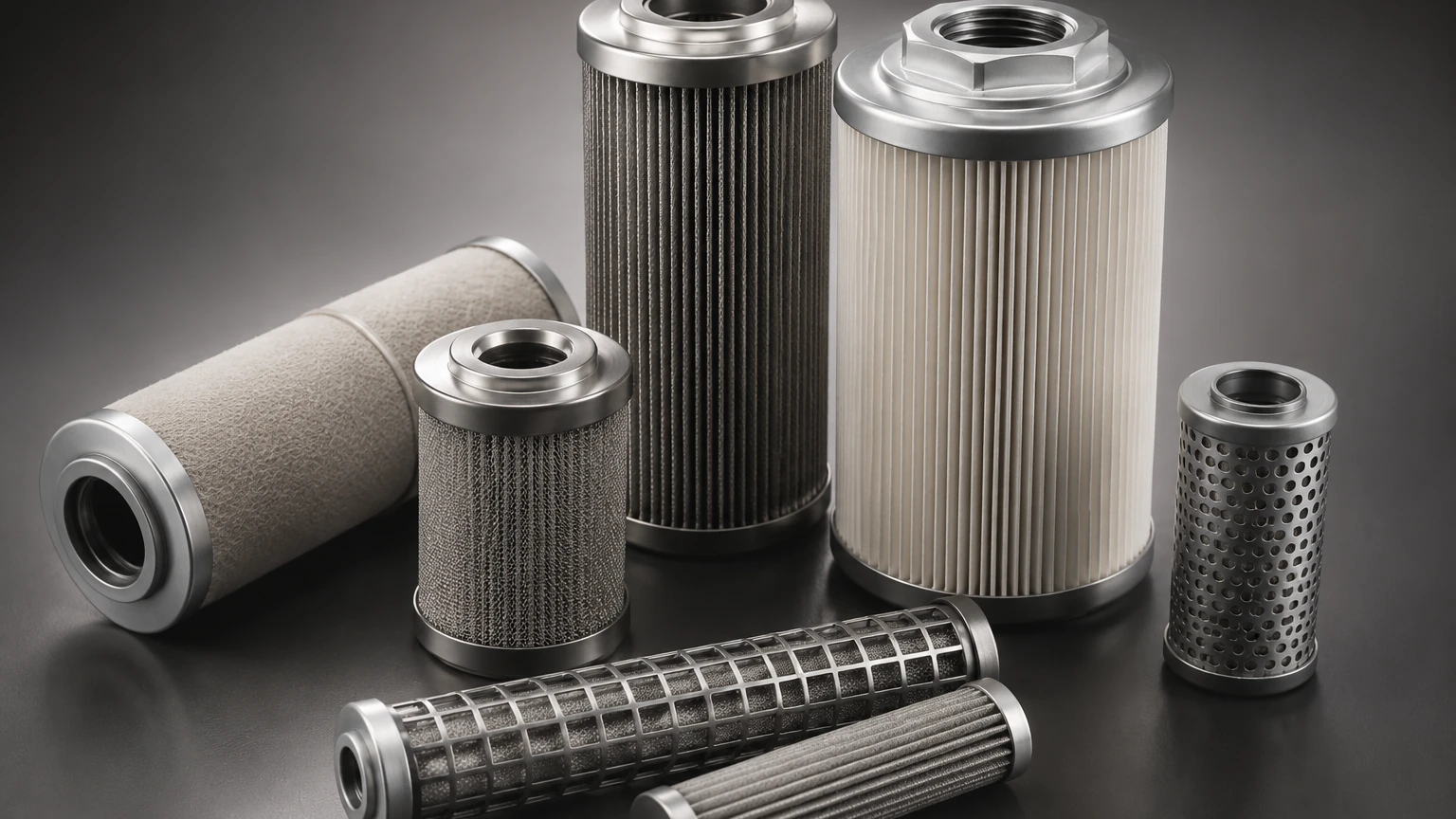
Customization and OEM Considerations for Industrial Filters
Standard off-the-shelf filters rarely meet the precise needs of specialized industrial machinery. Customization allows for the optimization of the filter to the specific housing and fluid characteristics. As a professional manufacturer, Kaifil provides extensive OEM capabilities to address these unique requirements.
Customization options often include:
* Specific End Cap Configurations: Ensuring a leak-proof seal with existing housings using DOE (Double Open End), SOE (Single Open End) with O-rings, or threaded connections.
* Reinforced Internal Cores: Adding perforated metal cores to support the mesh under high-pressure surges.
* Layered Media Structures: Combining different mesh sizes (e.g., a coarse outer layer for large debris and a fine inner layer for coalescence) to extend service life.
* Dimensional Tailoring: Adjusting length and diameter to fit restricted spatial envelopes in compact skid designs.
For those looking to integrate these components into new or existing systems, you can Review product options and application support to find a configuration that matches your technical specifications.
Operational Maintenance and Lifespan
The lifespan of an oil water separator filter is heavily dependent on the contaminant load and the maintenance regime. In systems with high solid particulate counts, the filter may blind (clog) more quickly.
Monitoring Differential Pressure
The most reliable way to determine when a filter needs attention is by monitoring the differential pressure across the housing. Most industrial systems include gauges or sensors that trigger an alarm when the $ΔP$ reaches a pre-set limit (e.g., 15-25 psi).
Cleaning Procedures
For reusable stainless steel filters, cleaning must be performed carefully to avoid damaging the precision mesh. Backflushing with a compatible solvent or clean water is the first line of defense. For stubborn deposits or biological fouling, ultrasonic cleaning baths are highly effective at removing particles lodged deep within the mesh pores.
Engineering Checklist Before Procurement
Before finalizing a purchase order for an oil water separator filter, engineering teams should confirm the following data points to ensure compatibility and performance:
* Fluid Compatibility: Are the pH levels and chemical additives compatible with the chosen stainless steel grade and gasket materials (e.g., Viton, EPDM, Buna-N)?
* Operating Temperature: What are the normal and maximum excursion temperatures of the process?
* Maximum Operating Pressure: Does the filter assembly meet the safety factors required by the system's design pressure?
* Target Purity: What is the specific ppm requirement for the effluent?
* Maintenance Access: Is there sufficient clearance in the plant layout to remove and replace the filter elements easily?
By addressing these factors during the design and procurement phase, companies can significantly reduce downtime and ensure that their oil-water separation processes remain efficient and compliant. For more detailed technical specifications and to explore the full range of stainless steel filtration solutions, visit the Kaifil Main Page.
Conclusion
Selecting the right oil water separator filter is a balance of material science, fluid dynamics, and mechanical design. Whether the application involves protecting sensitive downstream equipment or ensuring environmental compliance, the use of high-quality stainless steel filtration media provides the reliability and performance necessary for modern industrial operations. By focusing on precise micron ratings, robust construction, and customized engineering, facilities can achieve optimal separation efficiency and long-term cost savings.
