


Filtro De Aire Industrial
In the landscape of modern manufacturing, maintaining air quality and protecting downstream equipment are critical operational requirements. A high-quality filtro de aire industrial is more than a simple barrier; it is a precision-engineered component designed to handle high flow rates, extreme temperatures, and corrosive environments. While many industries initially consider disposable polymer or fiberglass media, technical professionals are increasingly turning to stainless steel and metal mesh filtration solutions for their durability, cleanability, and consistent performance under pressure.
Kaifil specializes in the production of custom stainless steel filtration solutions, providing the engineering expertise necessary to develop filters that meet the specific demands of chemical processing, food and beverage, pharmaceutical, and hydraulic applications. When selecting an industrial air filter, engineers must evaluate several technical factors, including material compatibility, filtration accuracy, and the total cost of ownership.
Engineering Considerations for Industrial Air Filtration
The primary function of an industrial air filter is to remove particulate matter from a gas stream while maintaining a manageable pressure drop. In industrial settings, "air" can often refer to process gases, compressed air, or ambient intake for heavy machinery. The performance of a filtro de aire industrial is defined by three main parameters: micron rating, permeability, and structural integrity.
Micron Rating and Filtration Efficiency
Filtration accuracy is typically measured in microns (μm). For industrial metal filters, this is categorized into absolute and nominal ratings. An absolute rating refers to the diameter of the largest spherical particle that can pass through the filter under specified test conditions, while a nominal rating indicates the filter's ability to retain a majority of particles of a certain size. In precision air filtration, achieving a high capture rate for fine particulates without significantly impeding airflow is the central engineering challenge.
Pressure Drop and Flow Dynamics
Every filter introduces resistance into the system, known as pressure drop (ΔP). A well-designed metal filter maximizes the effective filtration area—often through pleating—to ensure that the initial pressure drop remains low. As the filter captures contaminants, the ΔP will naturally increase. Engineers must select a filter media that provides sufficient surface area to extend the service life between cleaning cycles, ensuring that the system's blowers or compressors do not work harder than necessary.
Material Selection: Why Stainless Steel?
In many B2B environments, the choice of material for a filtro de aire industrial is dictated by the operating environment. While standard carbon steel or aluminum may suffice for basic ventilation, demanding industrial processes require the superior properties of stainless steel, specifically grades 304 and 316L.
Corrosion and Chemical Resistance
Industrial air streams often contain moisture, acidic vapors, or caustic gases. Stainless steel 316L, which contains molybdenum, offers enhanced resistance to pitting and crevice corrosion, making it the standard choice for chemical plants and offshore applications. This ensures that the filter media does not degrade or shed metallic particles into the clean air stream, which could compromise the final product or damage sensitive sensors.
Temperature Tolerance
Unlike synthetic filters that may melt or become brittle at high temperatures, stainless steel filters can operate in environments exceeding 500°C (depending on the alloy and seal type). This makes them ideal for exhaust gas filtration, steam filtration, and high-temperature process air applications where standard media would fail immediately.
Structural Strength
Industrial air systems often experience pressure surges or mechanical vibrations. Metal wire mesh and sintered metal components provide the structural rigidity needed to withstand these forces without collapsing or bypassing. This reliability is essential for protecting expensive downstream components like turbines, high-speed blowers, and precision valves.
Types of Metal Filter Media for Air Applications
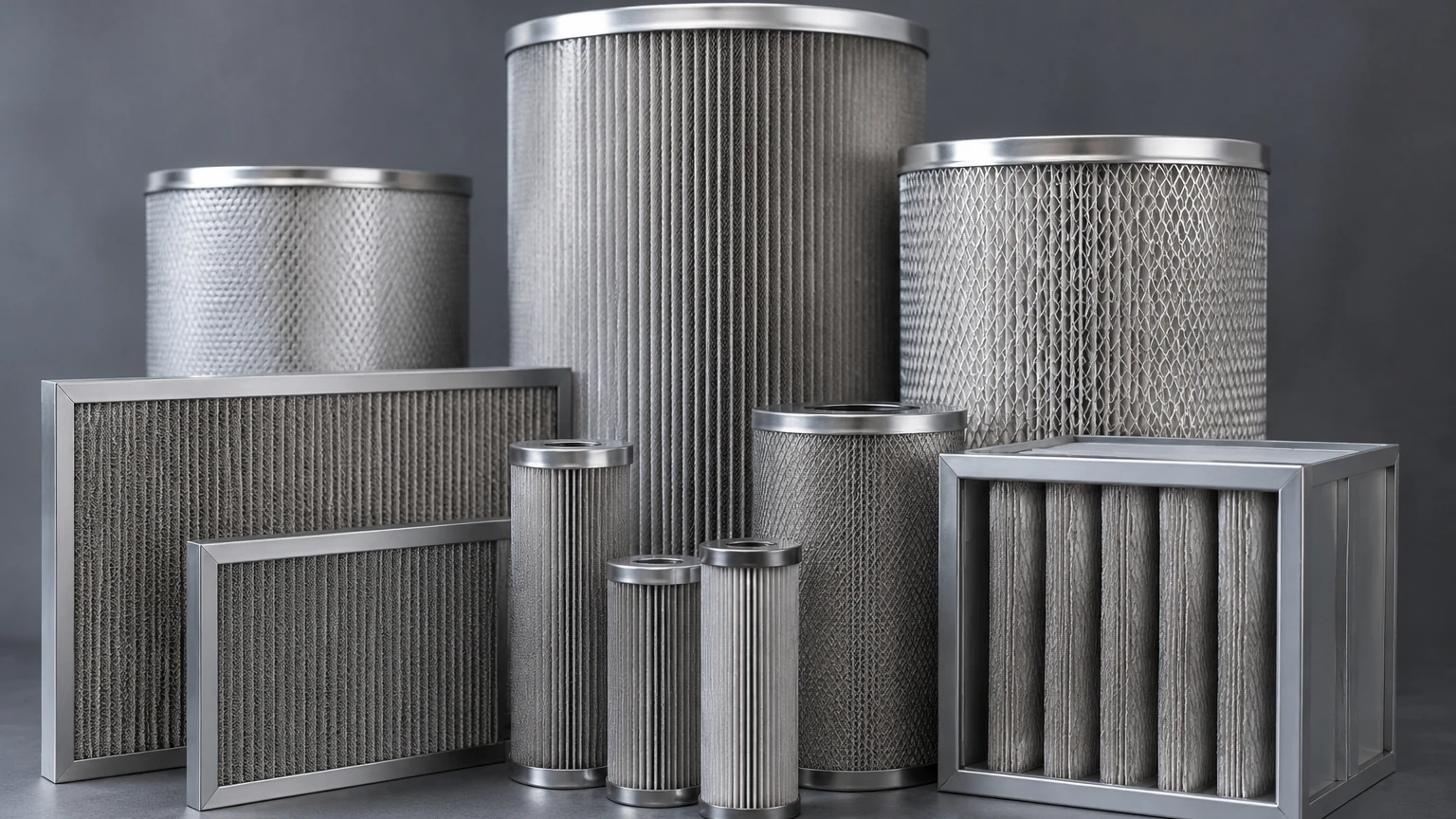
Depending on the specific requirements of the application, different types of metal media can be utilized within a filtro de aire industrial. Understanding the differences between these structures is key to optimizing filtration performance.
1. Woven Wire Mesh: This is the most common media for air filtration. It consists of metallic wires woven into specific patterns, such as plain weave, twill weave, or Dutch weave. Woven mesh provides a precise pore size and is exceptionally easy to clean.
2. Sintered Metal Mesh: This media is created by bonding multiple layers of wire mesh together using heat and pressure (sintering). The result is a robust, porous plate that offers higher mechanical strength and better filtration accuracy than a single layer of mesh. It is often used in high-pressure air systems.
3. Perforated Metal: Often used as a support structure or a pre-filter, perforated metal sheets protect finer filter media from large debris and provide the necessary mechanical support for pleated cartridges.
4. Pleated Filter Cartridges: To increase the filtration surface area within a compact footprint, the metal mesh is pleated. This design significantly lowers the face velocity of the air passing through the media, which improves filtration efficiency and extends the time between maintenance intervals.
For more information on the technical specifications of these materials and to explore available configurations, you can visit the Main Page of our technical resource center.
Customization and OEM Solutions
One of the most significant advantages of working with a professional manufacturer like Kaifil is the ability to customize the filtro de aire industrial to fit existing hardware or unique process requirements. Off-the-shelf filters often require compromises in terms of fit or performance, whereas custom solutions are engineered for the specific application.
Dimensional and Fitting Customization
Custom filters can be designed with specific flange types (such as ANSI or DIN), threaded connections (NPT/G), or specialized end caps to ensure a leak-proof fit within the filter housing. This is particularly important for OEM manufacturers who need to integrate filtration components into their proprietary equipment designs.
Multi-Stage Filtration
In environments with high dust loads, a single-stage filter may clog too quickly. Custom designs can incorporate multiple layers of media with varying micron ratings—effectively creating a "gradient" filter. The outer layers capture large particles, while the inner layers handle fine filtration, significantly increasing the dirt-holding capacity of the unit.
Maintenance and Total Cost of Ownership (TCO)
When evaluating the cost of a filtro de aire industrial, it is vital to look beyond the initial purchase price. The Total Cost of Ownership (TCO) includes the cost of replacement filters, labor for maintenance, disposal fees for contaminated media, and the energy costs associated with pressure drop.
Cleanability and Reusability
Unlike disposable filters, stainless steel air filters are designed to be cleaned and reused. Depending on the contaminant, they can be cleaned using several methods:
* Ultrasonic Cleaning: Using high-frequency sound waves in a cleaning solution to dislodge fine particles from deep within the mesh.
* Backwashing/Back-pulsing: Reversing the flow of air or liquid through the filter to blow off the accumulated dust cake.
* Chemical Cleaning: Using compatible solvents or detergents to dissolve oils or organic residues.
The ability to reuse the filter hundreds of times makes it a much more sustainable and cost-effective option for long-term industrial operations.
Reduced Downtime
Because metal filters are engineered for durability, they are less prone to sudden failure or "blow-through." This reliability reduces the risk of unscheduled downtime, which can be incredibly costly in high-volume manufacturing environments. Furthermore, the predictable nature of the pressure drop allows maintenance teams to schedule cleaning cycles during planned outages.
Industry Applications for Metal Air Filters
The versatility of the filtro de aire industrial made from stainless steel allows it to be used across a wide range of demanding sectors:
* Chemical Processing: Protecting vacuum pumps and compressors from corrosive dust and ensuring the purity of process gases.
* Food & Beverage: Filtering sterile air used in packaging lines and ensuring that pneumatic conveying systems do not introduce contaminants into the product.
* Pharmaceuticals: Maintaining high-purity air in cleanroom environments and capturing active pharmaceutical ingredients (APIs) during the manufacturing process.
* Power Generation: Protecting gas turbines and large engines from intake air contaminants that could cause erosion or fouling of internal components.
* Water Treatment: Filtering air used in aeration tanks to prevent the clogging of fine-bubble diffusers.
Conclusion: Selecting the Right Filtration Partner
Choosing the correct filtro de aire industrial requires a deep understanding of the technical variables at play. Engineers must balance the need for fine filtration with the practical realities of flow rates, pressure drops, and maintenance requirements. By opting for stainless steel and custom-engineered solutions, industrial facilities can achieve a higher level of process control and a lower long-term cost of operation.
As a dedicated manufacturer, Kaifil provides the technical support and manufacturing precision required to solve complex filtration challenges. Whether you are looking for a standard replacement cartridge or a completely custom OEM component, focusing on material quality and engineering integrity is the key to success. To review product options and application support, please refer to the Main Page for a comprehensive overview of our capabilities and technical specifications.
