


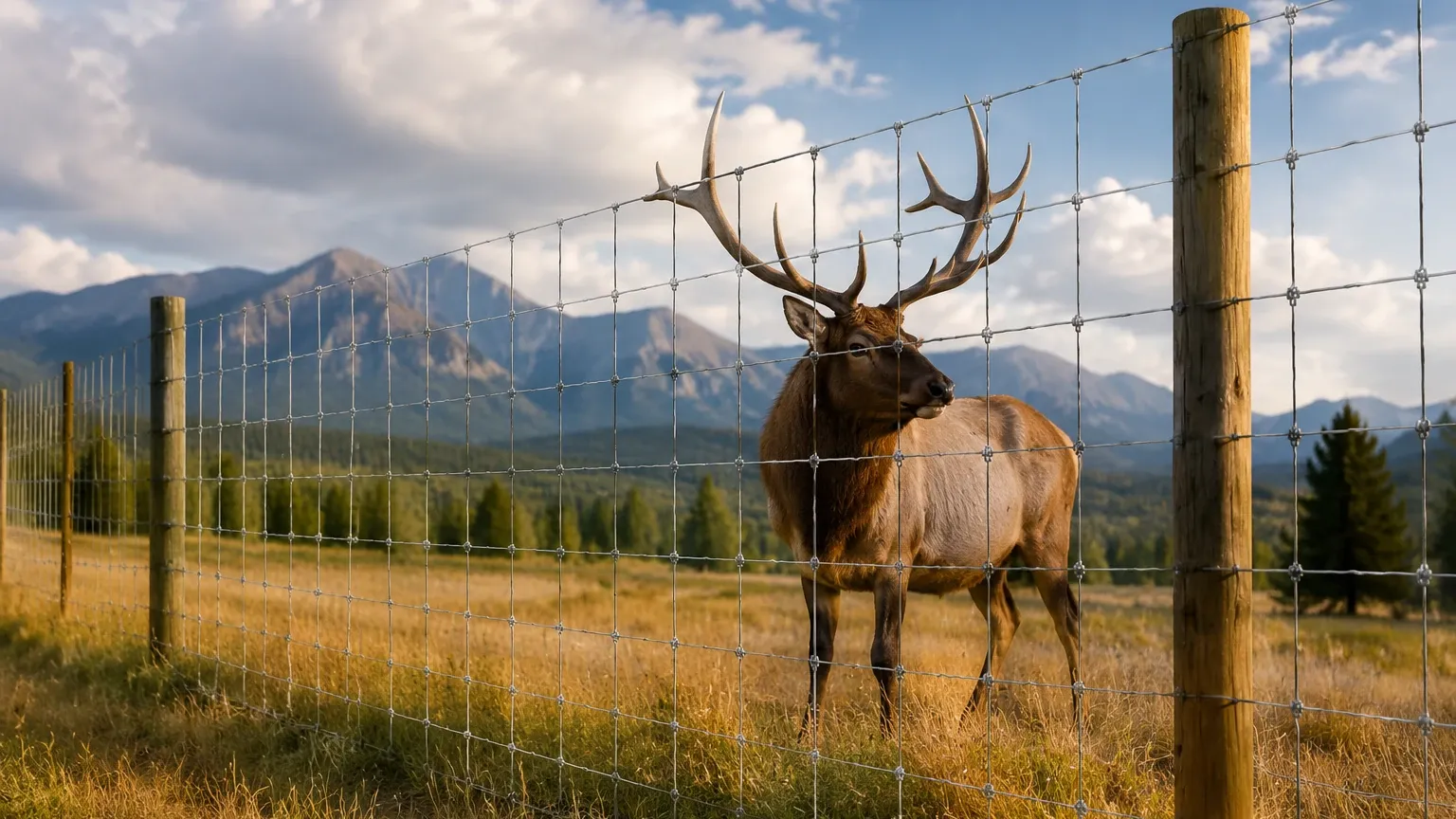
Woven Wire Elk Fence
In industrial, agricultural, and conservation engineering, the containment of large ungulates such as elk requires a sophisticated approach to barrier design. A woven wire elk fence is not merely a perimeter marker; it is a structural component engineered to withstand significant kinetic energy, environmental degradation, and long-term mechanical stress. Unlike standard residential or light agricultural fencing, industrial-grade woven wire mesh solutions must meet specific tensile strength and material durability standards to ensure safety and operational continuity.
Selecting the appropriate material and weave structure is critical for projects involving large-scale animal containment, highway safety barriers, or high-value livestock protection. This guide examines the technical specifications, material science, and engineering considerations essential for specifying and procuring high-performance woven wire systems.
Understanding Woven Wire Mesh in High-Impact Containment
The core of any effective elk barrier is the Woven Wire Mesh. Unlike welded wire, where intersecting wires are fused at fixed points, woven wire is manufactured by interlacing longitudinal (warp) and transverse (weft) wires. This mechanical interlocking allows for a degree of flexibility and "give" that is essential when dealing with large animals like elk, which can weigh up to 700–1,000 pounds and exert immense force upon impact.
In a woven structure, the energy of an impact is distributed across multiple wires and knots, rather than being concentrated at a single weld point. This reduces the risk of localized failure or "zippering," where one broken weld leads to a cascading structural collapse. For industrial applications, the choice of weave—such as plain weave or specialized high-tensile knots—determines the mesh's ability to maintain its aperture dimensions under tension.
Material Selection: Stainless Steel vs. Traditional Carbon Steel
While galvanized carbon steel is a common choice for general agricultural fencing, industrial and high-end conservation projects often require the superior properties of stainless steel. Kaifil specializes in providing Plain, twill and dutch woven wire mesh in SS304/316L — rolls, cut mesh and framed panels. Send mesh count or micron target for a technical quote. to meet these demanding environments.
SS304 (Austenitic Stainless Steel)
SS304 offers excellent corrosion resistance and high tensile strength. It is suitable for most inland environments where exposure to moisture and organic acids (from animal waste or soil) would cause standard galvanized wire to rust and fail prematurely. The mechanical properties of SS304 ensure that the woven wire elk fence remains rigid yet resilient over decades of service.
SS316L (Low Carbon Molybdenum-Bearing Steel)
For coastal installations or areas with high industrial pollution, SS316L is the preferred specification. The addition of molybdenum provides enhanced resistance to chloride-induced pitting and crevice corrosion. In the context of a woven wire elk fence, using SS316L minimizes the total cost of ownership by virtually eliminating the need for replacement due to environmental degradation.
Structural Advantages of Woven vs. Welded Wire Construction
Engineers must weigh the pros and cons of woven versus welded construction for large animal barriers. The primary advantage of a woven wire elk fence lies in its dynamic response to stress.
1. Flexibility and Elasticity: Woven mesh can absorb the shock of an animal hitting the fence without permanent deformation. The interlaced wires allow for a small amount of movement, which dissipates kinetic energy.
2. Tension Retention: High-tensile woven wire can be stretched tighter and maintained under higher tension than welded wire. This is crucial for elk fencing, which typically stands 7 to 8 feet high. Maintaining vertical and horizontal tension prevents the fence from sagging or "bellying" over time.
3. Adaptability to Terrain: Woven wire is significantly easier to install on uneven or sloping terrain. The mechanical joints allow the mesh to "rack" or conform to the grade of the land without buckling or compromising the integrity of the apertures.
Technical Specifications for Large Animal Barriers
When specifying a woven wire elk fence, several technical parameters must be defined to ensure the barrier meets the application's physical requirements.
Wire Gauge and Tensile Strength
For elk containment, wire diameters typically range from 12.5 gauge to 9 gauge. High-tensile wire is preferred because it allows for greater post spacing (up to 16–20 feet) without sacrificing the structural integrity of the fence. This reduces both material and labor costs during installation.
Aperture Size (Mesh Opening)
While filtration applications require micron-level precision, a woven wire elk fence requires apertures that prevent the animal from getting its head or hooves caught. Common configurations include graduated spacing, where the openings are smaller at the bottom (to deter smaller predators or calves) and larger toward the top. Typical industrial mesh for this purpose might utilize 6-inch by 6-inch or 6-inch by 12-inch openings.
Fence Height
Elk are capable of jumping significant heights. A standard woven wire elk fence must be at least 84 inches (7 feet) tall, with many professional specifications requiring 96 inches (8 feet). This height is achieved either through a single continuous roll of woven wire mesh or by stacking two smaller rolls with a secure mid-point connection.
Environmental Factors and Corrosion Resistance
Industrial filtration and containment systems often operate in harsh conditions. A woven wire elk fence is no exception. Soil chemistry, atmospheric salinity, and exposure to cleaning chemicals (in pharmaceutical or food-grade containment) can all impact the lifespan of the mesh.
Stainless steel woven wire mesh provides a passive oxide layer that protects the underlying metal. Unlike galvanized coatings, which act as a sacrificial layer and eventually wear away, the protection in stainless steel is intrinsic to the alloy. This makes it an ideal choice for permanent installations where maintenance access is limited or where the cost of replacement is prohibitively high.
Furthermore, the smooth surface of high-quality stainless steel woven wire reduces the accumulation of organic debris and biofilm, which can be a concern in sensitive ecological or pharmaceutical research environments.
Procurement Checklist: Specifying Woven Wire for Industrial Projects
For purchasing teams and engineers, the procurement process for a woven wire elk fence should involve a detailed verification of the following factors:
* Alloy Verification: Ensure the supplier provides material certifications (MTRs) for SS304 or SS316L to guarantee the chemical composition matches the specification.
* Mesh Uniformity: Inspect the consistency of the weave. Inconsistent apertures can lead to weak points that fail under the pressure of a large animal.
* Edge Treatment: Specify whether the mesh should have a knuckled or barbed edge. For animal safety, a knuckled (folded) edge is generally preferred to prevent injury.
* Roll Dimensions: Standardize roll lengths (e.g., 100 ft, 330 ft) to minimize waste and reduce the number of joins required in the field.
* Load Requirements: Define the expected impact load. If the fence is located in a high-traffic elk corridor or a confined holding pen, a heavier wire gauge may be necessary.
Maintenance and Long-Term Performance Expectations
A properly specified woven wire elk fence made from stainless steel requires minimal maintenance. However, regular inspections should focus on:
* Tension Levels: Over time, environmental shifts or extreme impacts may require the mesh to be re-tensioned to maintain its structural profile.
* Post Integrity: The fence is only as strong as its support structure. Ensure that corner posts and braces remain vertical and securely anchored.
* Debris Removal: While stainless steel is highly resistant to corrosion, heavy accumulation of damp organic matter against the base of the fence should be cleared to ensure maximum airflow and prevent localized environment-specific corrosion.
By focusing on high-quality materials and precise manufacturing standards, industrial operators can ensure that their woven wire mesh solutions provide a reliable, long-lasting barrier. Whether for wildlife management, industrial site security, or specialized agricultural containment, the engineering behind the weave is the most critical factor in the success of the project.
For technical assistance in selecting the right mesh count, wire diameter, or alloy for your specific containment needs, consulting with a manufacturer like Kaifil ensures that the final product meets the rigorous demands of industrial filtration and structural applications.
