


Pump Intake Screen
In industrial fluid handling, the pump intake screen serves as the primary mechanical barrier between a pump's internal components and the debris present in the source fluid. Whether the application involves drawing water from a reservoir, circulating chemicals in a processing plant, or managing hydraulic fluids, the integrity of the intake screen directly impacts the longevity and efficiency of the pumping system. For engineers and maintenance professionals, selecting the correct screen is not merely a matter of sizing a mesh; it involves a complex evaluation of flow dynamics, material compatibility, and the mechanical limits of the pump itself.
A well-engineered pump intake screen prevents large solids from entering the pump volute, where they can cause catastrophic impeller damage, clog internal passages, or accelerate the wear of mechanical seals. By maintaining a clean intake, facilities can significantly reduce unplanned downtime and extend the Mean Time Between Failures (MTBF) for their rotating equipment.
The Technical Role of Intake Filtration in Industrial Systems
The fundamental purpose of a pump intake screen is to protect the pump from solids that exceed the "maximum spherical solids handling" capacity specified by the pump manufacturer. However, the technical role extends beyond simple exclusion.
Preventing Cavitation and NPSH Issues
One of the most critical engineering considerations in pump system design is the Net Positive Suction Head (NPSH). Every pump requires a specific amount of pressure at the suction inlet to prevent the fluid from vaporizing, a phenomenon known as cavitation. A poorly designed or undersized intake screen creates an excessive pressure drop ($ΔP$). As the screen accumulates debris, this pressure drop increases. If the pressure at the suction flange falls below the vapor pressure of the liquid, cavitation bubbles form and subsequently collapse against the impeller, causing pitting, vibration, and eventual mechanical failure.
Protecting Internal Clearances
Precision-engineered pumps, particularly multistage centrifugal or high-pressure hydraulic pumps, often have tight internal clearances. Even small particles that do not immediately break an impeller can cause erosive wear over time. A pump intake screen must be rated to capture particles that could lodge in these clearances or erode the wear rings, which would lead to internal recirculation and a loss of hydraulic efficiency.
Engineering Considerations for Screen Selection
When specifying a pump intake screen, engineers must look beyond the physical dimensions of the pipe. Several technical parameters dictate the performance and reliability of the filtration component.
Effective Open Area (EOA)
The Effective Open Area is the total area of the holes or gaps in the screen through which fluid can flow. It is usually expressed as a percentage of the total surface area. For intake applications, a common engineering rule of thumb is to have an EOA that is at least three to five times the cross-sectional area of the suction pipe. This high ratio ensures that even if the screen is partially blinded by debris, the flow velocity remains low enough to prevent excessive pressure drop.
Approach Velocity
Approach velocity refers to the speed at which the fluid moves toward the screen surface. High approach velocities can "pin" debris against the screen, making it difficult to clean and increasing the rate of clogging. In environmental applications, such as water intake from natural sources, low approach velocities are often mandated by regulation to prevent the entrainment of aquatic life. From a mechanical perspective, low velocity ensures laminar flow into the pump suction, which reduces turbulence and improves pump performance.
Micron Rating vs. Mesh Count
In the context of stainless steel wire mesh filters, it is essential to distinguish between mesh count (the number of wires per inch) and the micron rating (the size of the largest particle that can pass through). For pump protection, the micron rating should be selected based on the pump’s solids-handling capability. Selecting a mesh that is too fine will lead to rapid clogging and high maintenance costs, while a mesh that is too coarse will fail to protect the pump.
Material Selection and Durability in Demanding Environments
Industrial filtration components must withstand harsh chemical environments and physical stresses. Stainless steel is the industry standard for pump intake screens due to its mechanical strength and corrosion resistance. At Kaifil, the focus is on providing high-performance stainless steel filtration solutions that meet these rigorous demands.
AISI 304 vs. 316L Stainless Steel
* Type 304: This is the most common grade for general industrial use. It provides excellent strength and good corrosion resistance in most water and mild chemical applications.
* Type 316L: Containing molybdenum, 316L offers superior resistance to chlorides and pitting. It is the preferred material for pharmaceutical, food and beverage, and marine environments where the fluid chemistry is more aggressive.
Structural Integrity
Unlike inline filters, a pump intake screen is often subjected to external pressure and potential impact from large debris. The screen must be structurally reinforced to prevent collapsing under the vacuum created by the pump suction. This is often achieved through the use of perforated metal backings or internal support frames that house the finer wire mesh.
Comparing Screen Designs: Mesh, Perforated, and Wedge Wire
The geometry of the filtration media significantly affects the performance of the pump intake screen. There are three primary designs used in industrial settings:
1. Stainless Steel Wire Mesh Screens
Wire mesh filters offer the highest percentage of open area and are highly customizable. They are ideal for applications requiring fine to medium filtration. Because the wires are woven, they provide a precise pore size. However, for very high-load debris applications, they may require additional structural support.
2. Perforated Metal Screens
Perforated screens are made by punching holes into a metal sheet. These are extremely robust and are typically used as "trash screens" to catch large debris before it reaches finer filtration stages. While they are very durable, their open area is generally lower than that of wire mesh.
3. Wedge Wire (V-Wire) Screens
Wedge wire is constructed from V-shaped profiles welded onto support rods. This design is inherently non-clogging because the V-shape creates a widening gap that allows particles to pass through once they clear the initial opening. Wedge wire is excellent for high-flow, heavy-duty intake applications, though it is often more expensive than standard mesh.
For more information on customized designs and material specifications, you can visit the Main Page to review product options and application support.
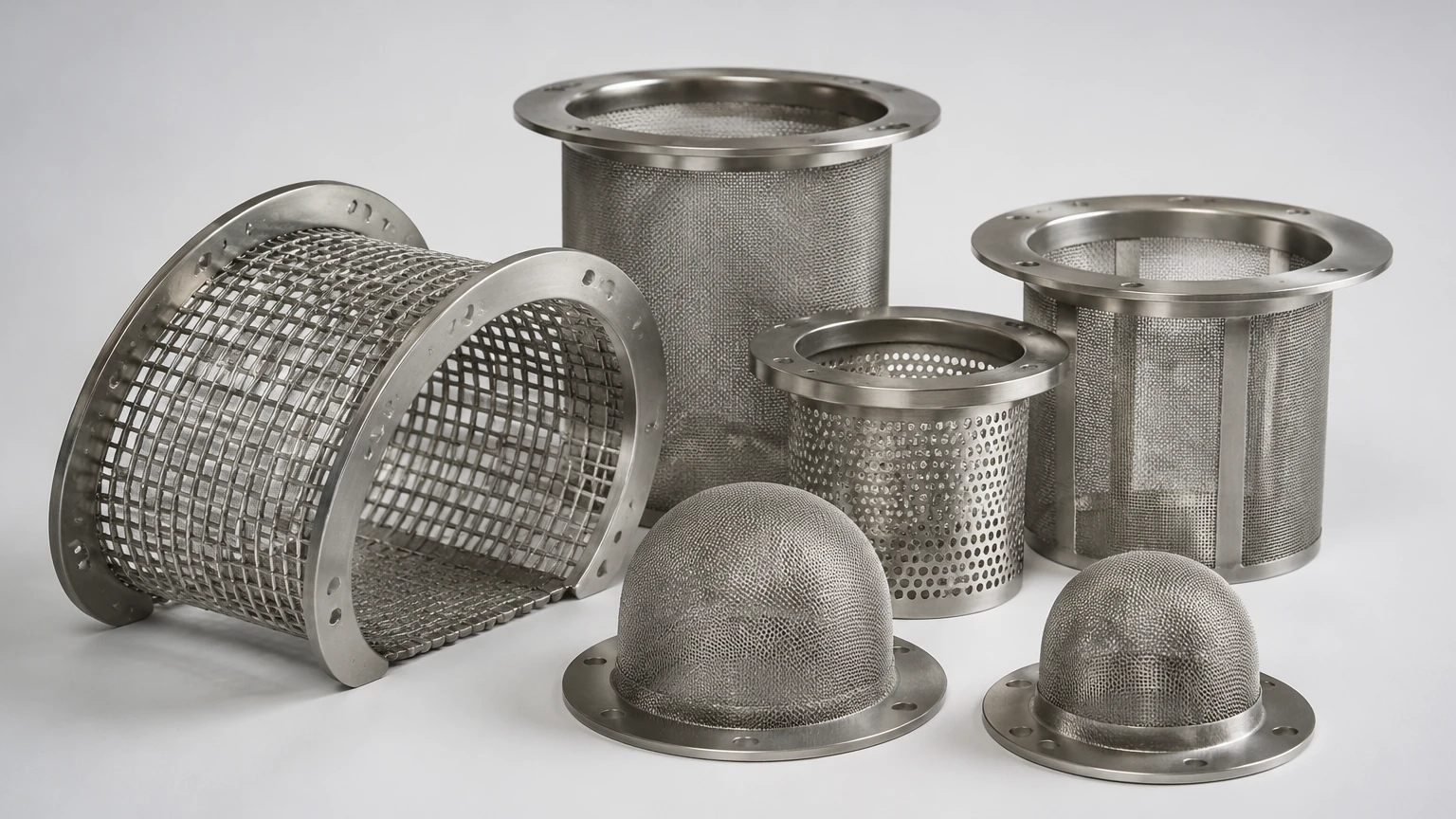
Customization and OEM Integration
Standard off-the-shelf screens rarely meet the specific requirements of complex industrial systems. Customization is often necessary to ensure the screen fits the physical constraints of the installation while meeting the hydraulic requirements of the pump.
Connection Types
Screens must be securely attached to the pump suction line. Common connection methods include:
* Flanged Connections: Used for large industrial pumps where a secure, leak-proof seal is required.
* Threaded NPT/BSP: Common for smaller pumps and hydraulic systems.
* Slip-fit or Friction-fit: Often used in temporary or low-pressure applications where easy removal is prioritized.
Geometric Constraints
In many retrofit scenarios, the space available for the intake screen is limited by the dimensions of a tank, sump, or vessel. Custom-fabricated screens can be designed in various shapes—conical, cylindrical, or flat—to maximize the filtration surface area within the available footprint.
Maintenance Protocols and Total Cost of Ownership
While the initial purchase price of a pump intake screen is a factor, the Total Cost of Ownership (TCO) is driven by maintenance requirements and the impact on pump energy consumption.
Monitoring Screen Health
In critical systems, engineers should install differential pressure ($ΔP$) gauges across the intake screen. A sudden or steady increase in $ΔP$ indicates that the screen is clogging. Automated systems can trigger an alarm or a backwash cycle when the pressure drop reaches a predetermined threshold.
Cleaning and Replacement Cycles
Stainless steel screens are generally cleanable, which offers a significant cost advantage over disposable filters. Cleaning methods include:
* Manual Cleaning: Removing the screen and using high-pressure water or air to dislodge debris.
* Backwashing: Reversing the flow through the screen to push debris away from the surface.
* Ultrasonic Cleaning: Used for fine mesh screens in pharmaceutical or food applications to remove microscopic buildup.
The replacement cycle for a high-quality stainless steel screen depends on the abrasiveness of the fluid and the frequency of cleaning. A well-maintained screen can last for several years, whereas a screen subjected to constant cavitation or corrosive attack may fail prematurely.
Conclusion: Making Informed Purchasing Decisions
Selecting a pump intake screen is a technical decision that requires a balance between filtration efficiency and hydraulic performance. Engineers must confirm several pieces of information before finalizing a specification:
1. Fluid Properties: Viscosity, temperature, and chemical composition.
2. Pump Specifications: Flow rate (GPM/m³h), NPSH requirements, and maximum solids handling.
3. Debris Profile: The type, size, and concentration of solids expected in the fluid.
4. Installation Environment: Space constraints and connection requirements.
By focusing on high-quality materials and precise engineering, such as the solutions provided by Kaifil, industrial operators can ensure their pumping systems remain protected, efficient, and reliable over the long term. For technical assistance in selecting the right filtration components for your specific industrial application, visiting the Main Page provides access to detailed product data and engineering expertise.
