


Sanitary Filter
In high-purity industrial sectors such as pharmaceutical manufacturing, food and beverage processing, and biotechnology, the integrity of the filtration process is paramount. A sanitary filter is not merely a separation device but a critical component designed to meet stringent hygienic standards, ensuring that the final product remains free from contaminants, bacteria, and particulate matter. For engineers and procurement specialists, selecting the right filtration hardware requires a deep understanding of material science, surface finishes, and structural design to ensure long-term compliance and operational efficiency.
As a specialized manufacturer, Kaifil provides custom stainless steel filtration solutions that address these demanding requirements. By focusing on precision engineering and high-grade materials, the goal is to provide components that not only filter effectively but also withstand the rigorous cleaning protocols typical of sanitary environments.
Defining the Sanitary Filter in Industrial Applications
The primary distinction between a standard industrial filter and a sanitary filter lies in the design intent. While a standard filter focuses primarily on particle retention and flow rate, a sanitary version must prioritize cleanability and the prevention of microbial growth. This is achieved through specific geometries that eliminate "dead zones"—areas where fluid can stagnate and bacteria can proliferate.
In the context of liquid and gas processing, these filters are often integrated into systems that require Clean-in-Place (CIP) or Steam-in-Place (SIP) capabilities. The ability to sterilize the filter housing and the internal element without disassembly is a hallmark of a true sanitary system. Whether used for clarifying beverages, sterilizing air for fermentation, or removing particulates from injectable drugs, the hardware must maintain its structural integrity under high pressure and temperature cycles.
Material Selection and Surface Integrity
The choice of material is the first line of defense in sanitary filtration. Stainless steel is the industry standard due to its corrosion resistance and durability. Specifically, Type 316L stainless steel is preferred over 304 in most sanitary applications because of its lower carbon content and superior resistance to pitting and crevice corrosion, especially when exposed to chlorides or acidic cleaning agents.
Surface Finish and Ra Values
Beyond the alloy composition, the surface finish of the filter housing and the internal support structures is critical. Rough surfaces provide microscopic nooks where proteins and microorganisms can adhere, resisting standard cleaning cycles. Sanitary filters are typically polished to a specific roughness average (Ra).
Engineering specifications often demand an internal surface finish of Ra < 0.8 μm (32 micro-inches) or even Ra < 0.4 μm for high-purity pharmaceutical applications. Achieving these levels often involves a combination of mechanical polishing and electropolishing. Electropolishing, in particular, removes the "peaks" of the metal surface at a molecular level, creating a featureless, mirror-like finish that is significantly easier to sanitize.
Structural Design: Ensuring Cleanability and Sterility
A sanitary filter must be designed to be completely drainable. Any residual fluid left in the housing after a production run poses a risk of cross-contamination or bacterial growth. To prevent this, manufacturers utilize specific design features:
* Tri-Clamp Connections: Unlike threaded fittings, which have recessed tracks that are nearly impossible to clean, Tri-clamp (or sanitary clamp) fittings provide a smooth, crevice-free transition between the filter and the piping system.
* Rounded Internal Corners: All internal angles are radiused to ensure that cleaning fluids can reach every surface and that no solids become trapped.
* O-ring Seals: High-performance elastomers such as EPDM, FKM (Viton), or PTFE-encapsulated silicone are used. These must be FDA-compliant and capable of maintaining a seal during the thermal expansion and contraction associated with SIP cycles.
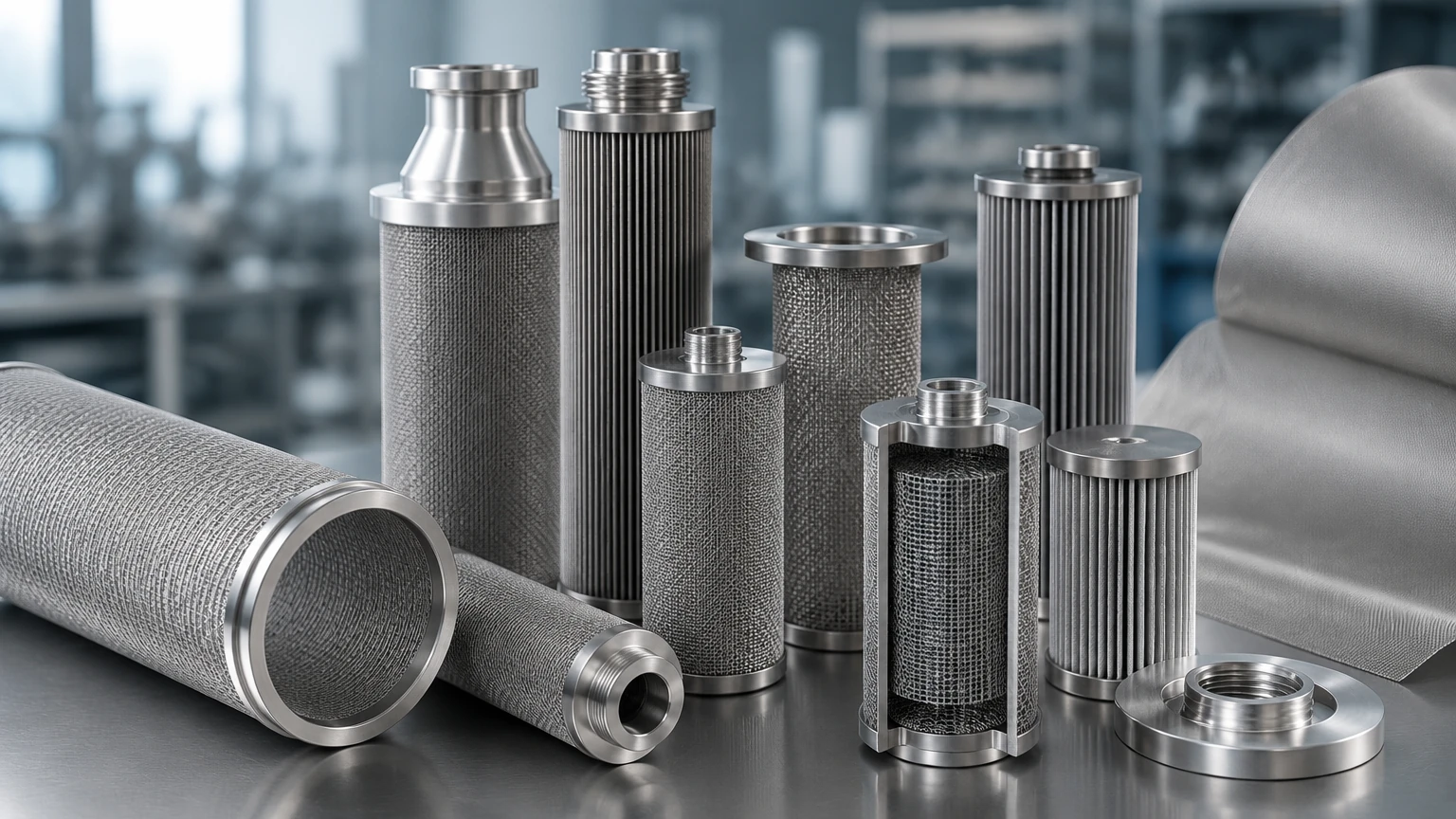
Kaifil’s expertise in manufacturing precision metal filter components ensures that these structural requirements are met with exacting tolerances. By visiting the Main Page, technical teams can explore the range of custom configurations available for specific housing and element designs.
Performance Evaluation: Filtration Accuracy and Flow Dynamics
When evaluating a sanitary filter, engineers must balance filtration efficiency with the physical constraints of the system. The performance of the filter element—whether it is a pleated wire mesh or a sintered metal cartridge—is measured by several key metrics:
Micron Rating and Beta Ratio
Filtration accuracy is defined by the micron rating. However, it is important to distinguish between "nominal" and "absolute" ratings. A nominal rating indicates the filter can trap a percentage of particles of a certain size, whereas an absolute rating implies a 99.9% or higher efficiency. In sanitary processes, absolute ratings are often required to guarantee the removal of specific contaminants, such as yeast cells in brewing or specific bacteria in dairy processing.
Pressure Drop (Delta P)
Every filter introduces a resistance to flow. As the filter element captures debris, this resistance increases. A well-designed sanitary filter should offer a low initial pressure drop to maximize the life of the pump and reduce energy consumption. If the initial pressure drop is too high, the filter will reach its terminal pressure—the point at which it must be cleaned or replaced—much faster, leading to increased downtime.
Identifying and Mitigating Common Filtration Risks
Implementing a sanitary filtration system is not without risks. Failure to account for specific process variables can lead to premature filter failure or, worse, product contamination.
1. Biofilm Formation: Even with high-grade stainless steel, if the cleaning cycle is skipped or the temperature is insufficient, a biofilm can form. Once established, biofilms are incredibly difficult to remove and can shed bacteria into the process stream.
2. Material Fatigue: Repeated steam sterilization cycles subject the filter to thermal shock. Over time, this can cause micro-cracks in the welds or the filter media itself. Regular integrity testing (such as bubble point or pressure hold tests) is essential to ensure the filter has not been compromised.
3. Bypass Issues: If the filter element is not seated correctly within the housing, fluid will take the path of least resistance, bypassing the filter media entirely. Sanitary housings must have robust locking mechanisms to ensure a positive seal at all times.
Customization and Technical Integration for OEM Applications
Standard off-the-shelf filters often fall short in specialized industrial environments. Customization allows engineers to tailor the filter to the exact flow characteristics and spatial constraints of their machinery. This includes adjusting the length and diameter of the filter cartridge, selecting specific wire mesh weaves for specialized particulate shapes, and designing custom mounting brackets.
For OEM applications, the ability to integrate a sanitary filter directly into a larger machine—such as a filling line or a heat exchanger—requires close collaboration with the manufacturer. Custom stainless steel solutions allow for the optimization of the filtration area, ensuring that the filter does not become a bottleneck in the production process.
Pre-Purchase Engineering Considerations
Before finalizing a purchase for sanitary filtration hardware, engineers should confirm several technical details to ensure the product is fit for purpose:
* Chemical Compatibility: Does the filter material (and the seals) resist the specific chemicals used in both the product and the cleaning agents?
* Operating Temperature and Pressure: What are the maximum and minimum values during both production and sterilization? Ensure the housing is rated for the highest pressure expected during a steam cycle.
* Regulatory Compliance: Does the manufacturer provide documentation for material traceability (MTRs) and compliance with relevant food and drug safety standards?
* Replacement Cycles: Based on the expected solids loading, what is the estimated time between cleaning or replacement? This affects the total cost of ownership.
* End-Cap Configurations: Ensure the filter element end-caps (e.g., Code 7, 222, or 226) are compatible with the existing housing to prevent bypass.
Conclusion
A sanitary filter is a vital safeguard in high-purity industrial processes. By focusing on high-grade 316L stainless steel, precise surface finishes, and designs that eliminate contamination risks, manufacturers like Kaifil enable industries to maintain the highest levels of product safety. Understanding the technical nuances of filtration accuracy, pressure dynamics, and material integrity allows engineering teams to select solutions that offer both high performance and long-term reliability. For more information on custom filtration components and engineering support, professionals are encouraged to review the technical resources available on the Kaifil Main Page.
