


Woven Wire Mesh vs Welded Wire Mesh: An Engineering Selection Guide
In industrial filtration and material separation, the choice between woven and welded wire structures is a fundamental engineering decision that impacts everything from filtration efficiency to the mechanical integrity of the final component. While both products are manufactured from metallic wires, their production methods, structural behaviors, and performance characteristics differ significantly.
For engineers and procurement teams, understanding the nuances of woven wire mesh vs welded wire mesh is essential for optimizing system performance and ensuring long-term durability in demanding environments such as chemical processing, pharmaceuticals, and food production. This guide provides a technical analysis of both materials to assist in the selection process.
Manufacturing Fundamentals: Interlacing vs. Fusion
The primary distinction between these two materials lies in how the wires are joined to form the mesh grid. This manufacturing process dictates the physical properties and the limits of the material's application.
Woven Wire Mesh Production
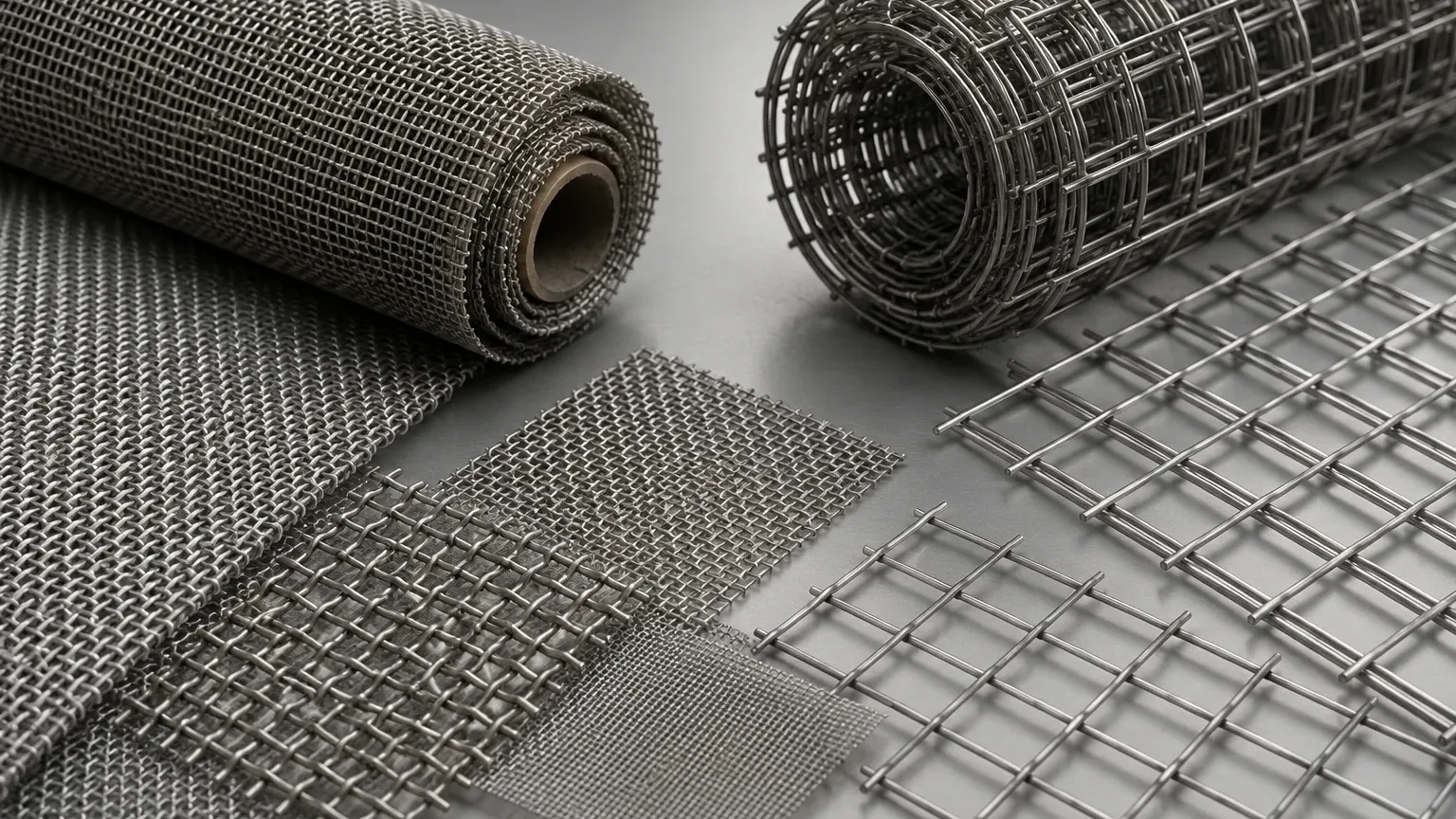
Woven Wire Mesh is produced through a mechanical process similar to textile weaving. Using specialized looms, the "warp" wires (running lengthwise) and "shute" or "weft" wires (running crosswise) are interlaced. No heat or welding is involved in the standard weaving process.
Depending on the intended application, different weave patterns are utilized:
* Plain Weave: Each shute wire passes over and under one warp wire.
* Twill Weave: Each shute wire passes over and under two warp wires, allowing for heavier wire diameters in a given mesh count.
* Dutch Weave: Uses different wire diameters for warp and shute to create a dense, tortuous path for fine filtration.
Welded Wire Mesh Production
Welded wire mesh is manufactured by laying wires in a grid pattern—typically at 90-degree angles—and fusing them at every intersection using an automated electrical resistance welding process. This creates a rigid, permanent bond. Because the wires are fused, they do not rely on mechanical tension to maintain their position, resulting in a structure that behaves more like a solid sheet of perforated metal than a flexible fabric.
Structural Characteristics and Mechanical Integrity
When evaluating woven wire mesh vs welded wire mesh, engineers must consider how the material responds to mechanical stress, vibration, and pressure.
Flexibility and Formability
Woven mesh is inherently more flexible. Because the wires are not fused, they can shift slightly relative to one another (depending on the weave density and tension). This makes woven mesh ideal for applications requiring deep drawing, pleating, or wrapping around cylindrical cores. In filtration, the ability to pleat a Plain, twill and dutch woven wire mesh in SS304/316L — rolls, cut mesh and framed panels. Send mesh count or micron target for a technical quote. significantly increases the effective surface area within a compact filter housing.
Welded mesh, by contrast, is extremely rigid. It cannot be easily pleated without risking the integrity of the weld points. However, this rigidity is an advantage in applications where the mesh must maintain a flat profile under heavy loads or where it serves as a structural support for finer filter media.
Aperture Stability and Precision
In welded mesh, the aperture (opening) size is fixed by the welding process. The wires cannot move, ensuring consistent opening sizes even under shear stress. However, welded mesh is generally limited to larger opening sizes, typically ranging from several millimeters down to approximately 0.5 mm.
Woven mesh offers far greater precision at the micron level. High-precision looms can produce mesh with openings as small as 1 micron. While the wires in a loose plain weave can potentially shift, industrial-grade woven mesh is often "calendered" (passed through high-pressure rollers) or sintered to lock the wires in place, providing exceptional aperture stability for critical separation tasks.
Filtration Performance and Micron Ratings
For filtration applications, the choice is usually dictated by the required micron rating and the nature of the fluid being processed.
Fine Filtration (Woven Mesh)
Woven wire mesh is the industry standard for fine liquid and gas filtration. The variety of weave patterns allows for specific performance characteristics:
* Surface Filtration: Plain and twill weaves provide a two-dimensional pore structure that is easy to clean via backwashing.
* Depth-Like Filtration: Dutch weaves (Plain Dutch, Twill Dutch, and Reverse Dutch) create a complex, three-dimensional pore structure. This is essential for capturing irregularly shaped particles and providing high dirt-holding capacity in hydraulic and fuel systems.
Coarse Straining and Support (Welded Mesh)
Welded mesh is rarely used for fine filtration due to the limitations of the welding process at small scales. Instead, it excels as a coarse strainer or a "support cage." In many multi-layer filter elements, a layer of fine woven mesh is sandwiched between layers of welded wire mesh or expanded metal. The welded mesh provides the structural skeleton necessary to withstand high differential pressures without the fine mesh collapsing.
Material Considerations: SS304 vs. SS316L
Both woven and welded meshes are commonly produced in stainless steel grades 304 and 316L. However, the manufacturing process interacts with the material properties differently.
1. Corrosion Resistance: In welded mesh, the welding process creates a "Heat Affected Zone" (HAZ) at every intersection. If the welding is not performed under strictly controlled conditions, it can lead to localized depletion of chromium, making the joints susceptible to intergranular corrosion. Woven mesh, being a mechanical assembly, does not have these thermal weak points.
2. Chemical Compatibility: For pharmaceutical and marine applications, SS316L is preferred due to its molybdenum content, which provides superior resistance to chlorides and organic acids. When selecting a welded mesh in these environments, it is critical to ensure the welding process has not compromised the alloy's corrosion resistance.
Engineering Selection Criteria
To determine the optimal mesh type for a project, engineers should evaluate the following five criteria:
1. Required Filtration Accuracy
If the application requires a micron rating below 500 microns, woven wire mesh is almost always the necessary choice. Welded mesh is typically reserved for "trash catchers" or coarse guards where openings exceed 1mm.
2. Differential Pressure and Mechanical Load
Will the mesh be subjected to high-pressure pulses or heavy weight? If the mesh is a standalone component, welded mesh offers higher structural rigidity. If the mesh is part of a high-pressure filter element, a combination of fine woven mesh for filtration and welded mesh for support is often the best engineering solution.
3. Fabrication Requirements
Does the component need to be pleated, rolled into a tight diameter, or formed into a conical shape? Woven mesh’s flexibility allows for complex geometries. Welded mesh is better suited for flat panels, large cylinders, or tray liners where minimal forming is required.
4. Cleaning and Maintenance
In food and beverage or chemical processing, "cleanability" is paramount. Woven mesh, particularly calendered plain weave, offers a smooth surface that releases filter cakes easily. Welded mesh has small crevices at the weld points where bacteria or cross-contaminants can lodge, making it more challenging to sterilize in sanitary applications.
5. Total Cost of Ownership
Welded wire mesh is generally less expensive to produce in large, coarse formats. However, for precision industrial applications, the durability and specialized performance of woven wire mesh often result in a lower total cost of ownership. Woven mesh's ability to be cleaned and reused multiple times in harsh environments outweighs the lower initial cost of disposable or less durable welded alternatives.
Common Risks in Mesh Selection
A common error in procurement is specifying "stainless steel mesh" without defining the construction method. This can lead to several risks:
* Media Migration: Using a low-quality woven mesh without proper edge tensioning can lead to wires shifting, resulting in "oversize" particles passing through the system.
* Weld Failure: In high-vibration environments (such as vibrating screens), the rigid joints of a welded mesh can suffer from fatigue and snap. Woven mesh, with its slight mechanical play, can often dissipate vibration energy more effectively.
* Pressure Drop: Specifying a welded mesh with thick wires for a support role may inadvertently reduce the effective open area, leading to an unacceptable pressure drop across the filter assembly.
Conclusion
The debate of woven wire mesh vs welded wire mesh is not about which material is superior, but which is most appropriate for the specific technical requirements of the application. Woven wire mesh remains the undisputed leader for precision filtration, flexibility, and chemical purity. Welded wire mesh serves as a robust, cost-effective solution for structural support, safety guarding, and coarse straining.
For engineers designing filtration systems, confirming the mesh count, wire diameter, weave type, and alloy grade is only the first step. One must also consider the mechanical stresses of the operating environment to choose the construction method that ensures system reliability. When high-precision separation and durability are required, stainless steel woven structures provide the engineering characteristics necessary for modern industrial standards.
