


Semiconductor Filter
In the precision-driven world of semiconductor manufacturing, the margin for error is measured in nanometers. As integrated circuit (IC) designs continue to shrink toward 5nm and 3nm nodes, the sensitivity of the fabrication process to particulate contamination reaches critical levels. A single sub-micron particle can bridge the gap between conductive lines, leading to short circuits, catastrophic yield loss, and compromised reliability. Consequently, the semiconductor filter has become one of the most vital components in the modern fabrication facility (fab), serving as the primary defense mechanism in gas delivery systems, chemical distribution, and ultrapure water (UPW) loops.
Industrial filtration for the semiconductor sector requires a sophisticated balance of material science, fluid dynamics, and high-purity manufacturing. Unlike standard industrial filters, components used in this sector must provide near-absolute retention of particles while ensuring zero outgassing, minimal metallic ion shedding, and extreme chemical resistance. This article examines the technical requirements, engineering considerations, and selection criteria for high-performance semiconductor filtration solutions.
The Criticality of Ultra-High Purity in Modern Fabrication
Semiconductor manufacturing involves a sequence of hundreds of complex steps, including photolithography, etching, ion implantation, and chemical mechanical planarization (CMP). Throughout these stages, various fluids—ranging from inert gases like nitrogen to highly aggressive acids like hydrofluoric acid—interact directly with the silicon wafer. If these fluids carry contaminants, the structural integrity of the wafer is at risk.
Contamination in a semiconductor environment generally falls into three categories: particulate, chemical (molecular), and microbial. A high-quality semiconductor filter must address these through specialized media. For process gases, sintered metal filters are often preferred due to their ability to withstand high pressures and temperatures while providing 99.9999999% (9-log) retention of particles down to the 0.003 µm range. In liquid applications, such as photoresist delivery or solvent cleaning, the focus shifts to low extractables and high flow rates to maintain throughput without introducing organic or metallic impurities.
Material Science in Semiconductor Filtration
The choice of material for a semiconductor filter is dictated by the chemical environment and the required purity level. While polymer-based filters (like PTFE or PFA) are common for certain liquid chemicals, stainless steel and high-nickel alloys are the gold standard for high-pressure gas systems and specific high-temperature liquid processes.
316L Stainless Steel
316L stainless steel is the foundational material for many metal filter components. Its low carbon content improves weldability and resistance to intergranular corrosion. For semiconductor applications, 316L is typically electropolished to achieve a surface roughness (Ra) of less than 0.25 µm. This process removes surface irregularities where particles or moisture could be trapped, facilitating faster dry-down times and reducing the risk of outgassing.
Nickel and Hastelloy
In environments involving halogenated gases or highly corrosive acids, standard stainless steel may be insufficient. Nickel filters offer superior resistance to high-temperature oxidation and are often used in dry gas delivery. Hastelloy C-22, a nickel-chromium-molybdenum alloy, provides exceptional resistance to pitting, crevice corrosion, and stress corrosion cracking, making it ideal for the most aggressive chemical environments in a fab.
Engineering Design: Pleated vs. Sintered Metal Components
The physical structure of the filter media determines its surface area, dirt-holding capacity, and pressure drop characteristics. Engineers must choose between different construction methods based on the specific requirements of the tool or system.
Sintered Metal Fiber Felt
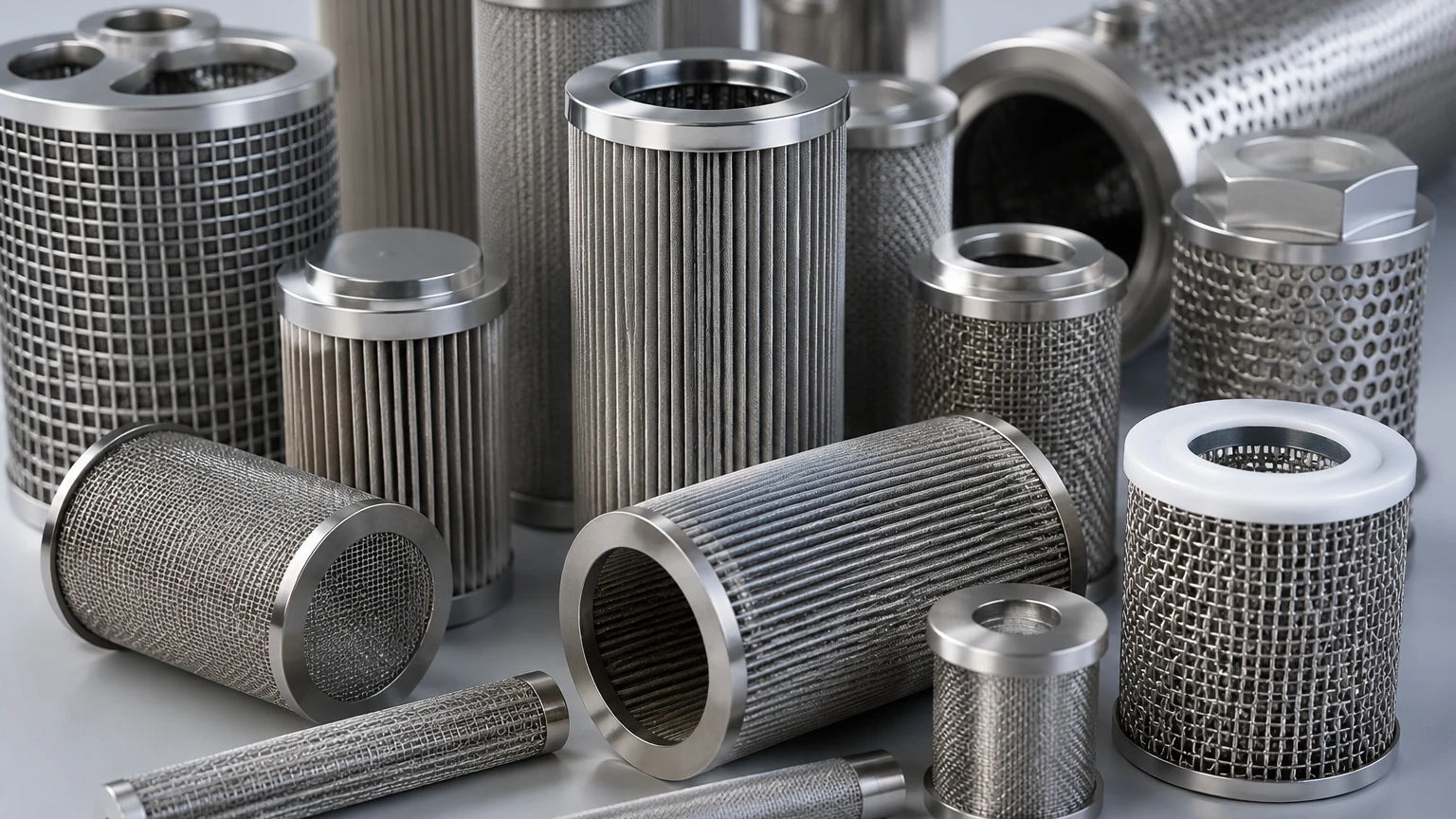
Sintered metal fiber felt is a non-woven structure composed of fine metal fibers. This media offers high porosity (up to 80%) compared to sintered powder filters. The high porosity allows for significantly higher flow rates and lower pressure drops, which is essential for maintaining consistent process conditions in high-volume manufacturing. The depth-loading nature of fiber felt also provides superior dirt-holding capacity, extending the service life of the semiconductor filter.
Pleated Wire Mesh
For applications requiring precise surface filtration, pleated stainless steel wire mesh is utilized. Pleating significantly increases the effective filtration area within a standard cartridge footprint. This design is particularly effective for protecting sensitive valves and mass flow controllers (MFCs) in gas panels, where high flow velocity and minimal space are common constraints. By maximizing the surface area, engineers can reduce the face velocity of the fluid, which improves particle capture efficiency through diffusion and interception mechanisms.
Performance Metrics and Validation Standards
When evaluating a semiconductor filter, technical professionals must look beyond simple micron ratings. The following metrics are essential for ensuring process stability:
1. Retention Efficiency: This is often expressed as a Log Reduction Value (LRV). For UHP gas filters, an LRV of 9 at the most penetrating particle size (MPPS) is standard. This means the filter can remove 999,999,999 out of every billion particles.
2. Pressure Drop (ΔP): A high pressure drop can lead to inconsistent flow and may require higher upstream pressure, increasing the stress on system seals and components. Low ΔP is a hallmark of optimized filter geometry.
3. Outgassing and Moisture Contribution: In vacuum and UHP gas systems, the introduction of even parts-per-billion (ppb) levels of moisture or hydrocarbons can ruin a process. Filters must undergo rigorous vacuum baking and testing to ensure they meet the stringent "no-add" requirements of the industry.
4. Particle Shedding: A filter should never become a source of contamination. Validation involves testing the filter under high-flow and pulse conditions to ensure that the media itself does not release fibers or particles into the downstream flow.
Application-Specific Filtration Strategies
Different segments of the semiconductor fab require tailored filtration approaches. Understanding these nuances is key to selecting the right component from a manufacturer's Main Page.
Gas Delivery Systems (GDS)
In the GDS, filters are placed at the source (gas cabinets) and at the point-of-use (POU) near the process tool. POU filters are the final line of defense. They must be compact and capable of handling the specific gas chemistry, whether it is an inert gas like Argon or a pyrophoric gas like Silane. Sintered metal filters are preferred here for their robustness and high-temperature tolerance during system bake-outs.
Chemical Mechanical Planarization (CMP)
CMP slurries contain abrasive particles designed to polish the wafer surface. However, oversized particles or aggregates in the slurry can cause micro-scratches. The semiconductor filter used in CMP must be designed for "large particle count" (LPC) reduction while allowing the functional abrasive particles to pass through. This requires a very narrow pore size distribution and a design that minimizes shear stress on the slurry.
Ultrapure Water (UPW) Loops
UPW is used in massive quantities for wafer rinsing. Filtration in UPW systems focuses on the removal of bacteria, silica, and fine particulates. Stainless steel housings with high-surface-area cartridges are used in the primary loops to ensure the water remains at the required 18.2 MΩ·cm resistivity level.
Custom OEM Solutions and Integration
Many semiconductor equipment manufacturers (OEMs) require bespoke filtration solutions that fit within the tight spatial constraints of modern process tools. Customization options often include:
* Custom End-Fittings: VCR, tube butt weld, or NPT fittings to match existing gas panel configurations.
* Variable Lengths and Diameters: Adjusting the physical dimensions to meet specific flow and pressure drop targets.
* Specialized Coatings: Applying coatings like fluoropolymers or specialized passivations to enhance chemical compatibility.
Working with a manufacturer that understands these engineering requirements allows for the development of integrated filtration components that simplify installation and reduce the number of potential leak points in a system. For detailed specifications on available configurations, engineers often consult the manufacturer's Main Page to review technical data sheets and material certifications.
Total Cost of Ownership and Maintenance
While the initial purchase price of a semiconductor filter is a factor, the total cost of ownership (TCO) is driven by yield impact and maintenance cycles. A lower-quality filter that requires frequent replacement or, worse, leads to a yield excursion, is far more expensive in the long run than a high-performance component.
Replacement Cycles
Filter life is typically monitored via differential pressure sensors. As the filter loads with contaminants, ΔP increases. In semiconductor environments, filters are often replaced on a preventative maintenance (PM) schedule rather than waiting for failure, as the cost of downtime for an unscheduled change-out is prohibitive.
Cleaning and Reusability
In certain non-UHP or less critical industrial applications, stainless steel filters can be cleaned using ultrasonic baths or chemical cleaning agents. However, in the highest purity semiconductor gas lines, filters are typically treated as consumables to avoid the risk of cross-contamination during the cleaning process. For liquid chemical filters, the decision to clean versus replace depends on the stability of the filter media and the nature of the trapped contaminants.
Conclusion
The evolution of semiconductor technology demands a parallel advancement in filtration science. The semiconductor filter is no longer a simple mechanical barrier; it is a highly engineered component that must meet extreme standards for purity, durability, and performance. By selecting the correct materials, such as electropolished 316L or Hastelloy, and utilizing advanced structures like sintered metal fiber felt, engineers can ensure the stability of their fabrication processes.
For procurement teams and design engineers, the focus should remain on technical validation and the ability of the supplier to provide customized, reliable solutions. As the industry moves toward even smaller nodes and more complex architectures, the role of precision filtration will only become more central to the success of global semiconductor manufacturing. For more information on custom filtration components and industrial solutions, visit the Main Page to explore the full range of technical capabilities and product offerings.
