


Water Filter for Seawater
Seawater filtration is a critical process in various industrial sectors, including desalination, offshore oil and gas, coastal power generation, and marine ballast water treatment. Unlike freshwater applications, seawater presents unique chemical and biological challenges that demand specialized engineering solutions. Selecting an effective water filter for seawater requires a deep understanding of material science, fluid dynamics, and the specific contaminants present in marine environments.
Industrial filtration systems must balance the need for high-efficiency particle removal with the necessity of resisting extreme corrosion and biological fouling. For engineers and procurement teams, the goal is to implement a solution that minimizes downtime, reduces maintenance costs, and protects downstream equipment such as high-pressure pumps and reverse osmosis (RO) membranes.
The Engineering Challenges of Seawater Filtration
Seawater is a complex medium characterized by high salinity, varying levels of suspended solids, and a rich diversity of biological life. These factors combine to create a highly aggressive environment for standard industrial filtration components.
Chemical Aggressiveness and Corrosion
Seawater typically contains chloride concentrations of approximately 19,000 mg/L. These ions are exceptionally effective at penetrating the passive oxide layer of many common metals, leading to localized corrosion phenomena such as pitting and crevice corrosion. In high-pressure applications, such as seawater reverse osmosis (SWRO), the risk of stress corrosion cracking (SCC) also increases significantly.
Suspended Solids and Turbidity
Coastal waters often contain high levels of Total Suspended Solids (TSS), including sand, silt, and clay. The concentration of these solids can fluctuate rapidly due to seasonal changes, storms, or dredging activities. A robust seawater filter must be capable of handling these peaks without premature clogging or mechanical failure.
Biological Fouling
Marine organisms, ranging from microscopic algae and bacteria to larger macro-organisms like barnacles and mussels, present a constant threat to filtration systems. Biofouling can lead to the formation of biofilms on filter surfaces, which increases pressure drop and can eventually lead to complete blockage. Furthermore, certain bacteria, such as Sulfate-Reducing Bacteria (SRB), can accelerate the corrosion of metal components through Microbiologically Influenced Corrosion (MIC).
Material Science: Preventing Pitting and Crevice Corrosion
In the context of seawater filtration, material selection is perhaps the most critical engineering decision. Standard 304 or even 316L stainless steel, while excellent for many industrial applications, often fails prematurely in warm or stagnant seawater.
The Importance of PREN
Engineers use the Pitting Resistance Equivalent Number (PREN) to evaluate a material's resistance to localized corrosion in chloride-rich environments. The formula typically used is PREN = %Cr + 3.3(%Mo + 0.5%W) + 16(%N). For reliable long-term performance in seawater, materials with a PREN value greater than 40 are generally recommended.
Advanced Metallic Alloys
1. Super Duplex Stainless Steels (e.g., Alloy 2507): These alloys offer a balanced microstructure of austenite and ferrite, providing high mechanical strength and exceptional resistance to pitting and stress corrosion cracking. They are a standard choice for high-pressure seawater filter housings and internal components.
2. 904L and 6% Moly Stainless Steels: These highly alloyed austenitic steels contain significant amounts of molybdenum and chromium, making them suitable for brackish water and some seawater applications where high-velocity flow helps maintain the passive layer.
3. Titanium: For the most demanding applications, titanium provides near-total immunity to seawater corrosion. While more expensive, its longevity in aggressive environments often results in a lower total cost of ownership over the system's lifecycle.
For more information on material compatibility and custom alloy options for filtration components, engineers can refer to the Main Page of technical manufacturers specializing in high-performance metal filters.
Types of Filtration Media for Marine Environments
The choice of filtration media depends on the required micron rating, flow rate, and the nature of the solids being removed. In seawater applications, durable metal media are often preferred over disposable polymer cartridges due to their cleanability and structural integrity.
Stainless Steel Wire Mesh
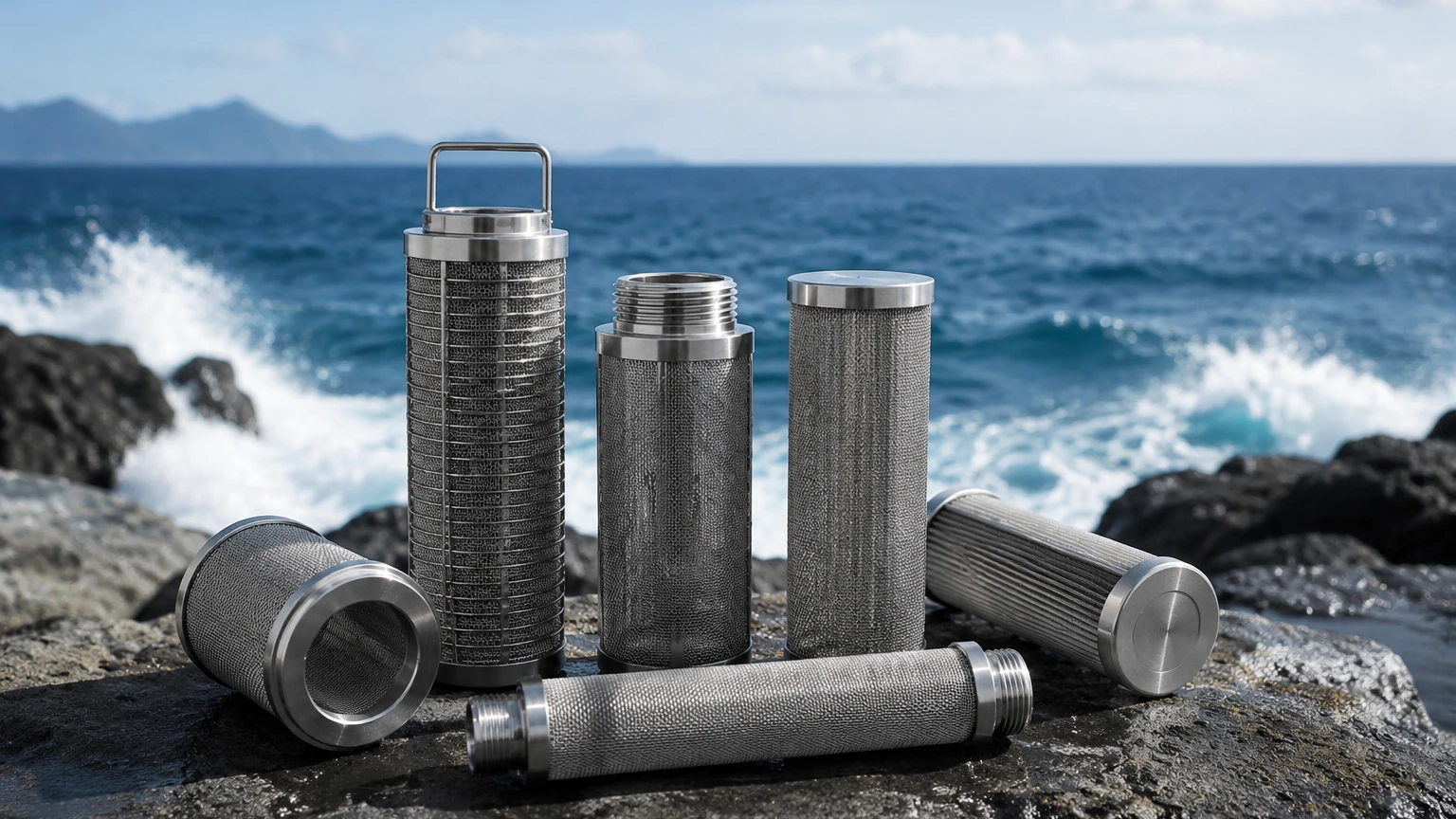
Woven wire mesh is a versatile medium that provides precise pore sizes. For seawater, specialized alloys must be used for the wire itself. Sintered wire mesh, which involves bonding multiple layers of mesh together through heat and pressure, offers enhanced mechanical stability and prevents individual wires from shifting under high-pressure differentials.
Wedge Wire Screens
Wedge wire is particularly effective for coarse filtration and intake screens. The V-shaped profile of the wire creates a slot that widens inwardly, reducing the risk of particles becoming wedged in the screen. This design is ideal for self-cleaning automatic filters used in seawater cooling systems.
Sintered Metal Fiber and Powder
For fine filtration requirements (sub-10 micron), sintered metal fiber felt or sintered metal powder components provide high porosity and excellent dirt-holding capacity. These depth-style filters are often used to protect sensitive downstream components in hydraulic systems or chemical injection lines on offshore platforms.
Operational Parameters: Flow Velocity and Pressure Management
Designing a seawater filtration system requires careful consideration of fluid dynamics to prevent both mechanical damage and accelerated corrosion.
Managing Flux and Velocity
High flow velocities can lead to erosion-corrosion, where the physical force of the water strips away the protective oxide layer of the metal. Conversely, excessively low velocities (stagnant conditions) promote the settling of solids and the growth of marine organisms, leading to crevice corrosion. Engineers typically aim for a "sweet spot" in velocity that maintains the passive layer without causing erosion.
Differential Pressure Monitoring
Monitoring the pressure drop (ΔP) across the filter is essential for determining cleaning or replacement cycles. In seawater systems, a rapid increase in ΔP often indicates a biological bloom or a sudden influx of silt. Automated systems are frequently programmed to trigger a backwash cycle once a specific pressure threshold is reached, ensuring continuous operation.
Addressing Biofouling and Organic Loading
Because seawater is a living medium, mechanical filtration alone is rarely sufficient for long-term stability. A comprehensive approach to biofouling management is necessary.
Pre-treatment and Chlorination
Many seawater systems utilize electro-chlorination or chemical dosing to kill or inhibit the growth of marine organisms before they reach the filters. However, engineers must ensure that the filter materials are compatible with these oxidizing agents. For instance, while titanium is highly resistant to chlorine, some stainless steels may experience accelerated corrosion if chlorine levels are not strictly controlled.
Self-Cleaning Mechanisms
Automatic backwashing filters are the industry standard for seawater intakes. These systems use a portion of the filtered water (or an external source) to flush accumulated solids and biological matter from the filter surface. The design of the backwash nozzle and the frequency of the cycle are critical to preventing the permanent attachment of biofilms.
Application-Specific Requirements: From RO to Cooling Systems
The configuration of a water filter for seawater varies significantly based on the end-use of the water.
SWRO Pre-filtration
In seawater reverse osmosis, the primary goal is to protect the membranes from fouling. This usually involves a multi-stage filtration process: coarse screens, followed by media filters (sand/anthracite), and finally high-precision cartridge filters. These final safety filters must have a high beta ratio to ensure that virtually no particles larger than 5 microns reach the RO membranes.
Offshore Oil and Gas
On offshore platforms, seawater is used for water injection (to maintain reservoir pressure) and for cooling machinery. Filters in these environments must be extremely compact and lightweight due to space constraints, while also meeting stringent safety and explosion-proof standards. Custom-engineered metal filter elements are often used here because they can withstand high operating pressures and are easily integrated into modular skid designs.
Coastal Power Plants
Power plants use massive volumes of seawater for condenser cooling. The filtration systems here are focused on removing large debris, seaweed, and fish to prevent the clogging of heat exchanger tubes. Large-scale traveling band screens and coarse pressure filters are common in these applications.
Selection Checklist for Procurement Teams
When sourcing a water filter for seawater, engineers and purchasing managers should confirm the following technical details to ensure the solution is fit for purpose:
* Water Chemistry Analysis: What is the average and peak salinity, TSS, and organic load? Are there specific chemical additives (like chlorine) present?
* Material Specifications: Does the material meet the PREN requirements for the operating temperature? Is the housing material compatible with the internal elements to prevent galvanic corrosion?
* Filtration Rating: What is the required absolute or nominal micron rating? What is the maximum allowable particle size for downstream equipment?
* Operating Conditions: What are the maximum operating pressure and temperature? What is the design flow rate and the maximum allowable pressure drop?
* Maintenance Requirements: Is the system manual or automatic? Are replacement parts (like gaskets and seals) resistant to seawater and chemicals?
* Customization Options: Can the filter be customized to fit existing piping layouts or space constraints? Manufacturers like Kaifil specialize in providing tailored solutions that meet these specific industrial needs.
For technical professionals looking to explore specific product configurations or request a quote for custom stainless steel filtration components, the Main Page offers a comprehensive overview of available technologies and engineering support services.
Conclusion
Effective seawater filtration is a balance of robust mechanical design and sophisticated material science. By selecting the appropriate alloys, such as Super Duplex or Titanium, and utilizing durable media like sintered wire mesh, industrial operators can overcome the challenges of corrosion and biofouling. Whether the application is protecting RO membranes or ensuring the efficiency of offshore cooling systems, a well-engineered water filter for seawater is essential for operational reliability and long-term cost efficiency. Working with a manufacturer that understands these technical nuances ensures that the filtration system will perform predictably in one of the world's most demanding environments.
