


Woven Wire Mesh for Sale: A Technical Procurement Guide for Industrial Filtration
In industrial filtration and separation, the selection of media is a critical engineering decision that directly impacts process efficiency, product purity, and equipment longevity. When searching for woven wire mesh for sale, procurement teams and engineers must look beyond simple pricing. The complexity of wire diameters, weave patterns, and alloy compositions means that the "off-the-shelf" approach rarely suffices for demanding applications in chemical processing, pharmaceuticals, or food and beverage production.
This guide examines the technical parameters of Plain, twill and dutch woven wire mesh in SS304/316L — rolls, cut mesh and framed panels. Send mesh count or micron target for a technical quote. to help technical professionals make informed decisions based on mechanical requirements and filtration objectives.
Understanding the Fundamentals of Woven Wire Mesh
Woven wire mesh is a precision-engineered material created by weaving metallic wires on industrial looms. Unlike perforated metal or expanded metal, woven mesh offers a unique combination of high open area, precise aperture control, and structural flexibility. In a B2B context, the term "for sale" typically refers to bulk rolls, cut-to-size pieces, or fabricated components like framed panels and filter cylinders.
The performance of the mesh is defined by several geometric factors:
* Wire Diameter: The thickness of the wire before weaving, which dictates the mechanical strength and the weight of the mesh.
* Aperture (Opening Size): The clear distance between two adjacent parallel wires.
* Mesh Count: The number of openings per linear inch (25.4 mm).
* Pitch: The distance from the center of one wire to the center of the next.
For engineers, the relationship between these factors is paramount. For instance, increasing the wire diameter for a fixed mesh count will decrease the aperture size and the percentage of open area, resulting in a stronger mesh but a higher pressure drop across the filter media.
Weave Patterns and Their Impact on Filtration Performance
The method by which wires are interlaced determines the mesh’s stability and its filtration characteristics. When evaluating woven wire mesh for sale, it is essential to match the weave pattern to the specific pressures and particle sizes of the application.
Plain Weave
This is the most common and straightforward weave, where each warp wire (running lengthwise) passes alternately over and under each weft wire (running crosswise). Plain weave provides the highest open area and is ideal for general-purpose screening and low-pressure filtration. However, it may lack the structural rigidity required for high-pressure hydraulic systems or heavy-duty industrial sieving.
Twill Weave
In a twill weave, each warp wire passes over and under two weft wires. This pattern allows for the use of heavier wire diameters relative to the mesh count, providing greater strength and durability. Twill weave is often selected for fine filtration tasks where a plain weave would be too fragile or where the mesh must withstand significant mechanical stress without deforming.
Dutch Weave (Plain and Twill)
Dutch weaves utilize different diameters for the warp and weft wires. Typically, the warp wires are heavier and spaced further apart, while the weft wires are thinner and driven closely together. This creates a "zero-aperture" mesh where the openings are not visible when looking directly through the material. Instead, the filtration occurs through a tortuous path, allowing for extremely fine micron ratings (down to 1–5 microns) and high mechanical stability under pressure.
Material Selection: Selecting the Right Alloy for Harsh Environments
The chemical and thermal environment of the application dictates the material choice. While various metals can be woven, stainless steel remains the industry standard for industrial filtration due to its corrosion resistance and mechanical properties.
* Stainless Steel 304: The most widely used grade, offering excellent cost-effectiveness and resistance to atmospheric corrosion. It is suitable for most food-grade applications and general industrial water treatment.
* Stainless Steel 316L: Containing molybdenum, 316L provides superior resistance to chlorides and acids. It is the preferred choice for marine environments, pharmaceutical processing, and chemical filtration where the risk of pitting corrosion is high. The "L" denotes low carbon content, which improves weldability and prevents sensitization in fabricated components.
* Specialty Alloys: For extreme conditions, materials like Monel, Inconel, or Hastelloy may be required to withstand high temperatures or highly aggressive chemical reagents.
When sourcing woven wire mesh for sale, verifying the material certification (MTR) is a critical step in quality assurance to ensure the alloy meets the specified ASTM or ISO standards.
Engineering Specifications: Mesh Count, Micron Rating, and Open Area
For a filtration engineer, the most critical data points involve the mesh's ability to retain particles while allowing fluid flow. These are often expressed through micron ratings and open area percentages.
Nominal vs. Absolute Micron Rating
* Nominal Rating: Represents the approximate size of the largest particle that can pass through the mesh. It is usually based on a percentage (e.g., 90% retention).
* Absolute Rating: Refers to the diameter of the largest hard spherical particle that will pass through the mesh under specified test conditions. For critical applications like hydraulic fluid cleaning or pharmaceutical sterile filtration, absolute ratings are mandatory.
The Open Area Calculation
The percentage of open area determines the flow capacity and the rate of pressure drop. A higher open area allows for higher flow rates but generally results in a less robust mesh. The formula for calculating open area in a plain weave is:
`Open Area % = (Aperture / (Aperture + Wire Diameter))² x 100`
Understanding this trade-off is essential when sizing a filter housing or calculating the total surface area required to maintain a specific flux rate.
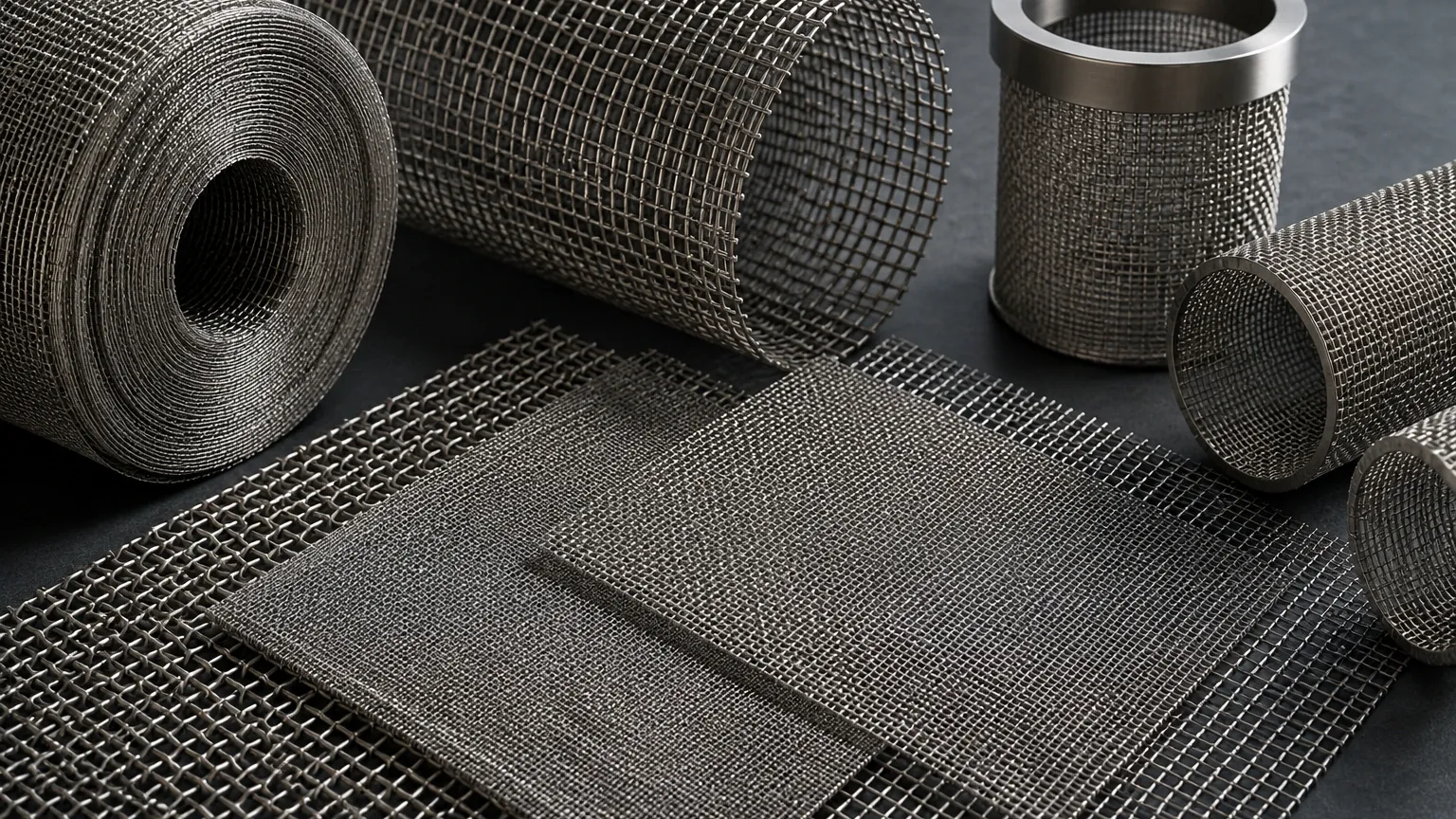
Customization and Secondary Processing for Industrial Applications
Standard rolls of woven wire mesh for sale are often just the starting point. Most industrial applications require secondary processing to integrate the mesh into a functional system. As a specialist manufacturer, Kaifil provides extensive customization options to meet these engineering needs:
1. Precision Slitting and Cutting: Mesh can be supplied in specific widths or laser-cut into complex geometric shapes to fit existing filter housings without the need for on-site trimming.
2. Framing and Edging: To prevent fraying and provide structural support, mesh panels can be fitted with U-binders, welded frames, or polymer gaskets.
3. Multi-Layer Sintering: For high-pressure environments, multiple layers of woven wire mesh can be sintered together. This process bonds the contact points of the wires, creating a rigid, porous plate that combines fine filtration layers with heavy-duty support layers.
4. Cylindrical and Pleated Elements: Mesh is often formed into cartridges. Pleating the mesh significantly increases the effective filtration area within the same footprint, extending the time between cleaning cycles.
Procurement Strategy: Evaluating Quality and Total Cost of Ownership
When evaluating woven wire mesh for sale, the initial purchase price is only one component of the total cost of ownership (TCO). Engineers should consider the following factors to ensure long-term value:
* Durability and Cleaning Cycles: High-quality stainless steel mesh can be cleaned and reused multiple times. Methods such as backwashing, ultrasonic cleaning, or chemical soaking can restore the flow rate. A cheaper, lower-quality mesh may deform during cleaning or suffer from wire migration, leading to premature failure.
* Consistency of Aperture: Inaccurate weaving leads to "bypass," where particles larger than the target micron rating pass through oversized openings. Reliable manufacturers use automated optical inspection to ensure aperture uniformity across the entire roll.
* Compatibility: Ensure the mesh and any secondary materials (adhesives, frames, gaskets) are compatible with the process fluid and operating temperatures.
* Replacement Frequency: By selecting a more robust weave or a superior alloy (e.g., 316L over 304), the interval between replacements can be extended, reducing downtime and labor costs.
Conclusion
Sourcing woven wire mesh for sale requires a deep understanding of the interplay between material science and mechanical engineering. Whether the goal is to protect sensitive downstream equipment from particulates or to achieve precise separation in a chemical process, the choice of weave, material, and customization is paramount. By focusing on technical specifications—such as absolute micron ratings, open area percentages, and alloy integrity—purchasing teams can secure filtration solutions that offer both performance and longevity.
For those seeking reliable, high-performance filtration components, working with a manufacturer that understands these engineering nuances is essential. From material selection to the final fabricated part, technical precision ensures that the filtration system operates at peak efficiency.
