


Woven Wire Mesh for Concrete: Engineering and Selection Guide
In the realm of industrial construction and specialized civil engineering, the integration of high-performance materials is essential for ensuring structural longevity and functional efficiency. While woven wire mesh is traditionally recognized for its role in high-precision filtration, its application within concrete structures—ranging from structural reinforcement to architectural cladding—has become a critical consideration for engineers. Selecting the appropriate woven wire mesh for concrete requires a deep understanding of material science, mechanical properties, and the chemical interactions between the metal alloy and the concrete matrix.
As a manufacturer specializing in stainless steel filtration and mesh solutions, Kaifil provides technical insights into how different mesh configurations perform under the demanding conditions of concrete applications. This guide explores the technical specifications, selection criteria, and engineering advantages of utilizing stainless steel woven wire mesh in concrete-related projects.
Understanding Woven Wire Mesh in Concrete Applications
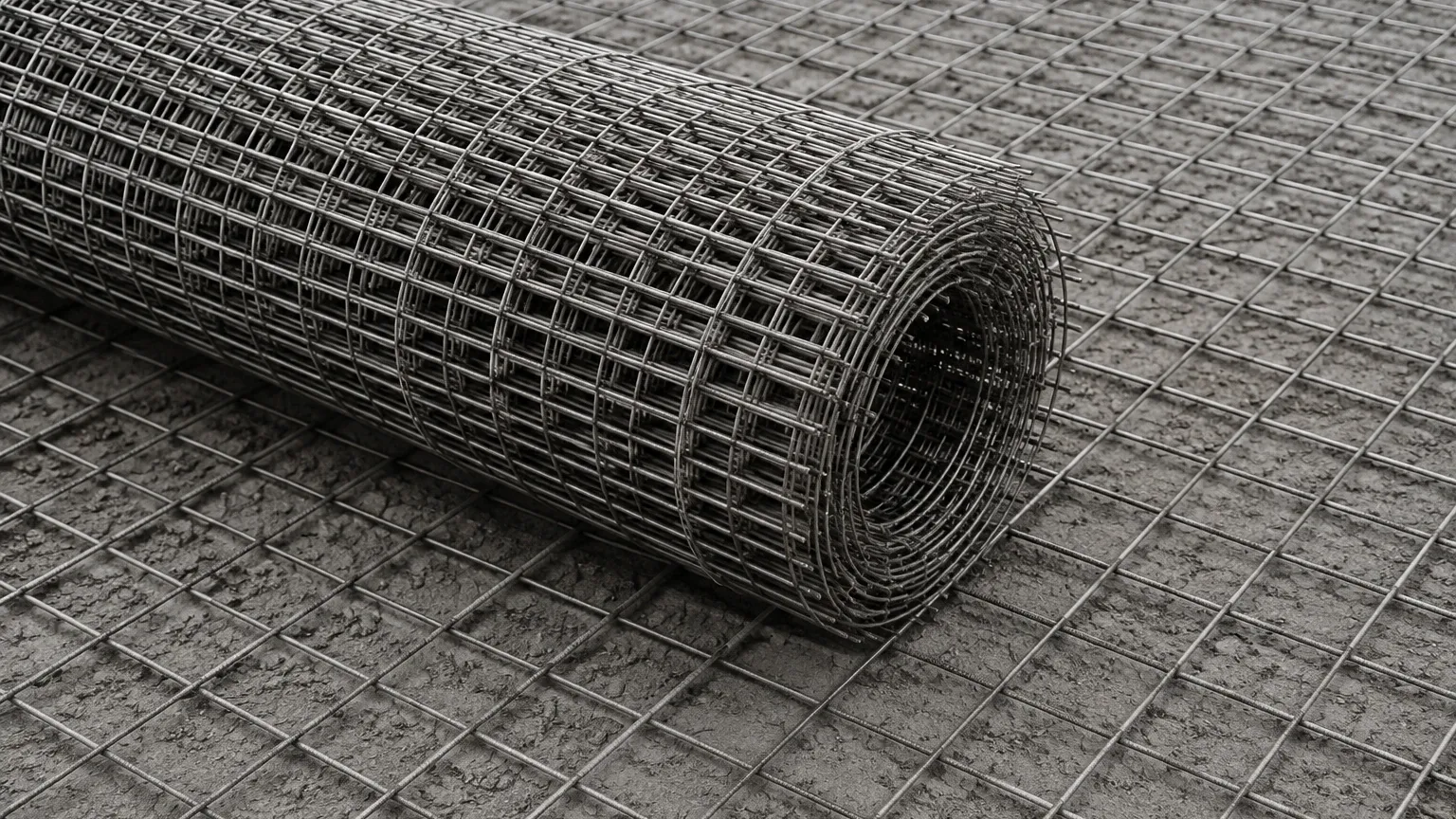
Woven Wire Mesh is produced by weaving individual metallic wires over and under one another to create a stable, uniform grid. Unlike welded wire reinforcement (WWR), which is fused at the intersections, woven mesh relies on the mechanical tension and friction of the weave to maintain its structure. This characteristic provides a degree of flexibility and a specific surface texture that can be advantageous in specialized concrete applications.
In concrete engineering, woven mesh is typically utilized in three primary capacities:
1. Micro-Reinforcement: Providing secondary reinforcement in thin-wall concrete elements, such as Glass Fiber Reinforced Concrete (GFRC) or ultra-high-performance concrete (UHPC), where traditional rebar is too bulky.
2. Crack Control: Distributing shrinkage stresses more evenly across the surface of a slab or decorative overlay to prevent the formation of large, structural fissures.
3. Architectural and Functional Facades: Acting as a protective or aesthetic layer that is either embedded near the surface or used as a permanent formwork that remains visible.
Material Selection: The Case for Stainless Steel (SS304 and SS316L)
The primary challenge for any metal embedded in concrete is corrosion. While concrete provides a naturally alkaline environment that protects steel (passivation), this protection can be compromised by carbonation or the ingress of chlorides (common in coastal areas or environments using de-icing salts). Once corrosion begins, the resulting rust occupies a larger volume than the original steel, leading to internal pressure, cracking, and eventually "concrete cancer" or spalling.
For critical infrastructure and high-end architectural projects, Plain, twill and dutch woven wire mesh in SS304/316L — rolls, cut mesh and framed panels. Send mesh count or micron target for a technical quote. is the preferred solution.
* Grade 304 Stainless Steel: Offers excellent resistance to oxidation and is suitable for most indoor or non-coastal outdoor applications. It provides the necessary tensile strength and durability for standard reinforcement needs.
* Grade 316L Stainless Steel: Contains molybdenum, which significantly enhances resistance to pitting and crevice corrosion in chloride-rich environments. The "L" denotes low carbon content, which is vital if the mesh requires welding during the fabrication of framed panels, as it prevents carbide precipitation.
Technical Specifications: Mesh Count, Wire Diameter, and Weave Type
When specifying woven wire mesh for concrete, engineers must balance the aperture size (the opening between wires) with the aggregate size used in the concrete mix. If the mesh is too fine, it can act as a filter, preventing the cement paste and fine aggregates from passing through, which leads to voids and weak spots (honeycombing).
Mesh Count and Aperture
The mesh count refers to the number of wires per linear inch. For concrete reinforcement, a lower mesh count with a larger aperture and thicker wire diameter is generally preferred to allow for aggregate interlock. However, for fine-grained mortars or GFRC, a higher mesh count may be used to provide a dense network of reinforcement near the surface.
Wire Diameter
The wire diameter directly impacts the tensile strength of the mesh and the overall thickness of the reinforced layer. In industrial applications, using a heavier wire gauge ensures that the mesh can withstand the mechanical stresses of the concrete pouring process without deforming or shifting.
Weave Types
* Plain Weave: The most common configuration where each warp wire crosses alternately over and under each shute wire. It offers the most consistent aperture size and is ideal for general reinforcement.
* Twill Weave: Each warp and shute wire passes over two and under two successive wires. This weave is more flexible than plain weave and can be used when the mesh needs to conform to complex, curved concrete forms.
* Dutch Weave: Primarily used for filtration, this weave features a higher density of wires in one direction. In concrete, it may be used for specialized drainage layers or as a fine-grit filter within a permeable concrete system.
Engineering Considerations for Concrete Reinforcement
Integrating woven wire mesh for concrete involves more than simply placing the material in the formwork. Several engineering factors must be addressed to ensure the composite material performs as intended.
1. Bonding and Interlock
The effectiveness of the reinforcement depends on the bond between the concrete and the wire surface. Woven mesh provides a mechanical interlock due to the "crimp" in the wires. The undulations of the weave create a textured surface area that increases the friction and adhesion of the cement paste compared to smooth, cold-drawn wire.
2. Thermal Expansion
One of the reasons stainless steel is compatible with concrete is that its coefficient of thermal expansion is relatively close to that of concrete. This minimizes internal stresses during temperature fluctuations, which is particularly important for outdoor structures or industrial floors subjected to thermal cycling.
3. Placement and Cover
To protect the mesh and ensure it contributes to the structural integrity, it must be placed at the correct depth. In thin-set applications, the "cover" (the distance between the mesh and the concrete surface) is minimal. Using stainless steel allows for a reduced cover compared to carbon steel, enabling the design of thinner, lighter concrete elements without the risk of surface staining from rust.
Specialized Applications: Filtration and Drainage
Beyond reinforcement, woven wire mesh serves a critical role in the filtration systems associated with concrete infrastructure. In water treatment plants, chemical processing facilities, and drainage systems, stainless steel mesh is often integrated into concrete basins or channels.
* Debris Screening: Coarse woven mesh is used to prevent large particles from entering concrete-lined intake systems.
* Permeable Concrete Systems: In sustainable urban drainage systems (SuDS), fine woven mesh can be used as a separation layer between different grades of aggregate or as a filter to capture sediment while allowing water to pass through the concrete structure.
Selection Guide: Confirming Project Requirements
Before purchasing industrial filters or mesh for concrete projects, procurement teams and engineers should confirm the following technical details to ensure the material is fit for purpose:
1. Environmental Exposure: Will the concrete be exposed to saltwater, chemical runoff, or high humidity? This determines whether SS304 or SS316L is required.
2. Mechanical Loading: What are the anticipated tensile and shear stresses? This dictates the required wire diameter and mesh density.
3. Compatibility with Aggregate: Does the aperture size allow for the free flow of the specific concrete mix being used? A general rule is that the aperture should be at least 2-3 times the size of the largest aggregate particle for structural pours.
4. Form Factor: Is the mesh required in bulk rolls for large-scale slab work, or as precision-cut, framed panels for architectural facades?
The Total Cost of Ownership (TCO) Perspective
While the initial cost of stainless steel woven wire mesh for concrete is higher than galvanized or carbon steel alternatives, the total cost of ownership is often lower when considering the entire lifecycle of the structure. The elimination of future repair costs associated with corrosion-induced spalling, combined with the extended service life of the asset, makes stainless steel a cost-effective choice for industrial and high-consequence infrastructure.
Furthermore, the precision of Kaifil’s manufacturing process ensures that the mesh arrives with consistent mechanical properties and dimensional accuracy. This reduces installation time and minimizes material waste on-site, contributing to overall project efficiency.
Conclusion
Woven wire mesh is a versatile and technically robust material that addresses many of the challenges inherent in modern concrete engineering. Whether used to enhance the durability of a structural slab, provide crack control in a decorative overlay, or serve as a high-precision filter within a concrete-lined industrial system, the choice of material and weave configuration is paramount.
By selecting high-quality stainless steel mesh and adhering to rigorous engineering standards, project teams can ensure that their concrete structures remain durable, functional, and aesthetically sound for decades. For engineers seeking to optimize their filtration or reinforcement systems, understanding the nuances of mesh count, wire gauge, and alloy selection is the first step toward a successful installation.
