


Magnetic Oil Filtration
In industrial lubrication and hydraulic systems, the presence of particulate contamination is the primary driver of component wear and system failure. While traditional barrier filtration methods—such as those utilizing stainless steel wire mesh or cellulose media—are highly effective at removing particles based on size, they often face challenges with sub-micron ferrous debris. Magnetic oil filtration serves as a critical technological supplement, specifically designed to target and remove iron and steel particles that are often small enough to pass through standard filter pores. By leveraging high-intensity magnetic fields, these systems capture wear-inducing contaminants without restricting fluid flow, providing a robust defense for high-precision industrial machinery.
Understanding the Role of Magnetic Oil Filtration in Industrial Systems
Magnetic oil filtration is not intended to replace mechanical filtration but rather to enhance the overall cleanliness of the fluid. In any system involving moving metal parts—such as gearboxes, hydraulic pumps, and turbines—frictional wear generates fine ferrous particles. These particles are often harder than the surfaces they originated from due to work-hardening during the wear process. If left in circulation, they act as grinding paste, accelerating the degradation of seals, bearings, and valves.
Unlike conventional barrier filters that rely on a physical mesh to trap particles, magnetic filters utilize magnetic flux to attract and hold ferromagnetic contaminants. This is particularly advantageous for capturing "silt-sized" particles (typically under 5 microns) which are often responsible for the majority of abrasive wear in high-pressure hydraulic systems. By integrating magnetic elements into the filtration circuit, engineers can significantly reduce the load on primary filter elements, extending their service life and maintaining lower ISO cleanliness codes.
The Physics of Magnetic Capture: Flux, Gradient, and Force
The effectiveness of magnetic oil filtration depends on three primary factors: the magnetic flux density, the magnetic gradient, and the residence time of the fluid within the magnetic field.
1. Magnetic Flux Density: Measured in Gauss or Tesla, this represents the strength of the magnetic field. High-intensity neodymium (rare earth) magnets are typically used in industrial applications to provide the necessary force to pull particles out of a moving oil stream.
2. Magnetic Gradient: The rate of change of the magnetic field strength over a distance. A high gradient is essential because the magnetic force exerted on a particle is proportional to both the field strength and the gradient. Sharp edges or specialized pole pieces in the filter design help concentrate the magnetic field, creating high-gradient zones that maximize capture efficiency.
3. Residence Time: For a particle to be captured, the magnetic force must overcome the hydrodynamic drag forces of the flowing oil. Slower flow rates or larger filter housings increase the time the oil spends in the magnetic field, allowing even the smallest particles to be successfully diverted to the magnetic surface.
Integrating Magnetic Filtration with Stainless Steel Mesh Solutions
For comprehensive fluid conditioning, the most effective strategy involves a multi-stage approach. Kaifil specializes in manufacturing precision stainless steel filtration components that serve as the backbone of industrial systems. When magnetic filtration is integrated with these high-performance Main Page solutions, the result is a highly resilient filtration architecture.
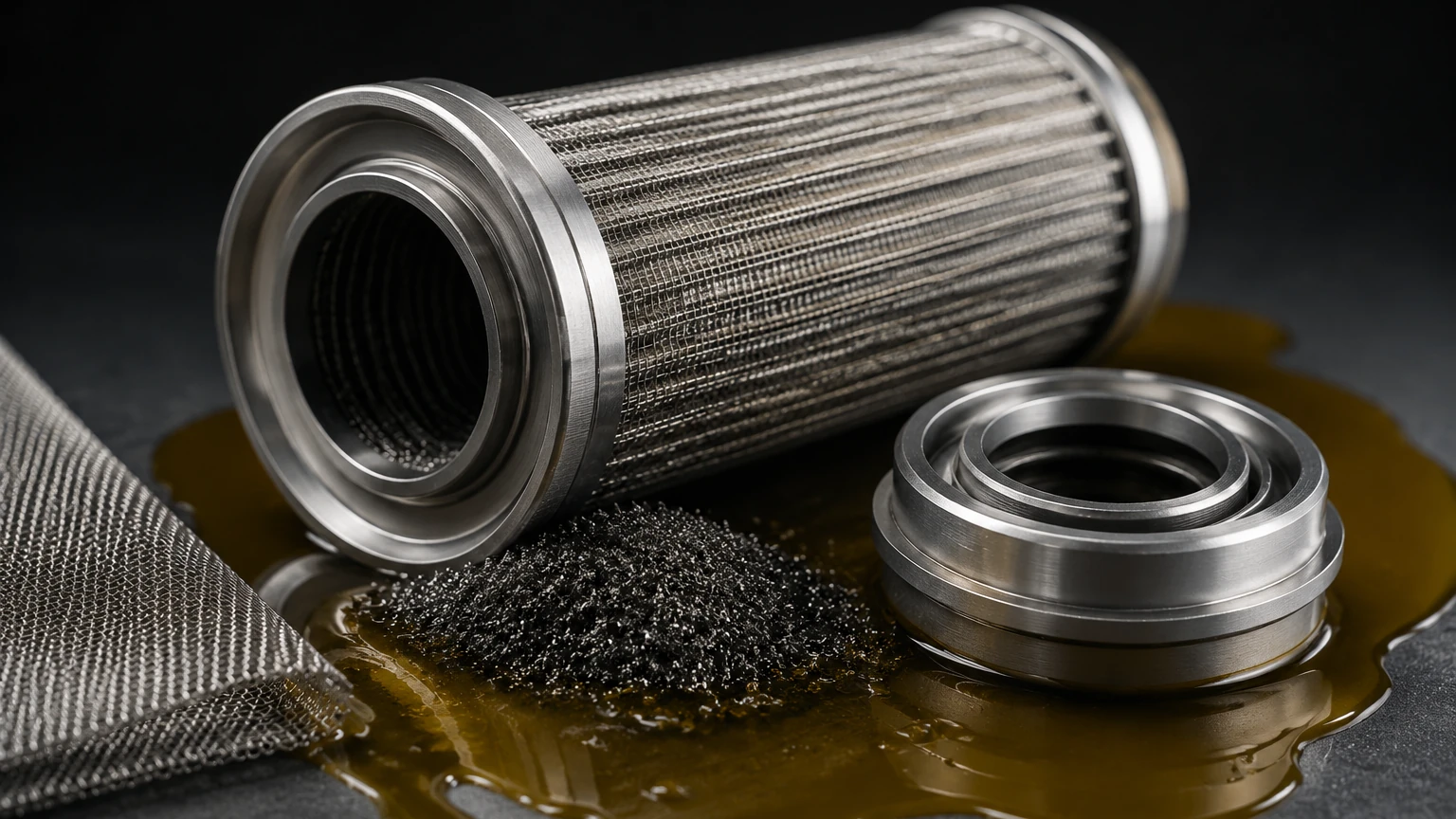
Stainless steel wire mesh filters provide a fixed pore size, ensuring that no particle above a specific micron rating can pass through. This is vital for capturing non-ferrous contaminants like brass, aluminum, and silica. When a magnetic core is added to the center of a stainless steel filter cartridge, it captures the fine ferrous dust that might otherwise migrate through the mesh. This synergy ensures that the mechanical filter does not become prematurely blinded by fine metallic silt, preserving the design pressure drop (ΔP) and reducing the frequency of filter replacements.
Engineering Selection Criteria: Gauss Rating and Flow Dynamics
When selecting or designing a magnetic oil filtration system, several engineering parameters must be evaluated to ensure performance matches the application requirements:
* Magnetic Intensity (Gauss): Standard ceramic magnets may offer 2,000 to 4,000 Gauss, which is often insufficient for high-velocity oil streams. Industrial-grade rare earth magnets can reach 10,000 to 12,000 Gauss, providing the necessary force to capture particles in high-viscosity lubricants.
* Fluid Viscosity: Higher viscosity oils exert more drag on particles. If the oil is thick (e.g., ISO VG 320 gear oil), a stronger magnetic field or a larger surface area is required to overcome the fluid's resistance to particle movement.
* Operating Temperature: All magnets have a maximum operating temperature. Standard neodymium magnets may begin to lose their magnetic properties above 80°C (176°F). For high-temperature applications, such as those found in certain chemical processes or heavy engine lubrication, specialized high-temperature grades (such as Samarium Cobalt) must be specified.
* Contamination Loading: The design must account for the volume of ferrous debris expected. If the magnetic surface becomes fully saturated with particles, its efficiency drops, and there is a risk of the captured debris being "washed off" back into the system during flow surges.
Performance Advantages: Extending Component Life and Oil Longevity
The implementation of magnetic oil filtration offers several quantifiable benefits for industrial operations. The most immediate impact is the reduction in the "chain reaction of wear." By removing the smallest abrasive particles, the rate of secondary wear is drastically slowed. This translates to longer intervals between overhauls for pumps and motors.
Furthermore, magnetic filtration aids in preserving the chemical stability of the oil. Ferrous particles act as catalysts for oil oxidation. When iron fines are suspended in hot oil, they accelerate the breakdown of additives and the formation of sludge and varnish. By removing these catalysts as soon as they are generated, magnetic filters help maintain the oil's TBN (Total Base Number) and viscosity profile, effectively extending the time between oil changes.
Customization and Material Compatibility in Harsh Environments
Industrial environments often present challenges such as corrosive fluids, high pressures, and extreme vibrations. Customization is therefore essential for successful magnetic filtration integration. At Kaifil, the focus is on providing filtration solutions that are tailored to these demanding conditions.
The housing and support structures for magnetic filters are typically constructed from 304 or 316L stainless steel. These materials offer excellent corrosion resistance and structural integrity. In many OEM applications, magnetic rods or "plugs" are designed to be inserted directly into existing filter housings or reservoirs. Custom-designed manifolds can also be engineered to ensure that the magnetic elements are positioned in the areas of highest particle concentration, such as the return line of a hydraulic circuit or the sump of a large gearbox.
Maintenance and Cleaning Procedures for Magnetic Assemblies
One of the primary advantages of magnetic oil filtration is that it is a "permanent" technology. Unlike disposable pleated paper elements, magnetic cores are reusable and do not require replacement unless they suffer physical damage or exceed their temperature limits. However, they do require regular cleaning to maintain efficiency.
Maintenance protocols typically involve:
1. Isolation and Depressurization: Ensuring the filter housing is safe to open.
2. Extraction: Removing the magnetic assembly from the fluid stream.
3. Wiping/Cleaning: Because the magnetic force is strong, particles can be difficult to remove by hand. Many industrial designs include a non-magnetic sleeve. When the magnet is pulled out of the sleeve, the ferrous debris falls off easily, allowing for quick and efficient cleaning.
4. Inspection: Examining the captured debris can provide valuable diagnostic information. A sudden increase in the volume of ferrous particles can serve as an early warning sign of a failing bearing or gear, allowing for predictive maintenance before a catastrophic failure occurs.
Conclusion: The Strategic Value of Magnetic Filtration
In the context of modern industrial maintenance, magnetic oil filtration represents a high-return investment. By specifically targeting the most damaging form of contamination—ferrous wear particles—it protects high-value assets and optimizes the performance of traditional barrier filters. Whether used as a standalone solution in a reservoir or integrated into a complex stainless steel filter assembly, magnetic technology provides a level of fluid cleanliness that is difficult to achieve through mechanical means alone. For engineers and purchasing teams, selecting the right combination of magnetic strength, material durability, and customized design is the key to achieving long-term system reliability and reducing the total cost of ownership.
