


Sintered Porous Metal
In the landscape of industrial filtration and fluid control, sintered porous metal stands as a critical material for applications requiring high mechanical strength, thermal stability, and precise permeability. Unlike traditional fabric or polymer filters, sintered metal components are engineered to withstand extreme environments where pressure, temperature, and chemical exposure would otherwise cause structural failure. For engineers and procurement specialists, understanding the technical nuances of these materials is essential for optimizing system performance and ensuring long-term reliability.
As a professional manufacturer of custom stainless steel filtration solutions, Kaifil provides a range of sintered products designed for the most demanding industrial sectors. By integrating advanced manufacturing techniques with deep engineering expertise, the Main Page of our technical resource center offers insights into how these components are tailored to meet specific filtration requirements.
The Manufacturing Process of Sintered Porous Metal
Sintering is a metallurgical process where metal powders or layers of wire mesh are heated in a controlled-atmosphere furnace to a temperature just below their melting point. This thermal energy causes the particles to bond at their contact points through a process known as solid-state diffusion. The result is a rigid, porous structure with high mechanical integrity.
There are two primary forms of sintered porous metal used in industrial filtration:
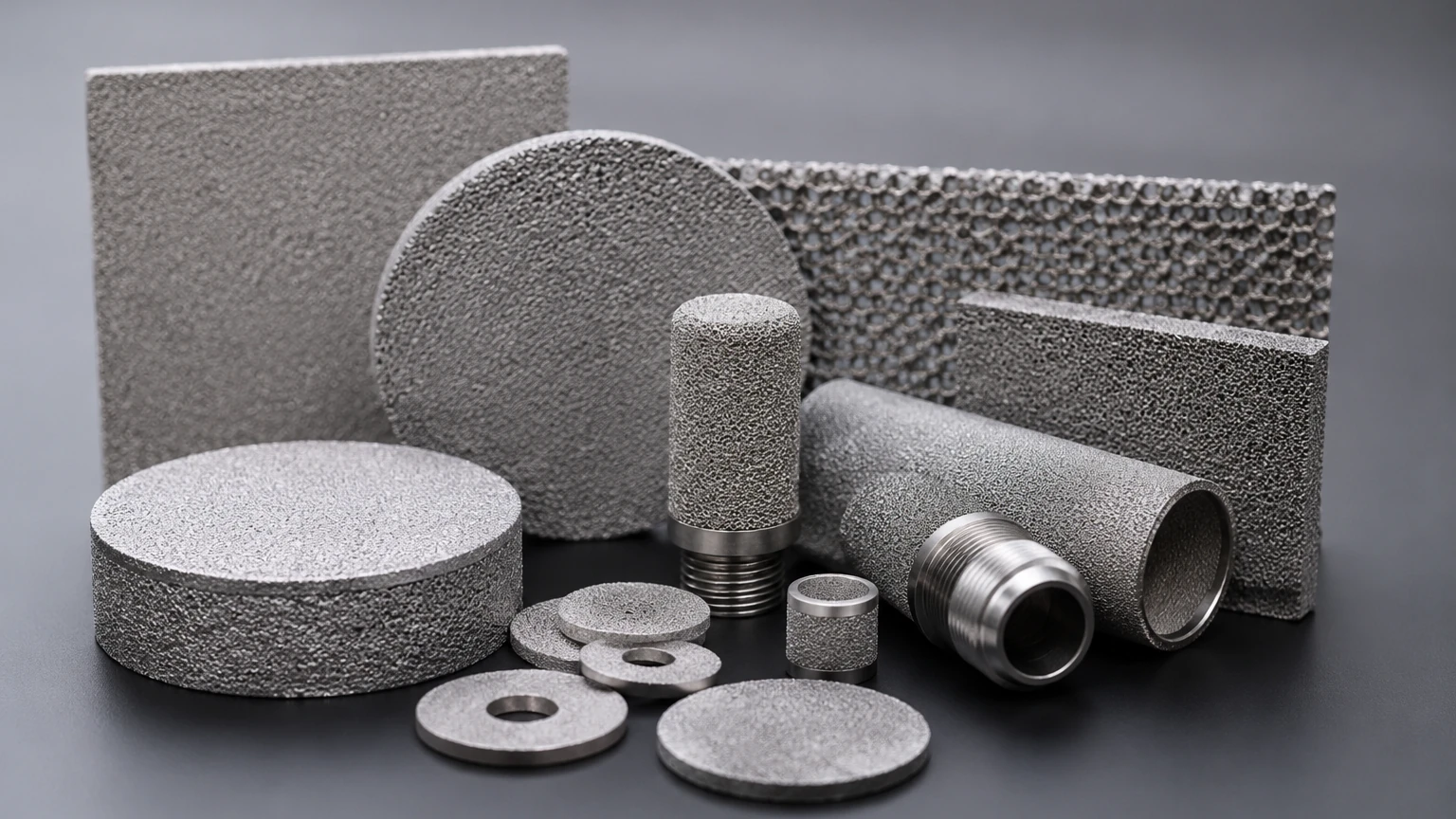
1. Sintered Metal Powder: This involves pressing spherical or irregular metal powders into a mold and then sintering them. The resulting structure features a tortuous path of interconnected pores, which provides excellent depth filtration and high dirt-holding capacity.
2. Sintered Wire Mesh: This involves layering multiple sheets of stainless steel wire mesh—often including a fine filtration layer, a protective layer, and several support layers—and sintering them together. This creates a robust, pleated, or flat filter medium with precise pore sizes and high flow rates.
For engineers, the choice between powder-based and mesh-based sintered metal often depends on the specific balance required between filtration accuracy, pressure drop, and the physical space available for the filter element.
Key Performance Characteristics for Industrial Applications
Sintered porous metal is selected for industrial processes primarily due to its durability and predictable performance. When evaluating these materials for a project, several technical characteristics must be considered:
Thermal and Chemical Resistance
Stainless steel sintered components, particularly those made from 316L, offer exceptional resistance to oxidation and corrosion. They can typically operate in temperatures ranging from cryogenic levels up to 600°C (1,112°F) in continuous service, depending on the alloy and atmospheric conditions. This makes them indispensable in chemical processing and steam filtration.
Structural Integrity
The metallurgical bonding achieved during sintering ensures that the medium does not migrate. Unlike fiber-based filters that may shed particles into the filtrate under high pressure, sintered porous metal remains stable. It can withstand high differential pressures, often exceeding several hundred PSI, without deforming or losing its pore structure.
Cleanability and Reusability
One of the most significant advantages of sintered metal is its ability to be cleaned and reused. Depending on the contaminant, filters can be restored through backwashing, ultrasonic cleaning, or chemical solvent baths. This capability significantly reduces the total cost of ownership compared to disposable filter elements.
Material Selection and Compatibility
The performance of a sintered porous metal filter is heavily influenced by the alloy used in its construction. While stainless steel is the industry standard, specific applications may require specialized materials:
* 316L Stainless Steel: The most common choice due to its excellent corrosion resistance and mechanical properties. It is widely used in the food and beverage, pharmaceutical, and general chemical industries.
* 304 Stainless Steel: Often used in less corrosive environments where cost-effectiveness is a priority.
* Nickel-Based Alloys (e.g., Hastelloy, Inconel): Reserved for highly aggressive chemical environments or extreme high-temperature applications where standard stainless steel would succumb to pitting or oxidation.
When selecting a material, engineers must confirm compatibility with the fluid being filtered, the cleaning agents used during maintenance, and the potential for galvanic corrosion if the filter is housed in a housing of a different metal.
Engineering Evaluation: Pore Size and Filtration Efficiency
Defining the filtration efficiency of sintered porous metal requires a technical understanding of pore size distribution. In the industry, ratings are typically categorized as either "nominal" or "absolute."
* Nominal Rating: Refers to the ability of the filter to retain a certain percentage (usually 60% to 90%) of particles of a specific size. This is often used for general-purpose filtration.
* Absolute Rating: Refers to the diameter of the largest spherical particle that will pass through the filter under specific test conditions. For critical applications in pharmaceuticals or aerospace, an absolute rating is mandatory to ensure process safety.
The Bubble Point Test
To verify the integrity and pore size of a sintered element, manufacturers use the Bubble Point Test. By submerging the filter in a liquid and gradually increasing air pressure, the pressure at which the first bubble appears (the bubble point) can be used to calculate the maximum pore size using the Cantor-Laplace equation. This non-destructive test is a standard quality control measure at Kaifil to ensure that every custom component meets the specified micron rating.
Common Risks and Failure Modes
Despite their robustness, sintered porous metal systems are not immune to failure if improperly specified or maintained. Engineers should be aware of the following risks:
1. Premature Clogging (Blinding): If the pore size is too small for the contaminant load, or if the fluid contains deformable particles (like certain polymers or oils), the filter may clog rapidly. This leads to frequent cleaning cycles and increased downtime.
2. Mechanical Fatigue: In systems with high-frequency pressure pulsations (such as hydraulic systems), the sintered structure can eventually develop micro-cracks. Selecting the appropriate support layers in a sintered mesh laminate can mitigate this risk.
3. Improper Cleaning: Using aggressive chemicals that are incompatible with the alloy, or failing to completely remove contaminants during an ultrasonic bath, can lead to permanent loss of permeability or localized corrosion.
Customization and OEM Solutions
Industrial filtration is rarely a one-size-fits-all field. Sintered porous metal components are highly customizable to fit specific housing designs and flow requirements. At Kaifil, we work closely with engineering teams to develop bespoke solutions, including:
* Custom Geometries: Beyond standard cylindrical cartridges, we produce sintered discs, plates, cones, and complex manifold assemblies.
* Graded Porosity: For specific depth filtration needs, we can manufacture components with varying porosity levels across the cross-section to optimize dirt-holding capacity and flow distribution.
* Integrated Fittings: Sintered elements can be welded to various end-fittings, such as NPT threads, flanges, or quick-connect couplings, ensuring a leak-proof integration into the existing system.
Total Cost of Ownership and Maintenance
While the initial purchase price of a sintered porous metal filter is higher than that of a polymer or paper equivalent, the total cost of ownership (TCO) is often lower in industrial settings. The calculation of TCO should include:
* Replacement Frequency: Sintered filters can last for years, whereas disposables may need replacement weekly or even daily.
* Disposal Costs: Reducing the volume of waste generated by used filter cartridges is both a cost-saving measure and an environmental benefit.
* Process Uptime: The ability to perform in-situ backwashing allows for longer continuous operation without breaking the system seal for filter changes.
Maintenance cycles should be determined by monitoring the differential pressure (ΔP) across the filter. Once the ΔP reaches a predetermined threshold, the cleaning protocol should be initiated to prevent permanent compaction of contaminants within the pore structure.
Conclusion
Sintered porous metal represents a pinnacle of engineering in the filtration industry, offering a unique combination of strength, precision, and longevity. Whether used for gas sparging, flame arrestors, or high-pressure hydraulic filtration, these components provide the reliability that modern industrial processes demand. By focusing on material science, precise pore control, and robust manufacturing, Kaifil ensures that every filtration challenge is met with a high-performance solution.
For more information on selecting the right filtration media or to discuss custom specifications for your next project, please visit the Main Page to explore our full range of capabilities and technical support services.
