


Filtro Acqua Autopulente
In industrial environments where process continuity is paramount, the management of suspended solids in water systems represents a significant engineering challenge. Manual filtration systems, while effective for low-load applications, often become a bottleneck in high-volume or high-debris scenarios due to the labor-intensive nature of cleaning and the associated downtime. The transition to a filtro acqua autopulente (self-cleaning water filter) addresses these inefficiencies by automating the debris removal process, ensuring a constant flow and protecting downstream equipment without manual intervention.
For engineers and procurement specialists, selecting the right self-cleaning technology requires a deep understanding of fluid dynamics, material science, and the specific mechanical triggers that initiate the cleaning cycle. As a specialized manufacturer of stainless steel filtration solutions, Kaifil provides the technical framework necessary to integrate these systems into complex industrial workflows, ranging from cooling water circuits to pharmaceutical pre-filtration.
Understanding the Mechanism of a Filtro Acqua Autopulente
The primary function of a self-cleaning filter is to remove particulate matter from a liquid stream while maintaining a continuous flow. Unlike traditional basket strainers or cartridge filters that require the system to be shut down for element replacement, a self-cleaning system utilizes an internal mechanism to clear the filter medium while the process remains online.
Differential Pressure Triggers
Most industrial self-cleaning filters operate based on differential pressure (DP). As contaminants accumulate on the surface of the filter element—typically a stainless steel wedge wire or sintered mesh—the open area decreases, causing a pressure drop between the inlet and the outlet. Once a pre-set DP threshold is reached, the system’s sensors signal the controller to initiate the cleaning cycle.
Backwashing vs. Mechanical Cleaning
There are two primary methods used in these systems:
1. Backwashing: This method utilizes a portion of the filtered fluid (or an external clean fluid source) to flow in the reverse direction through the filter medium. This reverse flow dislodges particles trapped on the screen and flushes them out through a dedicated drain valve.
2. Mechanical Scraping: In applications involving viscous fluids or sticky contaminants, a mechanical scraper or brush moves across the surface of the filter element. This physically displaces the solids, which then settle into a collection chamber at the bottom of the housing to be purged.
Engineering Considerations for Industrial Water Filtration
When designing or specifying a filtro acqua autopulente, the choice of filter media is the most critical factor in determining the system's longevity and efficiency. Industrial applications demand materials that can withstand corrosive environments, high pressures, and thermal cycling.
Stainless Steel: The Standard for Durability
At Kaifil, we emphasize the use of high-grade stainless steel, such as AISI 304 or 316L, for both the filter housing and the internal elements. Stainless steel offers superior resistance to oxidation and chemical attack, which is essential in sectors like chemical processing and wastewater treatment.
Wedge Wire vs. Perforated Plate
* Wedge Wire (V-Wire): This is often the preferred choice for self-cleaning systems. The V-shaped profile of the wire creates a slot that widens inwardly. This design ensures that any particle capable of passing through the narrowest point of the slot will continue through without getting wedged, significantly reducing the risk of permanent clogging.
* Sintered Metal Mesh: For applications requiring high precision (down to 1-5 microns), multi-layer sintered mesh provides excellent structural integrity and a uniform pore distribution. This is particularly useful in pharmaceutical and fine chemical applications where filtration accuracy is non-negotiable.
Selection Criteria for Engineers and Purchasing Teams
Selecting a self-cleaning filter is not a "one-size-fits-all" process. To ensure optimal performance and a high return on investment, several technical parameters must be evaluated during the procurement phase.
1. Micron Rating and Filtration Efficiency
The micron rating defines the size of the smallest particle the filter is designed to capture. However, engineers must distinguish between nominal and absolute ratings. In a self-cleaning context, choosing too fine a mesh can lead to frequent cleaning cycles and excessive water waste, while too coarse a mesh may fail to protect downstream components like spray nozzles or heat exchangers.
2. Flow Rate and Velocity
The system must be sized to handle the maximum peak flow rate without exceeding the recommended velocity for the filter medium. High velocities can force soft contaminants through the mesh or cause premature wear on the mechanical cleaning components.
3. Fluid Characteristics
Beyond just water, many industrial processes involve fluids with varying viscosities, temperatures, and chemical compositions. A filtro acqua autopulente intended for a cooling tower will have different seal and gasket requirements than one intended for a high-temperature oil filtration system.
4. Waste Management and Purge Volume
Every cleaning cycle results in a "purge"—a volume of fluid lost to the drain along with the contaminants. In water-scarce regions or processes involving expensive fluids, minimizing the purge volume is a key engineering goal. Advanced PLC-controlled systems allow for the fine-tuning of purge durations to balance cleanliness with fluid conservation.
Applications Across Demanding Industrial Sectors
The versatility of stainless steel self-cleaning filters allows them to be deployed across a wide spectrum of industries. Kaifil’s expertise in custom filtration components ensures that these systems meet the specific regulatory and operational standards of each sector.
Food and Beverage
In the food industry, hygiene is the top priority. Self-cleaning filters used here must feature sanitary finishes and be compatible with Clean-in-Place (CIP) protocols. They are commonly used to filter process water, ingredients, and even final products like juices or syrups to remove pips, skins, or accidental contaminants.
Chemical and Petrochemical Processing
These environments often involve aggressive chemicals and high pressures. A stainless steel filtro acqua autopulente provides the necessary corrosion resistance to handle acids, bases, and solvents. They protect sensitive equipment like high-pressure pumps and reactor vessels from particulate damage.
Power Generation and Cooling Towers
Cooling water systems are prone to biological growth and scale. If left unfiltered, these solids can coat heat exchanger tubes, drastically reducing thermal efficiency. Automated filtration ensures that the cooling water remains within specifications, extending the intervals between manual heat exchanger cleanings.
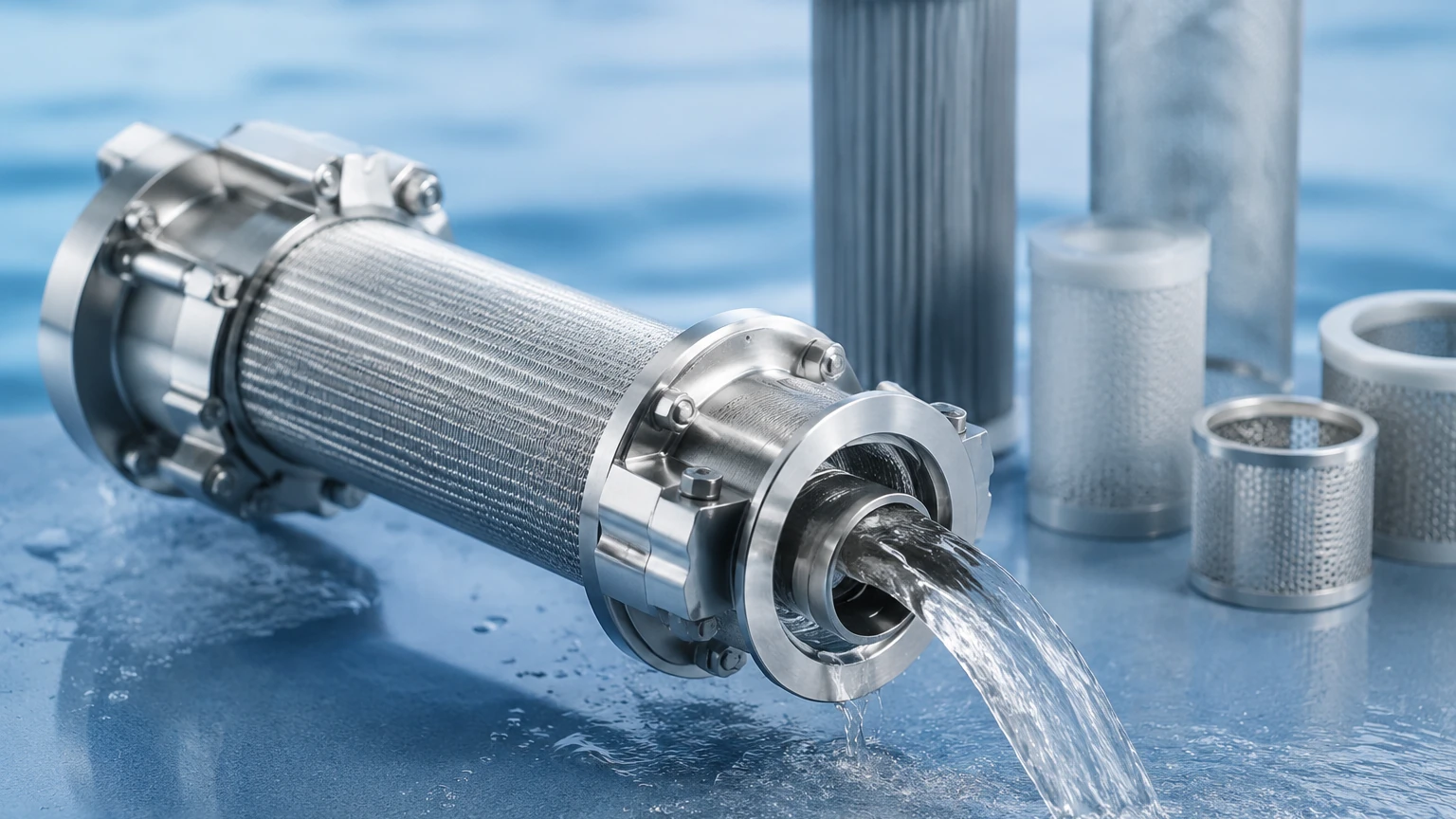
Customization and OEM Integration with Kaifil
One of the primary challenges for system integrators is fitting a filtration unit into an existing plant layout. Standard off-the-shelf units may not align with existing pipework or may lack the necessary certifications for specific regions.
As a dedicated manufacturer, Kaifil specializes in providing customized filtration solutions. This includes:
* Custom Housing Dimensions: Tailoring the inlet/outlet configurations (flanged, threaded, or tri-clamp) to match the facility's piping.
* Material Specialization: Offering exotic alloys or specific grades of stainless steel for highly corrosive environments.
* Internal Component Design: Engineering custom filter cartridges and wire mesh elements that provide the exact surface area and strength required for high-load applications.
By visiting our Main Page, technical teams can explore the range of manufacturing capabilities we offer, from precision metal filter components to complete OEM filtration assemblies. Our focus is on providing reliable, high-performance components that integrate seamlessly into larger industrial systems.
Maintenance, Performance, and Total Cost of Ownership
While the initial capital expenditure for a filtro acqua autopulente is higher than that of a manual filter, the Total Cost of Ownership (TCO) is significantly lower in the long run.
Reduced Labor Costs
Manual cleaning requires staff to stop the process, open the filter housing, clean or replace the element, and restart the system. In many plants, this can take hours of labor per week. An automated system eliminates this requirement, allowing maintenance personnel to focus on higher-value tasks.
Extended Equipment Life
By providing a consistent level of filtration, self-cleaning systems protect downstream equipment from gradual erosion and clogging. This leads to fewer emergency repairs and extends the overall service life of pumps, valves, and instrumentation.
Replacement Cycles
Unlike disposable fabric or paper cartridges, the stainless steel elements in a self-cleaning filter are designed for years of service. Maintenance typically involves the periodic inspection of seals, O-rings, and the drive motor or pneumatic actuator. Because the filter medium is not replaced frequently, the environmental impact and the recurring cost of consumables are greatly reduced.
Conclusion: Making an Informed Decision
For industrial facilities looking to optimize their water management, the implementation of a filtro acqua autopulente is a strategic investment in process stability. By understanding the technical nuances of cleaning mechanisms, material selection, and flow dynamics, engineers can specify a system that not only meets current needs but also adapts to future operational demands.
When evaluating potential solutions, it is essential to partner with a manufacturer that understands the rigors of industrial filtration. Kaifil’s commitment to quality and precision engineering ensures that every component—from the smallest wire mesh screen to the largest filter cartridge—is built to perform in the most demanding environments.
Before finalizing a purchase, technical teams should confirm the compatibility of the filter materials with their process fluid, verify the required filtration accuracy, and consider the potential for future flow rate increases. With the right configuration, a self-cleaning filtration system becomes an invisible but vital part of a high-efficiency industrial operation.
