


Aquaculture Water Treatment Systems
In the modern aquaculture industry, maintaining optimal water quality is the most critical factor for biological health and operational profitability. As global demand for seafood increases, production methods have shifted toward high-density environments, such as Recirculating Aquaculture Systems (RAS) and intensive flow-through systems. These environments necessitate sophisticated aquaculture water treatment systems capable of managing high organic loads while maintaining precise environmental parameters. At the core of these systems lies mechanical filtration—a primary defense mechanism designed to remove suspended solids before they can degrade into harmful ammonia or provide a substrate for pathogenic growth.
For engineers and system designers, selecting the right filtration components is not merely a matter of choosing a micron rating. It requires a deep understanding of fluid dynamics, material science, and the specific biological requirements of the aquatic species being farmed. High-performance stainless steel filtration components, such as those detailed on the Kaifil Main Page, provide the durability and precision required for these demanding industrial applications.
The Role of Mechanical Filtration in Aquaculture Water Treatment Systems
Mechanical filtration serves as the first stage in any robust aquaculture water treatment process. Its primary objective is the removal of Total Suspended Solids (TSS), which include uneaten feed, fecal matter, and biofilm fragments. If left in the water column, these solids contribute to the biochemical oxygen demand (BOD) and can quickly overwhelm biological filters.
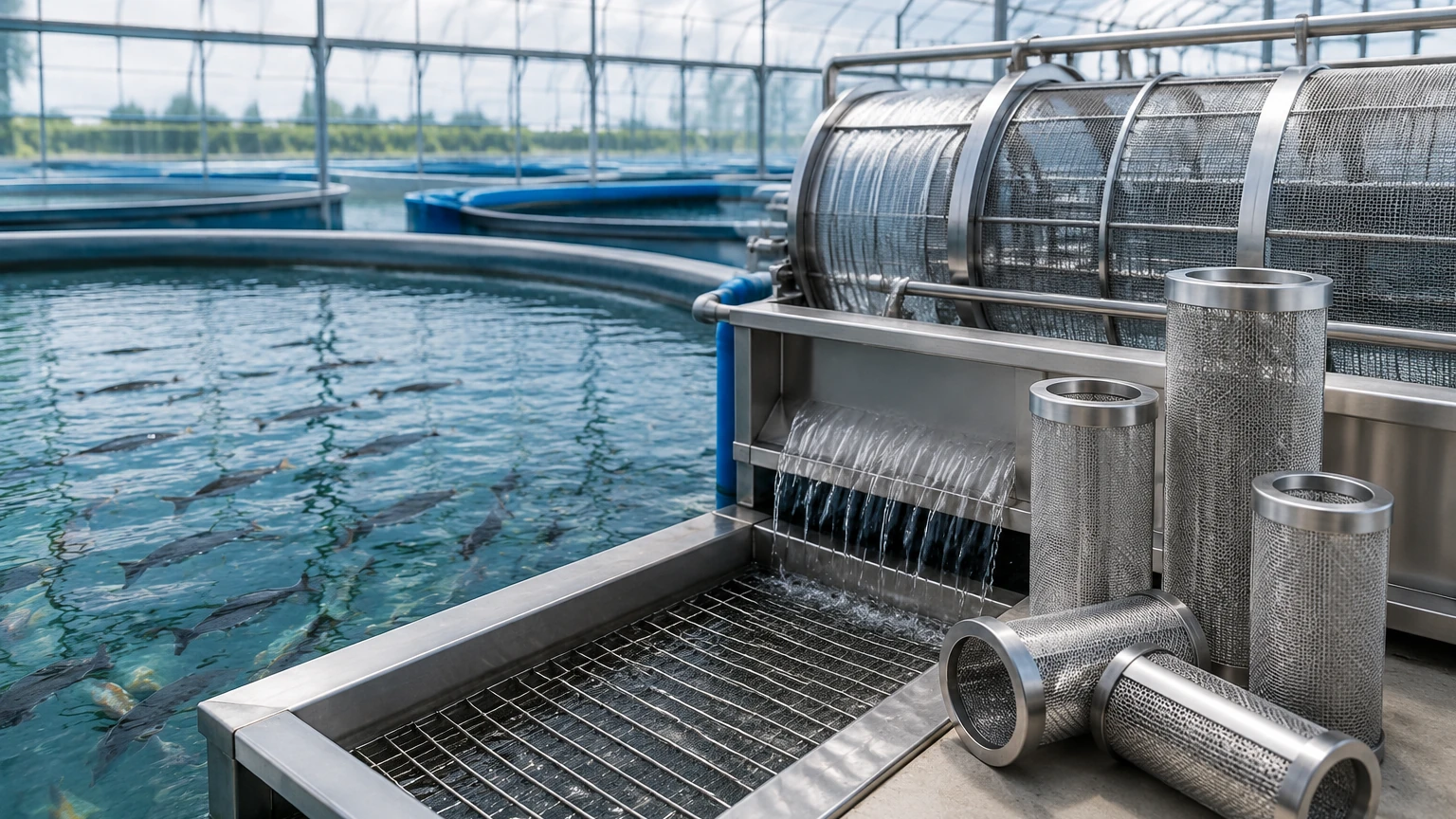
In aquaculture water treatment systems, mechanical filters are typically categorized by their ability to capture particles of specific sizes. While coarse filtration may target particles larger than 100 microns, fine filtration often requires precision down to 20 or 30 microns. Stainless steel wire mesh filters are particularly effective here because they offer a high percentage of open area, which translates to lower pressure drops and higher flow rates compared to synthetic media. Furthermore, the rigid structure of metal mesh ensures that pore sizes remain constant even under varying pressure, preventing "breakthrough" where particles are forced through the media as it becomes loaded.
Engineering Considerations for Material Selection
When designing components for aquaculture water treatment systems, material selection is a primary engineering concern. The environment is inherently corrosive, often involving high salinity, fluctuating pH levels, and the presence of cleaning chemicals or ozone.
1. Corrosion Resistance: For freshwater applications, Grade 304 stainless steel may suffice, but for marine or brackish water environments, Grade 316L is the industry standard. The addition of molybdenum in 316L provides superior resistance to pitting and crevice corrosion caused by chloride ions.
2. Structural Integrity: Unlike plastic or fabric mesh, stainless steel filter cartridges can withstand significant differential pressure ($ΔP$). This is vital in high-flow systems where a pump failure or sudden surge in organic load could cause softer materials to collapse or tear.
3. Biofouling Management: All aquaculture systems face the challenge of biofouling—the accumulation of microorganisms on surfaces. Stainless steel surfaces can be electropolished to a high degree of smoothness, which reduces the ability of bacteria to adhere and makes the cleaning process, whether via backwashing or ultrasonic cleaning, significantly more effective.
Optimizing Flow Rates and Filtration Efficiency
Efficiency in aquaculture water treatment systems is measured by the balance between filtration fineness and the energy required to move water through the system. Engineers must calculate the flux—the volume of water passing through a unit area of filter media over time.
Using precision-woven wire mesh allows for a predictable and repeatable flux. Because the wire diameter and weave pattern are controlled during manufacturing, the hydraulic resistance is known. In RAS applications, where water is recycled dozens of times per day, even a small reduction in pressure drop across the filter can lead to significant energy savings over the life of the system.
Furthermore, the geometry of the filter element—whether it is a cylindrical cartridge, a flat panel, or a pleated design—impacts the total surface area available for filtration. Pleated stainless steel elements are often preferred in compact aquaculture water treatment systems because they provide a much larger surface area within the same footprint, allowing for lower face velocities and longer intervals between cleaning cycles.
Customization and OEM Integration for System Designers
No two aquaculture operations are identical. A system designed for larval shrimp rearing has vastly different requirements than one designed for adult salmon grow-out. Consequently, off-the-shelf filtration solutions often fall short of specific performance targets.
Customization is a key part of the engineering process. This involves more than just sizing; it includes the design of custom end-caps, reinforced internal cores for high-pressure applications, and specialized mesh configurations (such as Dutch weaves for fine filtration or plain weaves for high-flow pre-filtration). For system integrators, partnering with a manufacturer that understands these nuances is essential. By integrating custom-engineered metal filters into their aquaculture water treatment systems, OEMs can guarantee higher reliability and lower maintenance requirements for the end-user.
Maintenance, Backwashing, and Total Cost of Ownership
While the initial capital expenditure (CAPEX) for stainless steel filtration components may be higher than for disposable or plastic alternatives, the total cost of ownership (TCO) is typically much lower. In industrial aquaculture, the cost of downtime and the labor required for frequent filter replacements can be prohibitive.
Stainless steel filters are designed for longevity. They are compatible with automated backwashing systems, where a reverse flow of water or air is used to dislodge accumulated solids. Because the media is rigid, it can withstand the mechanical stress of thousands of backwash cycles without losing its filtration characteristics.
Key maintenance considerations for engineers include:
* Cleaning Compatibility: Can the filter be cleaned in place (CIP)? Stainless steel is compatible with a wide range of chemical cleaners and high-temperature sterilization processes.
* Durability: Metal filters are resistant to abrasion from sand or other grit that may be present in source water, a common issue in coastal aquaculture water treatment systems.
* Sustainability: By eliminating the need for frequent replacement of disposable cartridges, stainless steel solutions reduce the waste stream of the facility, aligning with the sustainability goals of modern aquaculture.
Selecting the Right Filtration Partner
When evaluating components for aquaculture water treatment systems, purchasing teams and engineers should look for suppliers who provide detailed technical specifications and material certifications. Verification of the alloy grade, mesh count, and wire diameter is essential to ensure the component will perform as expected in a submerged, high-load environment.
As a specialized manufacturer, Kaifil provides the technical expertise required to navigate these choices. From initial design consultation to the production of precision metal filter components, the focus remains on delivering durability and filtration accuracy. For more information on the range of available filtration technologies and custom OEM capabilities, technical professionals are encouraged to visit the Main Page to explore specific product configurations.
Conclusion: The Future of Filtration in Aquaculture
As the aquaculture industry continues to move toward more closed-loop and intensive production models, the reliance on high-quality aquaculture water treatment systems will only grow. The ability to precisely control the aquatic environment starts with the effective removal of solids. By utilizing advanced stainless steel filtration media, operators can ensure clearer water, healthier stock, and a more resilient production process. Engineering decisions made today regarding material quality and filter design will directly impact the operational efficiency and sustainability of the aquaculture facilities of tomorrow.
