


Water Filtration Screens
In industrial environments, the integrity of fluid handling systems depends heavily on the efficiency of primary filtration components. Water filtration screens represent the first line of defense in protecting downstream equipment, ensuring process consistency, and maintaining the purity of water used in various applications. From cooling water loops and boiler feed systems to complex chemical processing and food production, these screens are engineered to remove suspended solids and particulate matter that could otherwise lead to mechanical wear, clogging, or product contamination.
Selecting the appropriate water filtration screens requires a deep understanding of fluid dynamics, material science, and the specific requirements of the application. For engineers and procurement teams, the goal is to balance filtration precision with operational longevity and cost-effectiveness. This guide examines the technical considerations, material choices, and engineering parameters essential for optimizing industrial water filtration.
The Critical Function of Water Filtration Screens in Industrial Processes
Industrial water systems often handle large volumes of fluid that may contain various contaminants, ranging from large debris in raw intake water to fine sand and scale in recirculating loops. Water filtration screens function by providing a physical barrier that intercepts particles larger than the screen's aperture while allowing the fluid to pass through with minimal resistance.
The role of these screens extends beyond simple debris removal. In high-pressure hydraulic systems, even microscopic particles can cause catastrophic pump failure. In the pharmaceutical and food industries, filtration screens must meet stringent hygiene standards to prevent bacterial growth and cross-contamination. By effectively managing the particle load, these components reduce the frequency of maintenance for secondary, finer filters and extend the service life of expensive machinery such as heat exchangers and high-precision nozzles.
Material Engineering: Selecting the Right Grade for Longevity
The environment in which water filtration screens operate determines the material requirements. While various polymers and alloys exist, stainless steel remains the industry standard for demanding B2B applications due to its mechanical strength, thermal stability, and corrosion resistance.
304 Stainless Steel
Grade 304 is the most common stainless steel used in filtration. It offers excellent durability and good corrosion resistance for standard industrial water applications. It is suitable for most freshwater filtration tasks where the chemical load is low and temperatures are moderate.
316 and 316L Stainless Steel
For more aggressive environments, such as those involving brackish water, high-salinity fluids, or chemical processing, 316 stainless steel is preferred. The addition of molybdenum enhances its resistance to pitting and crevice corrosion, particularly in chloride-rich environments. 316L (low carbon) is often specified for components that require welding, as it minimizes the risk of intergranular corrosion in the heat-affected zone.
Specialized Alloys
In extreme cases involving high temperatures or highly acidic/alkaline fluids, specialized alloys like Duplex stainless steel or Monel may be utilized. However, for the vast majority of industrial water filtration needs, 316L provides the optimal balance of performance and cost.
Engineering Parameters: Micron Rating, Open Area, and Flow Dynamics
When specifying water filtration screens, engineers must evaluate several interconnected technical parameters. A failure to align these factors can result in premature clogging, excessive pressure drops, or inadequate filtration.
Micron Rating and Filtration Accuracy
The micron rating defines the size of particles the screen is designed to trap. This can be expressed as "nominal" (an approximate value indicating the screen will trap most particles of that size) or "absolute" (a value indicating the screen will trap 100% of particles of that size). For industrial water filtration, the choice of micron rating must be based on the sensitivity of downstream equipment.
The Importance of Open Area
The "open area" is the ratio of the total area of the holes to the total area of the screen. A higher percentage of open area typically allows for higher flow rates and lower initial pressure drops. However, increasing the open area often requires thinner wires or larger apertures, which can compromise the mechanical strength of the screen. Engineering a screen involves finding the "sweet spot" where the structure is robust enough to withstand the system pressure while maintaining efficient flow.
Pressure Drop (ΔP)
Pressure drop is the difference in total pressure between two points of a fluid carrying network. As water filtration screens capture debris, the effective open area decreases, causing the pressure drop to increase. Monitoring ΔP is critical for determining when a screen needs cleaning or replacement. If the ΔP becomes too high, it can lead to pump cavitation or screen deformation.
Comparative Analysis: Wire Mesh vs. Wedge Wire Screens
Depending on the application, different screen structures offer distinct advantages. The two most prominent types in industrial water filtration are woven wire mesh and wedge wire (V-wire) screens.
Woven Wire Mesh
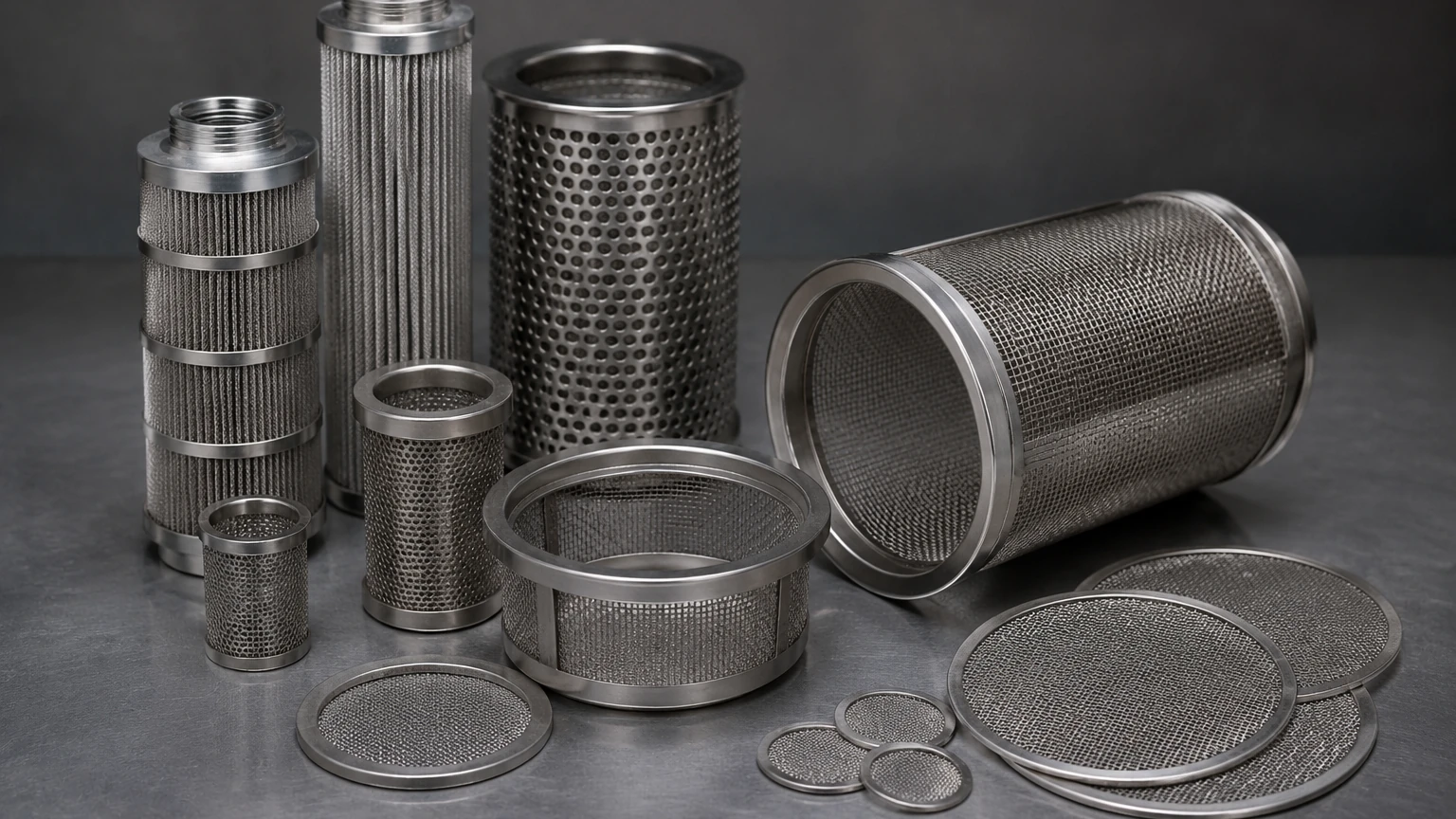
Woven wire mesh is highly versatile and can be manufactured to extremely fine micron ratings. It is ideal for applications requiring high precision. Stainless steel wire mesh filters are often used in multi-layer configurations (sintered mesh) to provide both fine filtration and structural rigidity. They are commonly found in cartridge filters for pharmaceutical and chemical applications.
Wedge Wire Screens
Wedge wire is constructed by welding V-shaped profile wires onto support rods. This creates a non-clogging surface because the V-shape allows particles to only make contact at two points. If a particle passes the leading edge, it will easily clear the rest of the screen. Wedge wire is exceptionally strong and is the preferred choice for heavy-duty applications like intake screens, well screens, and large-scale industrial strainers.
Addressing Common Risks: Corrosion, Fouling, and Mechanical Failure
Even the best-engineered water filtration screens are subject to the harsh realities of industrial operation. Understanding these risks is the first step in mitigation.
* Galvanic Corrosion: This occurs when two dissimilar metals are in contact in the presence of an electrolyte (water). Using consistent stainless steel grades throughout the filter housing and screen assembly minimizes this risk.
* Biofouling: In water systems, biofilms and algae can grow on the screen surface, rapidly increasing pressure drop. Selecting materials with smooth surface finishes or utilizing specialized coatings can help, though regular cleaning remains necessary.
* Mechanical Stress: High-velocity flow or sudden pressure surges (water hammer) can deform or rupture a screen. Engineers must ensure the screen's support structure is rated for the maximum possible system pressure, not just the operating pressure.
Operational Maintenance and Replacement Cycles
The total cost of ownership for water filtration screens is heavily influenced by maintenance requirements. While some systems utilize automatic backwashing to clean screens in situ, many industrial applications rely on manual cleaning or periodic replacement.
For reusable stainless steel screens, ultrasonic cleaning is often the most effective method for removing deeply embedded particles without damaging the mesh. The replacement cycle depends on the abrasiveness of the contaminants and the frequency of cleaning cycles. Over time, even stainless steel will experience fatigue or erosion. Establishing a predictive maintenance schedule based on ΔP trends and visual inspections is essential for preventing unplanned downtime.
The Value of Customization in Industrial Filtration Solutions
Off-the-shelf filtration products often fail to meet the specific nuances of a complex industrial process. Custom-engineered water filtration screens allow for optimized performance tailored to specific flow rates, housing dimensions, and particulate characteristics.
Customization options include:
* Variable Weave Patterns: Adjusting the weave to handle specific particle shapes (e.g., elongated fibers vs. spherical grains).
* Reinforced Structures: Adding internal or external support cages for high-pressure applications.
* Custom End Fittings: Ensuring seamless integration with existing piping and filter housings to eliminate bypass risks.
By working with a specialist manufacturer, engineering teams can develop filtration components that not only meet technical specifications but also contribute to the overall efficiency of the plant. For those seeking detailed specifications or technical support on custom filtration components, you can Review product options and application support on our Main Page to find the right solution for your specific industrial needs.
Conclusion
Water filtration screens are indispensable components in the industrial landscape. Their ability to protect high-value equipment and maintain process integrity makes them a critical focus for engineering and maintenance teams. By prioritizing material quality—specifically high-grade stainless steel—and carefully calculating parameters like micron rating and open area, facilities can achieve reliable, long-term filtration performance. As industrial processes become more complex and water quality standards more stringent, the role of precision-engineered filtration solutions will only continue to grow in importance.
