


Air Stripping Tower Manufacturers
Air stripping is a critical mass transfer process used extensively in environmental engineering and industrial wastewater treatment to remove volatile organic compounds (VOCs), ammonia, and dissolved gases from aqueous solutions. For engineers and procurement specialists, selecting the right air stripping tower manufacturers involves more than just comparing equipment costs; it requires a deep understanding of mass transfer efficiency, material durability, and the precision of internal components.
As industrial regulations regarding water quality become increasingly stringent, the reliability of air stripping systems depends heavily on the engineering quality of the tower internals, including packing supports, liquid distributors, and mist eliminators. This guide explores the technical considerations and evaluation criteria essential when partnering with manufacturers for industrial-scale stripping solutions.
Understanding the Air Stripping Process and Equipment Requirements
At its core, air stripping relies on Henry’s Law, which states that the amount of a dissolved gas in a liquid is proportional to its partial pressure above the liquid. By providing a high surface area for contact between contaminated water and clean air, the tower facilitates the migration of volatile contaminants from the liquid phase to the gas phase.
Air stripping tower manufacturers typically design systems as vertical cylindrical columns. The process involves water being pumped to the top of the tower and distributed over a bed of packing material. As the water trickles down, air is blown upward from the bottom. The packing material is the heart of the system, designed to maximize the surface area-to-volume ratio, thereby increasing the contact time and efficiency of the mass transfer.
For high-demand industrial applications, such as chemical processing or pharmaceutical manufacturing, the structural integrity of the tower and its internal filtration components is paramount. Manufacturers must account for factors such as the volumetric air-to-water ratio, the physical properties of the contaminants, and the temperature of the incoming streams, as these directly influence the height and diameter of the stripping column.
Key Evaluation Criteria for Air Stripping Tower Manufacturers
When evaluating potential air stripping tower manufacturers, technical professionals should look beyond the outer shell of the vessel. A high-performance stripping system is defined by its engineering precision and the quality of its sub-components.
Engineering Expertise and Modeling
Reliable manufacturers should demonstrate the ability to perform rigorous mass transfer modeling. This includes calculating the required Number of Transfer Units (NTU) and the Height of a Transfer Unit (HTU). Engineers should ask if the manufacturer uses empirical data or computer-aided simulations to predict the removal efficiency of specific VOCs under varying load conditions.
Material Compatibility and Durability
Industrial environments often involve corrosive fluids or high-temperature air streams. Manufacturers must offer a range of materials, from fiber-reinforced plastic (FRP) and high-density polyethylene (HDPE) for the vessel body to high-grade stainless steel for the internal supports and filtration mesh. In applications involving aggressive chemicals, 316L stainless steel or specialized alloys are often required to prevent premature failure due to pitting or stress corrosion cracking.
Customization and OEM Capabilities
No two industrial waste streams are identical. A manufacturer’s ability to provide customized internal designs—such as specialized liquid distributors or custom-sized wire mesh filters—is a significant advantage. For companies looking to integrate stripping towers into existing process lines, the manufacturer’s flexibility in OEM production is a critical factor for seamless integration.
The Critical Role of Internal Filtration and Support Components
While the packing material facilitates the stripping, the internal metal components ensure the system operates without interruption. This is where the expertise of a specialized manufacturer like Kaifil becomes essential. Precision-engineered stainless steel components serve several vital roles within an air stripping tower:
1. Packing Support Plates: These must be designed to hold the weight of the packing material and the liquid holdup while providing maximum open area to minimize air pressure drop. If the support plate is poorly designed, it can lead to "flooding," where the upward air velocity prevents the downward flow of water.
2. Mist Eliminators (Demisters): At the top of the tower, as air exits, it carries small droplets of water (entrainment). Stainless steel wire mesh demisters are used to capture these droplets, preventing contaminated water from being exhausted into the atmosphere or damaging downstream air treatment equipment.
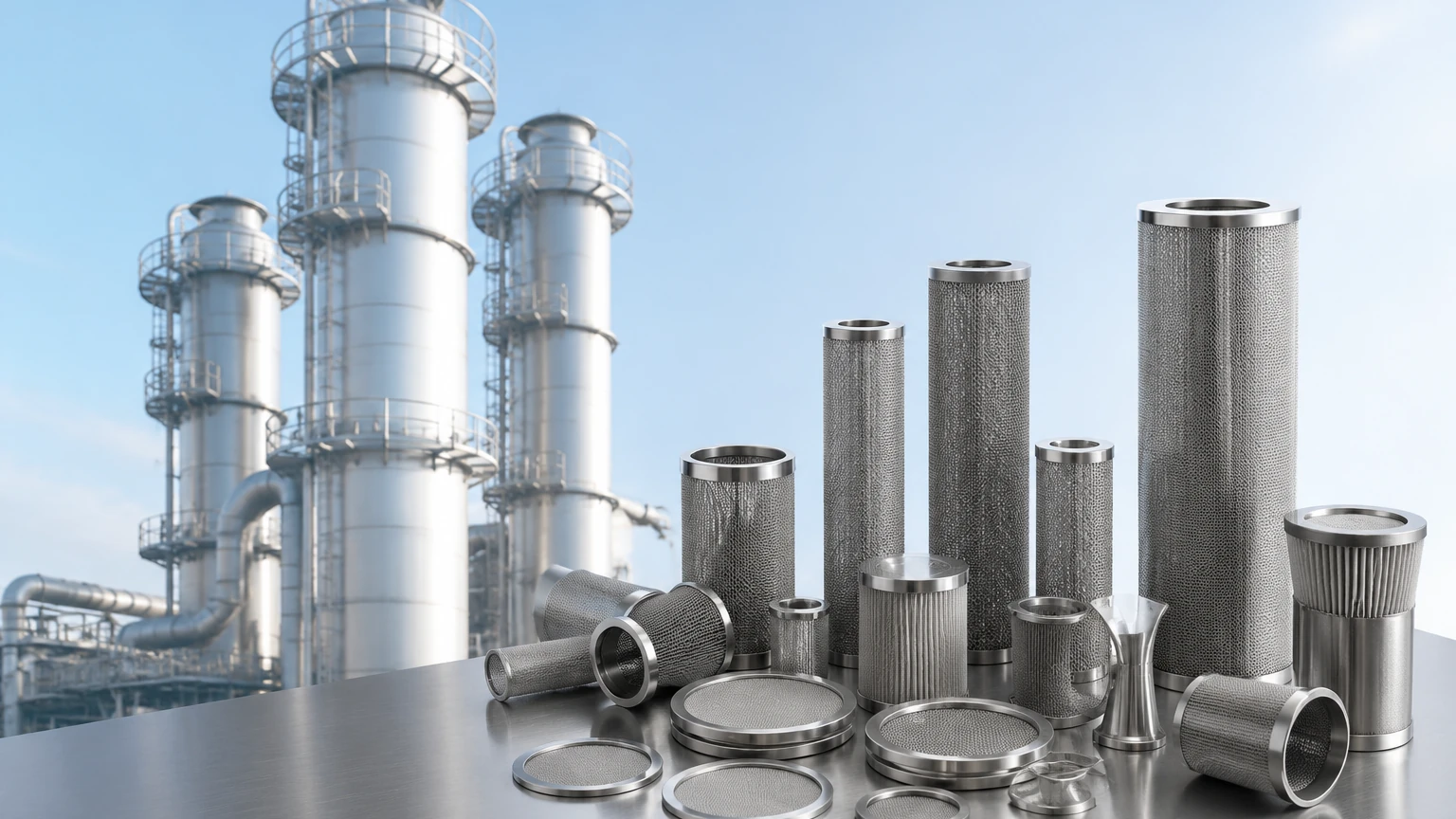
3. Inlet Filtration: To protect the packing material from fouling, inlet water must often be filtered. Using custom stainless steel filter cartridges at the inlet prevents suspended solids from entering the tower, which would otherwise clog the packing and reduce the surface area available for stripping.
For those seeking high-performance components to optimize their stripping systems, you can Review product options and application support on our Main Page to see how precision metal filtration enhances industrial processes.
Material Selection and Engineering Considerations for Corrosive Environments
In the context of air stripping, material selection is not just about strength; it is about chemical resistance and longevity. Air stripping tower manufacturers often deal with water containing dissolved H2S, CO2, or various organic solvents that can be highly aggressive toward standard materials.
* Stainless Steel (304/316L): These are the industry standards for internal components like wire mesh filters and support grids. 316L, with its molybdenum content, offers superior resistance to chlorides, making it ideal for brackish water or chemical wastewater.
* Pressure Drop Optimization: Every internal component, from the filter mesh to the support grid, contributes to the total pressure drop of the system. Engineers must select components that balance filtration or support efficiency with low resistance. A higher pressure drop requires more powerful (and energy-intensive) blowers, increasing the total cost of ownership.
* Thermal Stability: Unlike plastic internals, stainless steel components maintain their structural integrity at elevated temperatures, which may be required if steam stripping or heated air is used to increase the volatility of certain contaminants.
Common Risks and How to Mitigate Them in Tower Procurement
Procuring an air stripping system involves several risks that can lead to operational failures or high maintenance costs if not addressed during the design phase.
Fouling and Scaling
One of the most common issues in air stripping is the buildup of mineral scale (such as calcium carbonate) or biological growth on the packing material. This reduces the void space and increases pressure drop. Manufacturers should provide guidance on maintenance cycles and may suggest the integration of specialized filtration components to mitigate the entry of scale-forming solids.
Inefficient Liquid Distribution
If the liquid distributor at the top of the tower does not provide uniform coverage, "channeling" occurs. This is where water flows down the walls or through specific paths, bypassing the air stream and significantly reducing removal efficiency. It is vital to confirm that the manufacturer’s distributor design is compatible with the intended flow rate ranges.
Carryover and Environmental Compliance
Insufficient mist elimination can lead to the release of droplets containing the very contaminants the tower is meant to remove. Ensuring the manufacturer uses high-quality, multi-layered wire mesh demisters is essential for meeting environmental discharge permits.
Customization and OEM Solutions for Industrial Stripping Systems
As industrial processes become more specialized, the demand for OEM filtration and support components within air stripping towers has grown. Manufacturers who can produce custom-sized stainless steel filter cartridges, precision-cut wire mesh, and bespoke support structures allow for more compact and efficient tower designs.
For engineering firms and system integrators, partnering with a component manufacturer that understands the nuances of industrial filtration is a strategic advantage. This ensures that every part of the tower, from the smallest mesh screen to the largest support grid, is engineered for the specific chemical and physical demands of the application.
Conclusion: Selecting the Right Partner for Long-Term Performance
Choosing between air stripping tower manufacturers requires a technical audit of their engineering capabilities and the quality of the materials they employ. A well-designed tower is an investment in long-term environmental compliance and operational efficiency. By focusing on the precision of internal components—such as stainless steel filtration media and robust support structures—engineers can ensure their stripping systems remain effective even in the most demanding industrial environments.
For more information on high-quality stainless steel filtration solutions and custom metal components designed for industrial applications, visit the Kaifil Main Page. Understanding the intersection of material science and mass transfer engineering is the key to selecting a manufacturer that can deliver a reliable, low-maintenance air stripping solution.
