


Reticulated Foam Sheets
In the landscape of industrial filtration and fluid management, reticulated foam sheets represent a critical material category for engineers seeking high-porosity, low-pressure-drop solutions. Unlike standard flexible foams used in packaging or upholstery, reticulated foam undergoes a specific manufacturing process to remove the thin cell membranes, leaving behind a skeletal dodecahedron structure. This open-cell architecture is what defines its utility in air and liquid filtration, acoustic dampening, and fluid distribution.
For technical professionals and procurement teams, understanding the mechanical properties and chemical compatibility of reticulated foam is essential for optimizing system performance. While many industrial applications eventually require the durability of stainless steel components found on the Main Page of specialized manufacturers, reticulated foam often serves as the primary line of defense or a specialized media in complex filtration assemblies.
Understanding the Structure of Reticulated Foam
The primary characteristic that sets reticulated foam sheets apart from other porous materials is the "reticulation" process itself. Standard polyurethane foam consists of both struts (the skeletal frame) and windows (the thin membranes between the struts). In its raw state, the foam is "closed-cell" or partially open, which restricts airflow and fluid movement.
To create a reticulated structure, the foam is placed in a pressure vessel where a controlled explosion (thermal reticulation) or a chemical bath (chemical reticulation) removes the membranes. Thermal reticulation, often referred to as "zapping," is the most common method. It involves filling the foam cells with a combustible gas mixture and igniting it. The resulting heat flash melts the thin membranes and wraps them around the thicker struts, creating a completely open, three-dimensional net. This process ensures that the resulting reticulated foam sheets have a void volume typically exceeding 95%, providing minimal resistance to flow.
Key Performance Metrics: PPI and Porosity
When specifying reticulated foam sheets for industrial use, the most critical metric is Pores Per Inch (PPI). This measurement dictates the filtration efficiency and the pressure drop across the media.
Pore Size and Filtration Efficiency
* 10 to 30 PPI: These are coarse grades used primarily for large particle filtration, such as pre-filters in HVAC systems or as debris catchers in outdoor power equipment. They offer the lowest pressure drop and highest dust-holding capacity for large contaminants.
* 45 to 60 PPI: Medium grades are frequently used in small engine air filters and medical devices. They strike a balance between capturing mid-sized particulates and maintaining high flow rates.
* 80 to 100+ PPI: Fine grades are used for high-efficiency air filtration and specialized liquid applications. While they capture smaller particles, they require more frequent cleaning or replacement due to their higher resistance and faster loading rates.
Engineers must calculate the face velocity of the fluid or gas passing through the foam. Because reticulated foam sheets have such high porosity, they can operate at much higher velocities than traditional fabric or paper media without causing a significant spike in backpressure. However, as the PPI increases, the internal surface area increases exponentially, which improves particulate capture through impingement and interception.
Material Selection: Polyether vs. Polyester Foam
Choosing the correct polymer base is as important as selecting the right PPI. Reticulated foam sheets are generally manufactured from two types of polyurethane: polyester and polyether.
Polyester-Based Reticulated Foam
Polyester foam is characterized by its high mechanical strength and excellent resistance to hydrocarbons, oils, and fuels. It is the preferred choice for automotive air filters, gasket materials, and applications involving petroleum-based lubricants. However, polyester foam is susceptible to hydrolysis—the breakdown of the polymer chain when exposed to high humidity and heat over long periods. In environments where moisture is a constant factor, polyester may degrade into a sticky or crumbly substance.
Polyether-Based Reticulated Foam
Polyether foam is formulated specifically to resist hydrolysis. It is the standard for water treatment, marine applications, and outdoor environments where humidity is high. While it generally has slightly lower tensile strength and tear resistance than polyester, its longevity in aqueous environments makes it indispensable for aquatic filtration and medical components that undergo sterilization. It also tends to have better resistance to microbial growth, which is a vital consideration in HVAC and water processing.
Industrial Applications and Pre-Filtration Roles
Reticulated foam sheets are rarely used in isolation within heavy industrial processes; rather, they function as part of a multi-stage filtration strategy.
HVAC and Air Handling
In large-scale air handling units (AHUs), reticulated foam serves as a washable pre-filter. By capturing large dust particles and debris before they reach high-efficiency HEPA filters or electrostatic precipitators, the foam extends the service life of more expensive downstream components. The ability to wash and reuse foam sheets provides a significant total cost of ownership (TCO) advantage in high-loading environments.
Fluid Management and Reservoirs
In hydraulic systems and fuel tanks, reticulated foam is used for "baffling." By filling a tank with high-PPI foam, engineers can prevent fluid sloshing and suppress explosions in volatile environments (such as racing fuel cells). The foam breaks up the surface tension and limits the rapid movement of the liquid without significantly reducing the tank's volume capacity.
Acoustic and Thermal Management
The open-cell structure is also effective at dissipating sound energy. Reticulated foam sheets are often used as liners for compressor housings and generator enclosures. The sound waves enter the labyrinthine structure of the foam and are converted into low-level heat through friction against the struts.
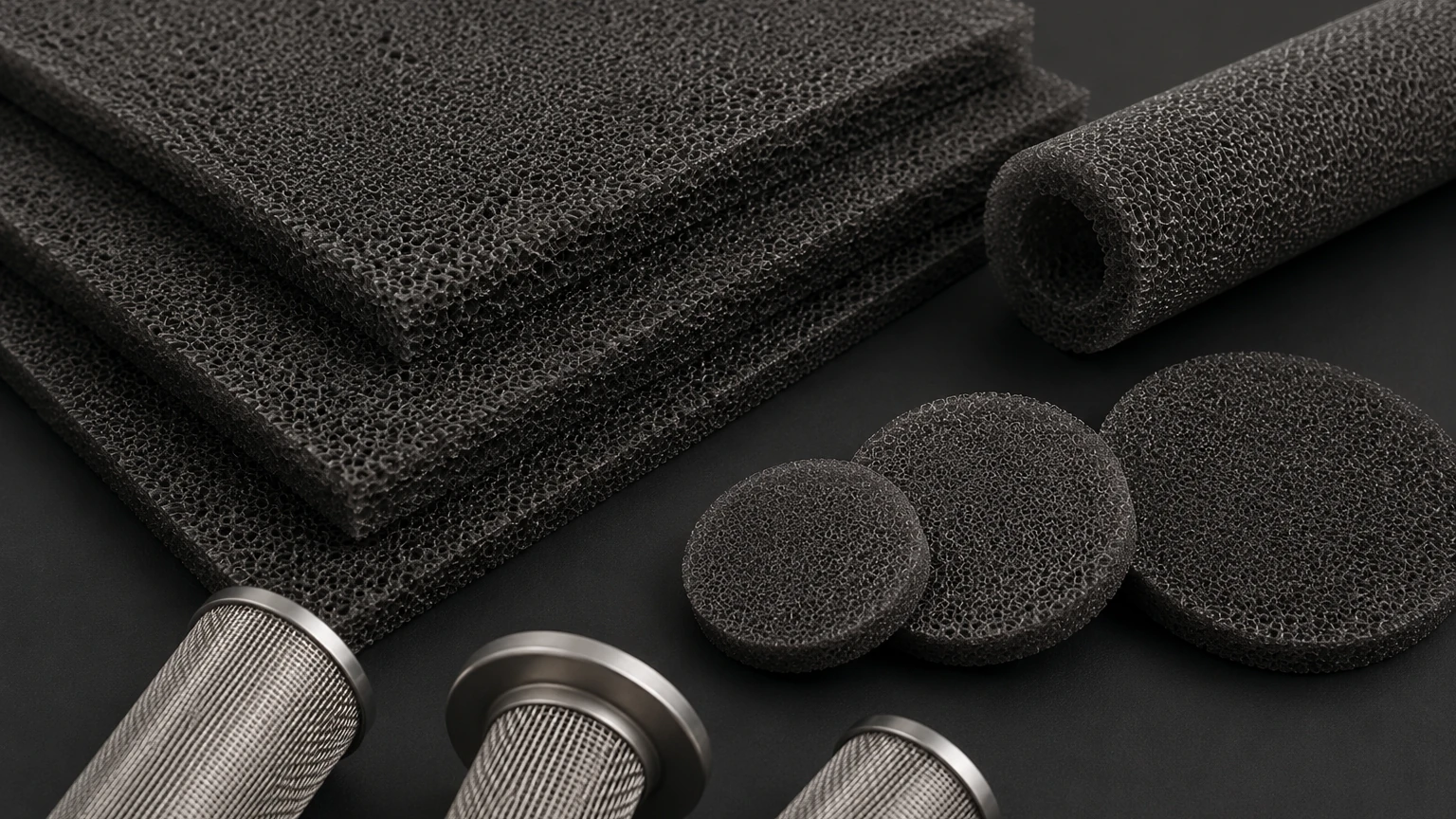
Comparing Foam Sheets with Stainless Steel Wire Mesh
In the context of high-performance filtration, it is helpful to compare reticulated foam with the stainless steel solutions available on the Kaifil Main Page. While both materials offer porous structures for separation, their applications differ based on environmental demands.
| Feature | Reticulated Foam Sheets | Stainless Steel Wire Mesh |
| :— | :— | :— |
| Temperature Resistance | Limited (typically up to 120°C) | High (up to 800°C depending on alloy) |
| Chemical Resistance | Variable (sensitive to strong acids/solvents) | Excellent (resistant to most industrial chemicals) |
| Durability | Moderate (subject to mechanical wear) | Exceptional (high pressure and abrasion resistance) |
| Cleanability | Washable (limited cycles) | Ultrasonic/Backwashable (nearly infinite cycles) |
| Precision | Nominal (pore size varies slightly) | Absolute (precise micron ratings) |
Engineers often use reticulated foam as a low-cost, disposable, or washable pre-filter stage to protect precision stainless steel filter cartridges. In a chemical processing plant, for example, a 20 PPI foam sheet might capture large scale and rust, while a 10-micron stainless steel mesh cartridge performs the final, critical separation. This hybrid approach optimizes both filtration quality and operational costs.
Engineering Considerations for Custom Filtration Systems
When integrating reticulated foam sheets into a custom filtration housing, several design factors must be addressed to ensure reliable performance.
Compression and Sealing
Reticulated foam is highly compressible. While this makes it easy to fit into irregular shapes, excessive compression can distort the pore structure, leading to localized "blind spots" or areas of high resistance. Engineers must design housings that provide enough compression to prevent bypass (fluid leaking around the edges) without crushing the internal struts of the foam.
Face Velocity and Pressure Drop
The relationship between velocity and pressure drop in foam is non-linear. As flow increases, the turbulence within the foam cells increases, leading to a sharper rise in pressure. It is standard practice to design for a face velocity that keeps the pressure drop within the initial 20% of the system's allowable limit, providing a "buffer" for when the foam begins to load with contaminants.
Customization and Fabrication
One of the greatest advantages of reticulated foam sheets is their ease of fabrication. They can be die-cut into complex gaskets, CNC routed into three-dimensional shapes, or laminated with adhesive backings for easy installation. For OEM applications, foam can also be impregnated with specialized coatings, such as activated carbon for odor removal or antimicrobial agents for medical use.
Maintenance, Durability, and Replacement Cycles
The lifespan of reticulated foam sheets is dictated by the contaminant loading rate and the cleaning protocol. In many air-filtration applications, the foam can be vacuumed, rinsed with water, or cleaned with mild detergents. However, it is vital to inspect the foam for "friability"—the tendency of the material to crumble or shed particles.
In industrial settings, UV exposure and ozone can accelerate the degradation of polyurethane. If the foam is located near high-voltage equipment or in direct sunlight, specialized UV-stabilized grades must be specified. Failure to replace degraded foam can lead to "media migration," where bits of the foam itself break off and contaminate the downstream process, potentially damaging sensitive equipment like pumps or high-precision metal filters.
For systems requiring zero-fail reliability and long-term chemical stability, transitioning from foam to the permanent filtration solutions found on the Kaifil Main Page is often the most cost-effective long-term strategy. Metal filters eliminate the risk of media migration and can withstand the aggressive cleaning cycles required in pharmaceutical and food-grade applications.
Conclusion
Reticulated foam sheets remain a versatile and essential tool in the engineer's toolkit for fluid and air management. Their unique open-cell structure provides a combination of high flow and effective particulate capture that is difficult to replicate with other low-cost materials. By carefully selecting between polyester and polyether bases and accurately specifying the required PPI, technical teams can solve complex pre-filtration and acoustic challenges.
When designing a complete filtration system, the goal is always to balance initial cost with long-term durability. By utilizing reticulated foam for high-volume pre-filtration and reserving precision stainless steel components for critical separation stages, industrial operators can achieve optimal efficiency and equipment protection. For more information on high-performance metal filtration components that complement these systems, visiting the Main Page of a professional manufacturer provides the necessary technical context for final equipment selection.
