


Strainer Mesh Screen Sizes
In industrial fluid management, the precision of filtration components determines the operational efficiency and lifespan of the entire system. Choosing the correct strainer mesh screen sizes is not merely a matter of selecting a filter that "looks right"; it is a rigorous engineering calculation that balances particulate retention, flow rates, and structural durability. For engineers and procurement specialists, understanding the technical specifications of these components is essential to prevent downstream equipment failure, minimize pressure drops, and ensure product purity.
As a leading manufacturer of custom stainless steel filtration solutions, Kaifil specializes in producing high-performance wire mesh filters and cartridges tailored to the exacting needs of the chemical, pharmaceutical, and food processing industries. By visiting our Main Page, technical teams can explore the breadth of customization options available for precision metal filter components. This article provides a comprehensive technical analysis of how to evaluate and specify strainer mesh screen sizes for industrial applications.
The Engineering Relationship Between Mesh, Microns, and Wire Diameter
The most fundamental challenge in specifying a strainer is navigating the terminology of mesh versus microns. While both describe the fineness of a filter, they represent different physical properties.
Defining Mesh Count
Mesh count is defined as the number of openings per linear inch, measured from the center of one wire to a point one inch away. A 20-mesh screen has 20 openings per inch, while a 400-mesh screen has 400. Because the count is a measure of frequency, a higher mesh number always indicates a finer filter. However, mesh count alone is an incomplete specification.
The Role of Wire Diameter
The actual size of the opening (the aperture) is determined by both the mesh count and the wire diameter. For example, if you have two 100-mesh screens, but one uses a 0.0045-inch wire and the other uses a 0.0030-inch wire, the aperture sizes will differ significantly. The screen with the thinner wire will have larger openings and a higher percentage of open area, but it will be mechanically weaker. When engineers discuss strainer mesh screen sizes, they must account for this "wire gauge" factor to ensure the screen can withstand the differential pressure of the system.
Micron Ratings and Absolute vs. Nominal Filtration
Micron ratings provide a direct measurement of the aperture size in micrometers (one-millionth of a meter). In B2B procurement, it is vital to distinguish between nominal and absolute micron ratings. A nominal rating indicates the screen can stop a high percentage (usually 60% to 90%) of particles of a certain size. An absolute rating, typically achieved through specialized weaves like Dutch Weave or Twilled Dutch Weave, indicates that 99.9% of particles larger than the rating will be captured. For critical applications like hydraulic valve protection or pharmaceutical batching, absolute ratings are the industry standard.
Calculating Percentage of Open Area (POA) and Flow Dynamics
One of the most overlooked factors in filter selection is the Percentage of Open Area (POA). This is the ratio of the total area of the holes to the total area of the screen surface. It is the primary driver of the "clean pressure drop" ($ΔP$)—the resistance the fluid encounters when the filter is first installed.
The Formula for Open Area
The mathematical formula for calculating POA in a square mesh is:
$$POA = (O / (O + W))^2 \times 100$$
Where:
* O = Opening size (aperture)
* W = Wire diameter
A high POA is desirable because it allows for higher flow rates with less energy consumption. However, as the strainer mesh screen sizes become finer, the wire diameter often must decrease to maintain a reasonable POA. This creates a trade-off: a high-flow screen is often more fragile and prone to "blinding" or "pin-holing" under high-pressure surges.
Impact on Pump Performance
In systems where pumps are located downstream of the strainer, an incorrectly sized mesh can lead to cavitation. If the mesh is too fine or the open area is too low, the suction side of the pump may experience a vacuum, causing vapor bubbles to form and collapse, which destroys pump impellers and seals. Engineers must calculate the Total Dynamic Head (TDH) and ensure the strainer’s flow coefficient ($Cv$) aligns with the pump's requirements.
Selection Criteria for Industrial Applications
Different industries require different approaches to strainer mesh screen sizes. The nature of the contaminant (deformable vs. rigid) and the viscosity of the fluid are the two most important variables.
Water Treatment and Cooling Systems
For raw water intake or cooling towers, the goal is typically to remove large debris like grit, leaves, and scale. Coarse mesh sizes ranging from 20 to 60 mesh are standard. These sizes provide excellent structural integrity and can handle high flow velocities without significant maintenance.
Chemical and Petrochemical Processing
In these environments, corrosion resistance is as important as the mesh size. Using 316L stainless steel mesh in sizes ranging from 80 to 200 mesh is common. These screens must be able to handle aggressive solvents and high temperatures. The selection often depends on the specific catalyst or downstream reactor requirements, where even small amounts of particulate can poison a chemical reaction.
Food, Beverage, and Pharmaceutical
These sectors require "sanitary" filtration. The mesh must not only be sized correctly (often 100 to 400 mesh) but must also be manufactured to prevent bacterial growth. This involves using smooth-surface weaves and precision welding techniques that eliminate crevices. In these applications, the strainer mesh screen sizes are often dictated by regulatory standards (such as FDA or 3-A) to ensure that the final product is free of contaminants.
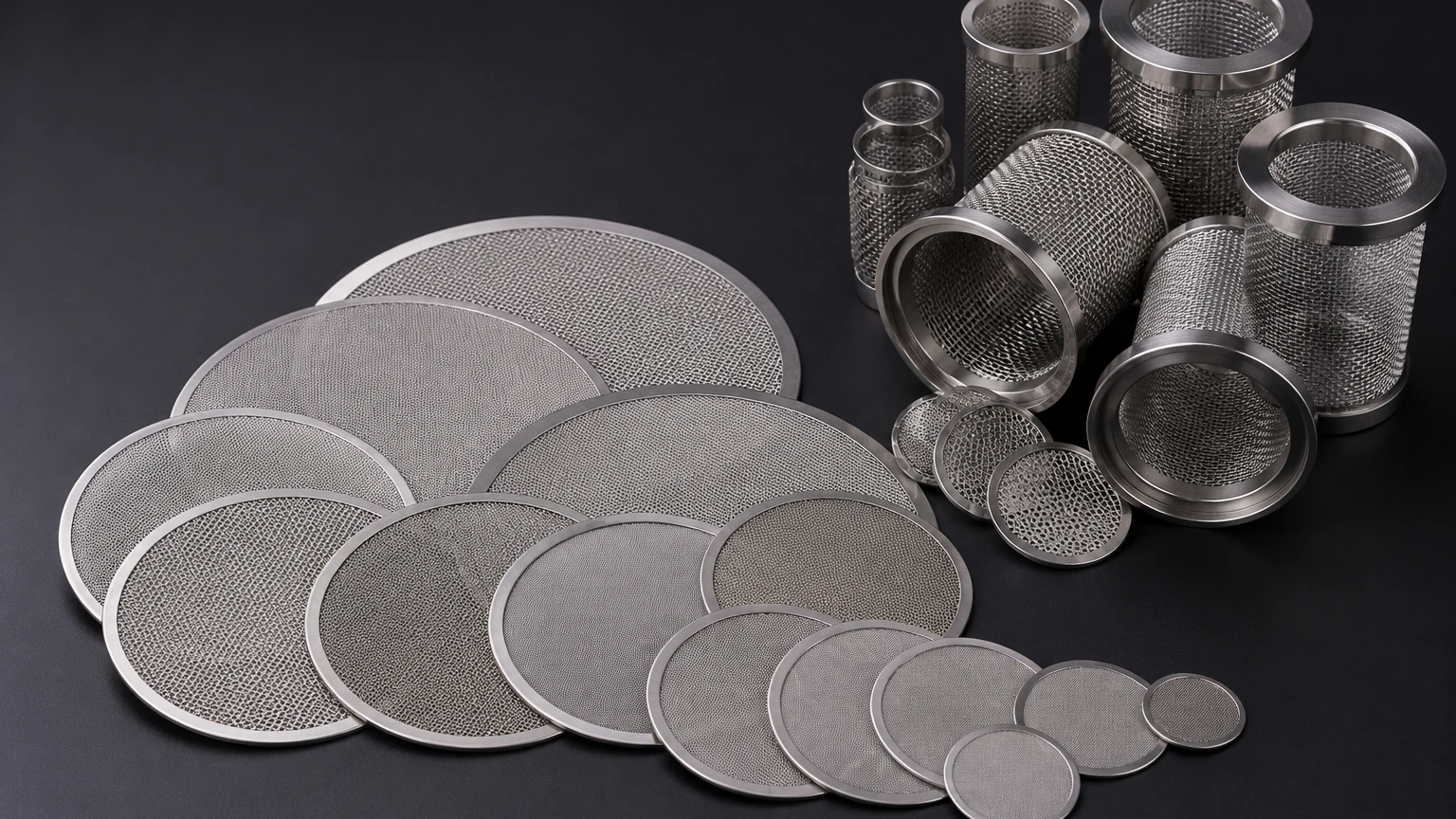
Structural Design and Reinforcement for Fine Mesh
As filtration requirements move into the sub-100 micron range, the wire mesh becomes increasingly delicate. A single layer of 300-mesh screen is similar in thickness to human hair and cannot support the weight of a fluid column or the force of a pressure surge on its own. To solve this, industrial filters utilize multi-layer constructions.
Perforated Metal Backing
Most industrial strainer cartridges use a heavy-duty perforated metal basket as a skeleton. The fine wire mesh is then wrapped around or pleated inside this basket. The perforated metal provides the mechanical strength to resist bursting or collapsing, while the mesh provides the actual filtration.
Sintered Mesh Solutions
For the most demanding environments, Kaifil provides sintered wire mesh. This process uses heat and pressure to fuse multiple layers of mesh together without the use of binders. A typical 5-layer sintered structure includes a fine filtration layer, a distribution layer, and several heavy support layers. This creates a monolithic component that maintains precise strainer mesh screen sizes even under extreme pressure and allows for repeated cleaning without deforming the apertures.
Pleated vs. Cylindrical Designs
When high flow rates are required in a small footprint, pleated mesh is used. Pleating increases the effective surface area of the filter by 3 to 10 times compared to a standard cylinder. This increased area means that for the same strainer mesh screen sizes, the velocity of the fluid through any single point of the mesh is lower, which reduces wear and extends the time between cleaning cycles.
Operational Longevity: Cleaning, Maintenance, and Replacement
The total cost of ownership (TCO) of a filtration system is heavily influenced by how the strainer mesh screen sizes affect maintenance cycles. A filter that is too fine will clog (blind) rapidly, leading to frequent downtime.
Monitoring Pressure Differential
Industrial systems should always be equipped with pressure gauges upstream and downstream of the strainer. The "differential pressure" ($ΔP$) is the most reliable indicator of filter health. Most systems are designed to be cleaned or replaced when the $ΔP$ reaches a specific threshold (e.g., 10-15 psi). If the $ΔP$ rises too quickly, it suggests that the strainer mesh screen sizes are too fine for the particulate load or that the fluid's viscosity has changed.
Cleaning Methodologies
* Backwashing: Reversing the flow of fluid to flush particles off the surface of the mesh. This is effective for rigid particles and coarser mesh.
* Ultrasonic Cleaning: Using high-frequency sound waves in a solvent bath to dislodge fine particles trapped within the weave. This is the preferred method for fine mesh and sintered components.
* Chemical Cleaning: Using acids or alkalis to dissolve organic or mineral buildup. This requires the mesh to be made of high-grade stainless steel or exotic alloys to prevent corrosion during the cleaning process.
When to Replace
Despite effective cleaning, all mesh screens eventually succumb to fatigue or abrasion. "Wire thinning" occurs in high-velocity systems, where the abrasive nature of the particles slowly wears away the metal. Regular inspection is required to ensure that the strainer mesh screen sizes have not enlarged due to wear, which would allow oversized contaminants to pass through and damage downstream equipment.
Conclusion: Making an Informed Procurement Decision
Specifying the correct strainer mesh screen sizes is a balancing act between protection and performance. A mesh that is too coarse fails to protect sensitive equipment, while a mesh that is too fine creates unnecessary energy costs and maintenance burdens.
By focusing on the technical parameters—mesh count, wire diameter, micron rating, and percentage of open area—engineers can design systems that are both robust and efficient. Partnering with a specialized manufacturer like Kaifil ensures that you receive filtration components engineered for your specific industrial environment. Whether you require standard wire mesh or custom-engineered sintered structures, the right choice starts with a deep understanding of the physics of filtration. For more information on our manufacturing capabilities and to view our full product catalog, please visit our Main Page.
