


Nitrogen Purifier
In modern industrial manufacturing, the demand for high-purity nitrogen gas is nearly universal. From the inerting of chemical storage tanks to the prevention of oxidation in semiconductor fabrication, the quality of nitrogen directly impacts product yield and equipment longevity. A nitrogen purifier is the essential system used to remove residual oxygen, moisture, and particulate matter from nitrogen gas streams, elevating standard industrial-grade nitrogen to ultra-high purity (UHP) levels.
For engineers and procurement professionals, the efficiency of a nitrogen purifier is not solely dependent on the chemical adsorbents or membranes used; it is significantly influenced by the mechanical filtration components that protect these sensitive stages. Kaifil, a specialist in custom stainless steel filtration, provides the precision-engineered components required to ensure these systems operate at peak performance. This guide explores the technical landscape of nitrogen purification, the critical role of high-performance filtration, and the engineering considerations necessary for selecting the right components.
Understanding the Role of Nitrogen Purification in Industrial Applications
Nitrogen is often produced on-site or delivered in bulk with purities ranging from 95% to 99.9%. While sufficient for some applications, many high-tech industries require purities of 99.999% (5N) or even 99.9999% (6N). At these levels, contaminants are measured in parts per billion (ppb).
The primary contaminants addressed by a nitrogen purifier include:
* Oxygen (O2): Even trace amounts of oxygen can cause oxidation in metal heat treatment or degrade sensitive electronic components.
* Moisture (H2O): Water vapor can lead to corrosion in piping and interfere with chemical reactions.
* Hydrocarbons: Often introduced by compressors, these must be removed to prevent contamination in food, beverage, and pharmaceutical processes.
* Particulate Matter: Dust, pipe scale, and adsorbent fines can clog downstream valves and damage delicate instrumentation.
To achieve the necessary gas quality, a nitrogen purifier typically employs a combination of catalytic reaction, adsorption, and high-efficiency mechanical filtration. Each stage requires robust hardware to maintain gas velocity and pressure stability.
Core Technologies Behind the Nitrogen Purifier
There are several methods for purifying nitrogen, and the choice of technology depends on the initial gas quality and the required end-use purity.
Pressure Swing Adsorption (PSA)
PSA systems utilize Carbon Molecular Sieves (CMS) to adsorb oxygen and other impurities under high pressure. When the pressure is released, the impurities are desorbed and vented. This process requires precise pre-filtration to prevent oil or water droplets from coating the CMS, which would drastically reduce its efficiency.
Membrane Separation
Membrane purifiers use hollow-fiber technology where gases permeate at different rates. While excellent for bulk separation, membranes are highly sensitive to particulate contamination. A single microscopic particle can compromise the integrity of the fiber, leading to costly system failures.
Catalytic Deoxygenation
In this process, a small amount of hydrogen is added to the nitrogen stream. The gas passes over a catalyst (typically palladium or platinum), where the hydrogen reacts with residual oxygen to form water, which is then removed by a desiccant dryer. The catalyst bed must be protected by high-temperature stainless steel filters to prevent the migration of catalyst fines into the process stream.
The Essential Role of Stainless Steel Filtration in Purification Systems
In any nitrogen purifier setup, filtration is the first and last line of defense. Standard polymer filters often fail to meet the rigorous demands of industrial gas purification due to temperature limitations, outgassing, or chemical incompatibility. This is where stainless steel filtration components become indispensable.
Pre-Filtration and Coalescing
Before nitrogen enters the purification stage, it must be free of liquid aerosols and large particles. Stainless steel wire mesh filters are used to coalesce oil and water droplets, allowing them to be drained away. These filters are chosen for their high mechanical strength and ability to withstand the high differential pressures often found in nitrogen supply lines.
Adsorbent and Catalyst Protection
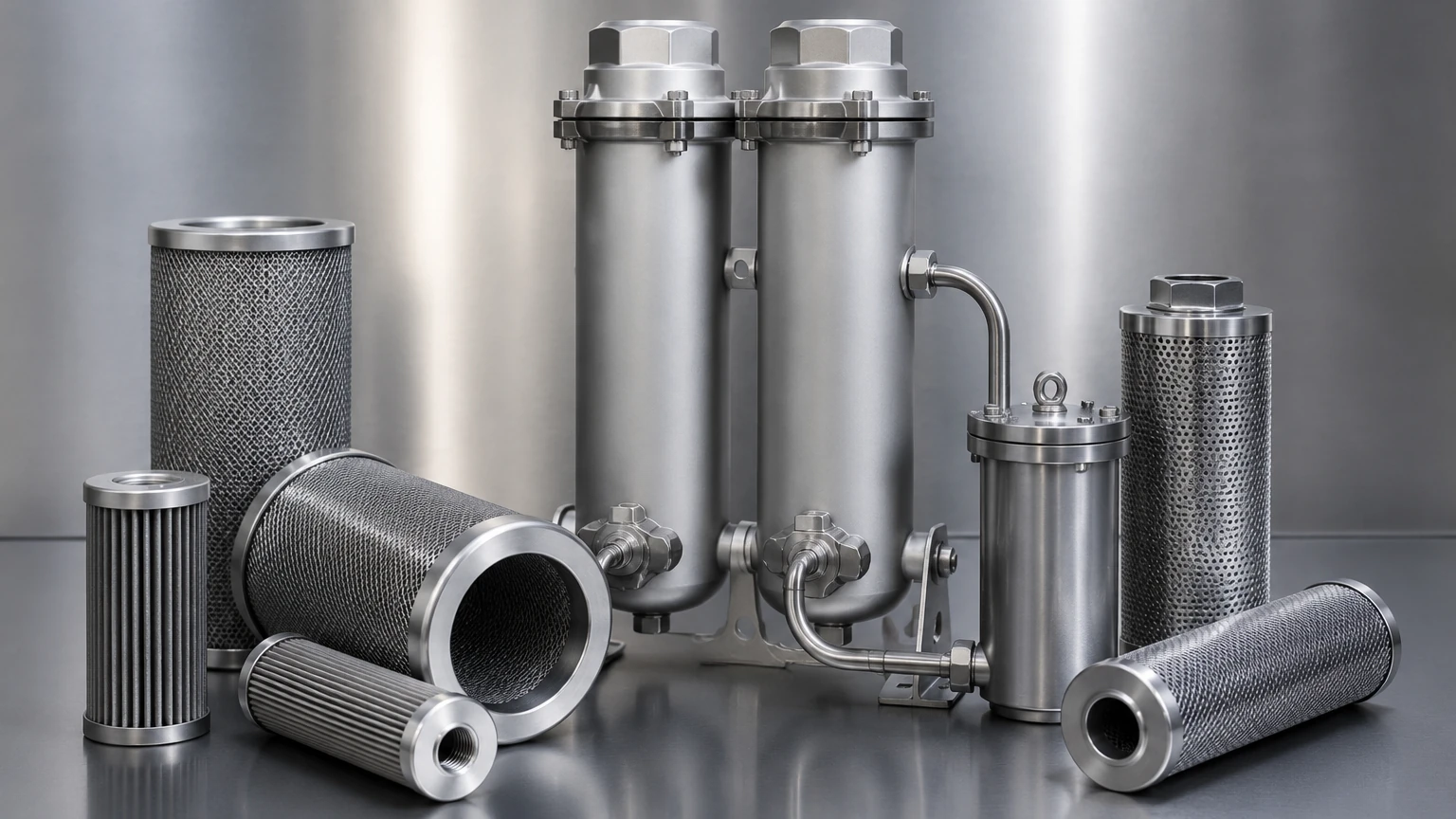
Inside a nitrogen purifier, the active media (molecular sieves or catalysts) can break down over time due to pressure cycles or thermal stress, creating "fines." If these fines escape the purification vessel, they can contaminate the final product. Sintered metal filter cartridges are typically installed at the outlet of the purifier to capture these particles. Because these filters are made from 304 or 316L stainless steel, they offer absolute filtration ratings and can withstand the abrasive nature of the fines.
Ultra-Fine Final Filtration
For UHP applications, final filtration must remove particles down to the sub-micron level. Pleated stainless steel wire mesh filters provide a large surface area, ensuring low pressure drop while maintaining high dirt-holding capacity. This is critical for maintaining a steady flow of nitrogen to the production line without requiring frequent system shutdowns for filter replacement.
Technical Specifications: Selecting the Right Filter for Nitrogen Systems
When specifying filtration for a nitrogen purifier, engineers must move beyond basic dimensions and consider the physics of the gas stream. For more information on specific configurations, professionals often Review product options and application support to align hardware with system demands.
Micron Rating: Absolute vs. Nominal
In nitrogen purification, "nominal" ratings are rarely sufficient. An absolute rating ensures that 99.9% of particles at the specified size are captured. For protecting sensitive downstream equipment like mass flow controllers, an absolute rating of 0.5 to 1 micron is often the industry standard.
Pressure Drop ($ΔP$)
Every filter introduces resistance to the flow. In a nitrogen purifier, excessive pressure drop can lead to energy inefficiency and may interfere with the pressure-sensitive cycles of PSA systems. Engineers must calculate the initial clean pressure drop and the terminal pressure drop (the point at which the filter must be cleaned or replaced). Stainless steel filters are advantageous here because their rigid structure prevents "media migration" or pore enlargement under high $ΔP$.
Material Selection
While 304 stainless steel is suitable for many nitrogen applications, 316L is preferred for its superior corrosion resistance, especially if the nitrogen stream contains trace amounts of moisture or acidic gases. In high-temperature catalytic purifiers, specialized alloys may be required to prevent oxidation of the filter media itself.
Engineering Considerations: Customization and Material Compatibility
No two industrial nitrogen systems are identical. Customization is often required to integrate filtration into existing nitrogen purifier footprints or to meet specific flow requirements.
Housing and Connection Types
The filter housing must be rated for the maximum operating pressure of the nitrogen system, which can often exceed 300 psi. Common connection types include NPT threads, flanged connections, or specialized quick-connect fittings for pharmaceutical applications. The seal material (O-rings) must also be compatible with the gas; Viton or PTFE are common choices for nitrogen service to ensure no outgassing occurs.
Flow Rate and Velocity
High gas velocities can lead to "channeling" in adsorbent beds and can cause erosion in filter media. By customizing the diameter and length of the filter cartridge, engineers can optimize the face velocity, ensuring efficient particle capture and extending the service life of the filter element.
OEM Capabilities
For manufacturers of nitrogen purifiers, sourcing reliable OEM components is critical for brand reputation. Custom-branded filter elements with specific end-cap designs (such as Code 7 or Double Open End) allow for seamless integration into proprietary system designs. Kaifil’s ability to manufacture to precise tolerances ensures that the filtration stage does not become a bottleneck in the purification process.
Maintenance Strategies for Long-Term Filtration Performance
To maintain the integrity of a nitrogen purifier, a proactive maintenance schedule is essential. Unlike disposable plastic filters, stainless steel components offer the potential for cleaning and reuse, which significantly lowers the total cost of ownership.
Monitoring Differential Pressure
The most effective way to track filter health is by monitoring the differential pressure across the filter housing. A sudden increase in $ΔP$ usually indicates a surge in particulate matter or a failure in the upstream adsorbent bed. Most industrial systems are equipped with DP gauges or transmitters that alert operators when the filter reaches its terminal pressure.
Cleaning Procedures
Stainless steel filters can be cleaned using several methods, depending on the contaminant:
* Ultrasonic Cleaning: Highly effective for removing deeply embedded particles in sintered media.
* Backpulsing: In some automated systems, a reverse flow of high-pressure nitrogen can be used to dislodge surface-loaded dust.
* Chemical Cleaning: Used when hydrocarbons or organic films have fouled the mesh.
Replacement Cycles
While stainless steel is durable, it is not infinite. Repeated cleaning cycles can eventually fatigue the metal mesh. Engineers should establish a replacement cycle based on the criticality of the nitrogen purity. In semiconductor or pharmaceutical applications, filters may be replaced annually regardless of pressure drop to ensure absolute process security.
Conclusion
A nitrogen purifier is a sophisticated piece of equipment that relies on the synergy of chemical and mechanical processes. By selecting high-quality stainless steel filtration components, engineers can protect their investment, ensure the longevity of adsorbent media, and guarantee the delivery of ultra-high purity nitrogen.
Whether you are designing a new purification system or optimizing an existing one, the technical details of the filtration stage cannot be overlooked. From material compatibility to precise micron ratings, every decision impacts the final gas quality. For those looking to source or design custom filtration solutions for industrial gas applications, the Main Page of Kaifil offers a comprehensive overview of the engineering capabilities and product ranges available to support demanding filtration requirements.
