


Industrial Gas Filter
In modern industrial processing, the purity of gas streams is a fundamental requirement for both operational efficiency and equipment longevity. An industrial gas filter is engineered to remove solid particulates, liquid droplets, and aerosols from compressed air or process gases. Whether the application involves protecting high-speed turbine blades from erosion or ensuring sterile air for pharmaceutical packaging, the selection of the correct filtration media and housing design is a critical engineering decision.
For technical professionals and procurement teams, understanding the nuances of gas filtration—ranging from the physics of particle capture to the metallurgical properties of the filter media—is essential. This guide examines the technical considerations, material requirements, and performance benchmarks necessary for implementing effective gas filtration solutions.
The Fundamental Role of Gas Filtration in Industry
Industrial gas streams often contain a variety of contaminants, including pipe scale, rust, moisture, and oil carryover from compressors. If left unmanaged, these contaminants lead to increased maintenance costs, unplanned downtime, and compromised product quality.
An industrial gas filter serves as the primary line of defense. Its primary functions include:
* Equipment Protection: Downstream components such as compressors, valves, regulators, and analytical instruments are highly sensitive to particulate damage. Fine dust can cause abrasive wear on moving parts, while liquid slugs can lead to mechanical failure.
* Process Purity: In industries like semiconductor manufacturing or chemical synthesis, even trace amounts of contaminants can ruin entire batches of product.
* Environmental Compliance: Filtration systems are often required to treat exhaust gases, removing hazardous particulates before they are released into the atmosphere.
To explore a comprehensive range of industrial filtration components and custom manufacturing capabilities, engineers can visit the Main Page for detailed technical specifications and product support.
Technical Mechanisms of Gas Filtration
Unlike liquid filtration, where particles are primarily captured through mechanical sieving, gas filtration relies on a combination of physical mechanisms that vary depending on particle size and gas velocity. Understanding these mechanisms allows engineers to select the appropriate micron rating and media structure.
1. Inertial Impaction
This mechanism occurs when larger particles (typically those greater than 1 micron) possess enough inertia that they cannot follow the streamlines of the gas as it flows around a filter fiber. Instead, the particle continues on its original path and strikes the fiber, where it becomes trapped. This is most effective at higher gas velocities.
2. Interception
Interception happens when a particle follows a gas streamline but comes within one particle radius of a filter fiber. The particle then makes contact with the fiber and is captured. This mechanism is generally dominant for particles in the 0.1 to 1.0-micron range.
3. Diffusion (Brownian Motion)
For extremely small particles (less than 0.1 microns), the random movement caused by collisions with gas molecules—known as Brownian motion—increases the likelihood that the particle will contact a filter fiber. Diffusion is most effective at low gas velocities, providing the particle more time to deviate from the streamline.
4. Electrostatic Attraction
In some specialized media, electrostatic charges are used to attract and hold particles. While common in synthetic air filters, industrial metal filters rely more heavily on the first three mechanical methods for long-term durability in harsh environments.
Material Selection: The Case for Stainless Steel
While polymer-based filters are common in light-duty applications, heavy industrial gas filtration often demands the use of stainless steel. As a specialized manufacturer, Kaifil utilizes high-grade materials like 304 and 316L stainless steel to meet the rigorous demands of chemical and high-temperature processes.
Durability and Temperature Resistance
Industrial gas streams frequently operate at elevated temperatures that would degrade synthetic fibers. Stainless steel filter cartridges can maintain structural integrity at temperatures exceeding 500°C (depending on the alloy and seal materials). This makes them indispensable for steam filtration and hot gas recovery.
Corrosion and Chemical Compatibility
In the chemical processing industry, the gas stream may contain corrosive elements such as sulfur compounds or acidic vapors. 316L stainless steel, with its molybdenum content, provides superior resistance to pitting and crevice corrosion compared to standard carbon steel or aluminum housings.
Cleanability and Longevity
One of the most significant advantages of an industrial gas filter made from metal mesh or sintered metal is that it is often cleanable. Through ultrasonic cleaning, backpulsing, or chemical baths, the filter can be restored to its original differential pressure, significantly reducing the total cost of ownership compared to disposable cartridges.
Engineering Considerations for Filter Selection
Selecting an industrial gas filter requires more than just matching a pipe size. Engineers must evaluate several performance parameters to ensure the system operates efficiently over its intended lifespan.
Pressure Drop (Delta P)
Pressure drop is the difference in pressure between the inlet and outlet of the filter. Every psi of pressure drop represents an energy cost, particularly in compressed air systems. A well-designed filter should offer low initial pressure drop while providing sufficient surface area to prevent rapid clogging.
Micron Rating: Absolute vs. Nominal
* Nominal Rating: An approximate value indicating the filter's ability to retain a percentage of particles of a certain size (e.g., 90% of 5-micron particles).
* Absolute Rating: The diameter of the largest hard spherical particle that will pass through the filter under specified test conditions. For critical gas applications, absolute ratings are preferred to ensure consistent performance.
Flow Velocity and Housing Design
High gas velocities can lead to "re-entrainment," where captured liquid droplets are stripped from the filter media and carried downstream. Proper housing design ensures that the gas velocity is reduced as it enters the filter element, allowing for effective separation and drainage.
Specialization in Gas Filtration: Coalescing vs. Particulate
Depending on the contaminants present, an industrial gas filter may be classified as either a particulate filter or a coalescing filter.
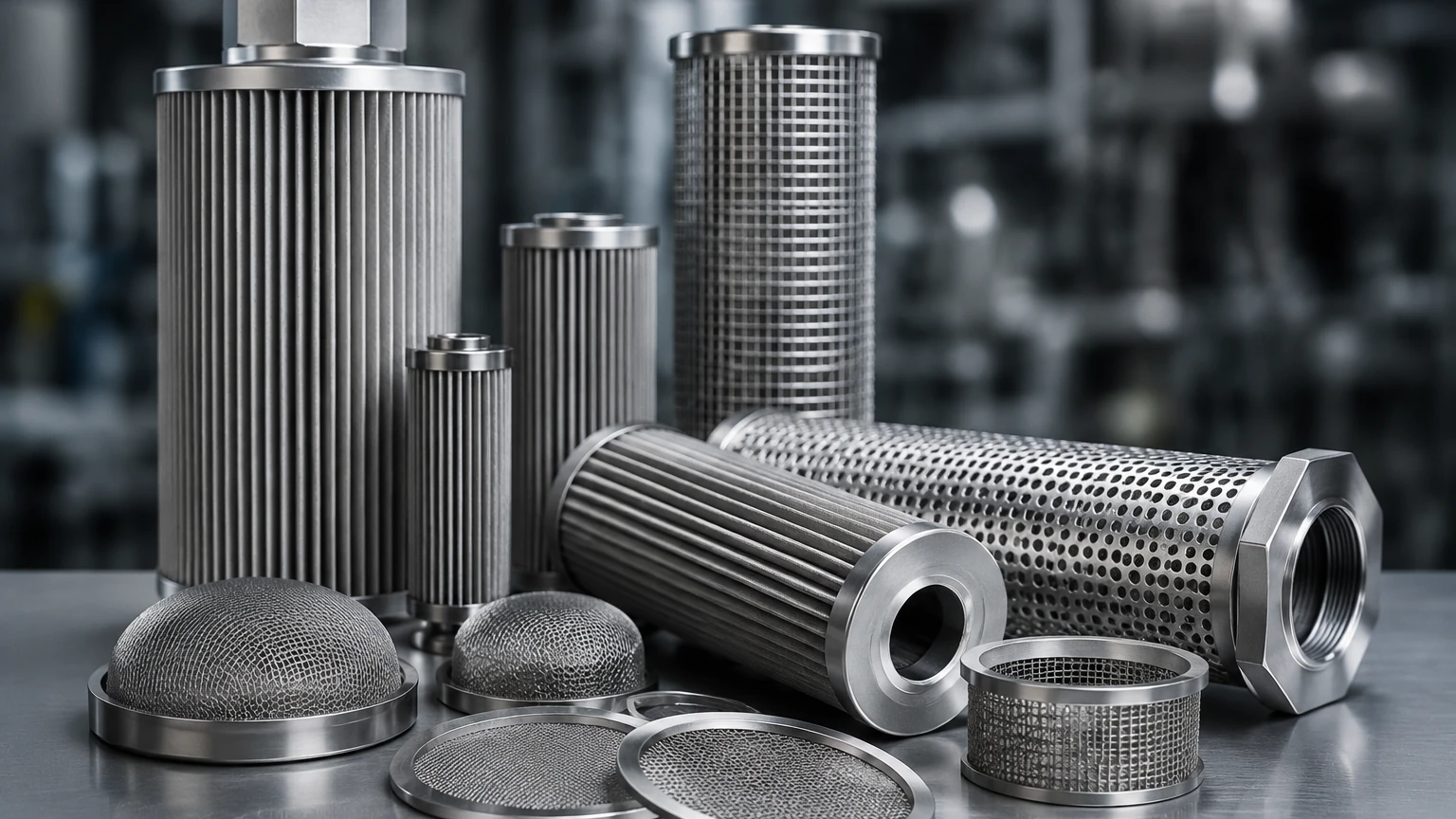
* Particulate Filters: These are designed to remove solid debris. They typically use pleated wire mesh or sintered metal to maximize surface area and dirt-holding capacity. They are often used as pre-filters to protect more sensitive downstream components.
* Coalescing Filters: These are specifically designed to remove liquid aerosols and oil mists. As the gas passes through the media, tiny droplets collide and merge (coalesce) into larger drops, which then drain to the bottom of the filter housing due to gravity. These are essential for high-purity air applications and natural gas processing.
Customization and OEM Solutions
Standard off-the-shelf filters often fail to meet the specific spatial or performance requirements of complex industrial machinery. This is where custom engineering becomes vital. Manufacturers like Kaifil provide OEM services to develop filtration components that fit unique housing geometries or meet specific filtration efficiencies.
Customization options often include:
* Variable Layering: Combining different mesh counts to create a gradient density filter for better depth filtration.
* End Cap Configurations: Custom fittings (threaded, flanged, or O-ring seals) to ensure a leak-proof interface with existing hardware.
* Reinforced Structures: Adding internal support cores or external shrouds to withstand high differential pressures without collapsing.
For projects requiring specialized designs, consulting the Main Page can provide insights into the manufacturing processes and material options available for bespoke filtration solutions.
Maintenance and Operational Best Practices
To ensure the continued performance of an industrial gas filter, a proactive maintenance schedule is required. The primary indicator of filter health is the differential pressure gauge.
1. Monitor Differential Pressure: As the filter captures contaminants, the resistance to flow increases. Most industrial systems have a recommended "change-out" pressure (e.g., 10-15 psi). Exceeding this can lead to media rupture or bypass leakage.
2. Regular Inspection of Seals: Even the highest quality filter element will fail if the O-rings or gaskets are degraded. Seals should be checked for brittleness or swelling during every filter change.
3. Proper Drainage: For coalescing filters, the manual or automatic drain must be functioning correctly. If the liquid level in the housing rises too high, it will be re-entrained into the gas stream, defeating the purpose of the filter.
Conclusion: Selecting the Right Partner
Implementing an effective industrial gas filter system is a balance between filtration efficiency, energy consumption, and material durability. By focusing on high-quality stainless steel components and understanding the specific physics of the gas stream, engineers can significantly improve the reliability of their industrial processes.
Whether you are designing a new system or optimizing an existing one, choosing a manufacturer with deep technical expertise in metal filtration ensures that the components will perform under the most demanding conditions. For further technical data, application guides, and to view the full product catalog, please refer to the Main Page of Kaifil’s filtration resources. Selecting the right filtration partner is the first step toward achieving long-term operational excellence and protecting your critical industrial assets.
