


What Is a Coalescer of an Oil Water Separator
In industrial fluid processing, the separation of immiscible liquids—most commonly oil and water—is a critical requirement for environmental compliance, equipment longevity, and process efficiency. Central to this process is the coalescer. Understanding what is a coalescer of an oil water separator requires a deep dive into the fluid dynamics and material science that allow microscopic droplets to merge into larger, manageable masses.
For engineers and procurement specialists, selecting the right coalescing media is not merely a matter of purchasing a filter; it is an engineering decision that impacts the total cost of ownership and the reliability of downstream systems. Whether used in petrochemical refining, marine bilge water treatment, or hydraulic fluid maintenance, the coalescer serves as the primary engine of separation efficiency.
Understanding the Role of a Coalescer in Industrial Separation
A coalescer is a specialized component designed to facilitate the merging of small, dispersed droplets of one liquid (the discontinuous phase) into larger droplets within another liquid (the continuous phase). In the context of an oil-water separator, the coalescer typically targets either oil droplets suspended in water or water droplets suspended in oil.
Unlike standard particulate filters that trap solids through mechanical straining, a coalescer utilizes surface tension and flow dynamics to alter the physical state of the fluid mixture. The primary objective is to increase the droplet size to a point where gravity or buoyancy can effectively separate the two liquids. Without a coalescer, microscopic droplets (often smaller than 20 microns) may remain in a stable emulsion indefinitely, passing through standard separation chambers without being removed.
Industrial applications often require high-performance components to handle aggressive chemicals or high temperatures. Manufacturers like Kaifil specialize in providing the robust stainless steel media necessary for these demanding environments. For those seeking specific technical data on media types, visiting the Main Page provides a comprehensive overview of available filtration and separation technologies.
The Technical Principles of Coalescence
To understand what is a coalescer of an oil water separator, one must examine the three-stage process of coalescence: interception, attachment, and release.
1. Interception and Impingement
As the emulsion flows through the coalescing media—which may consist of specialized wire mesh, pleated fibers, or structured plates—the small droplets come into contact with the media surface. This is achieved through Brownian motion for very small droplets or inertial impaction for larger ones. The design of the media must ensure a high surface area to maximize the probability of contact without creating an excessive pressure drop.
2. Attachment and Coalescence
Once a droplet contacts the media, it must adhere to the surface or to other droplets already captured. This is where the material properties of the coalescer become critical. Coalescers are often designed to be "oleophilic" (oil-attracting) or "hydrophilic" (water-attracting) depending on which phase needs to be merged. As more droplets accumulate, they collide and merge into larger globules. This process is driven by the reduction of surface free energy; one large drop has less surface area than many small drops of the same volume.
3. Release and Gravity Separation
Eventually, the merged droplets grow large enough that the drag force of the flowing fluid or the force of gravity overcomes the adhesive forces holding them to the media. These enlarged droplets are released into the downstream flow. Because the droplets are now significantly larger, their settling or rising velocity increases exponentially, following Stokes' Law. In an oil-in-water application, the large oil globules quickly rise to the surface of the separator tank, where they can be skimmed off.
Common Materials and Media for Industrial Coalescers
The choice of material for a coalescer is dictated by the chemical compatibility of the fluids, the operating temperature, and the required filtration fineness. In heavy industrial and B2B sectors, stainless steel is often the preferred material due to its durability and resistance to corrosion.
Stainless Steel Wire Mesh
Knitted or woven stainless steel wire mesh is a staple in high-performance coalescers. The multi-layered structure of the mesh provides a tortuous path for the fluid, ensuring high contact probability. Stainless steel is particularly valued in the chemical and pharmaceutical industries where plastic-based media might degrade or leach contaminants into the process stream.
Parallel Plate Packs
In large-scale water treatment, corrugated plate interceptors (CPI) or parallel plate packs are used. These rely on providing a short distance for droplets to travel before hitting a surface and coalescing. While effective for high flow rates, they are generally less efficient at removing very fine emulsions compared to depth-style media.
Cartridge-Style Coalescers
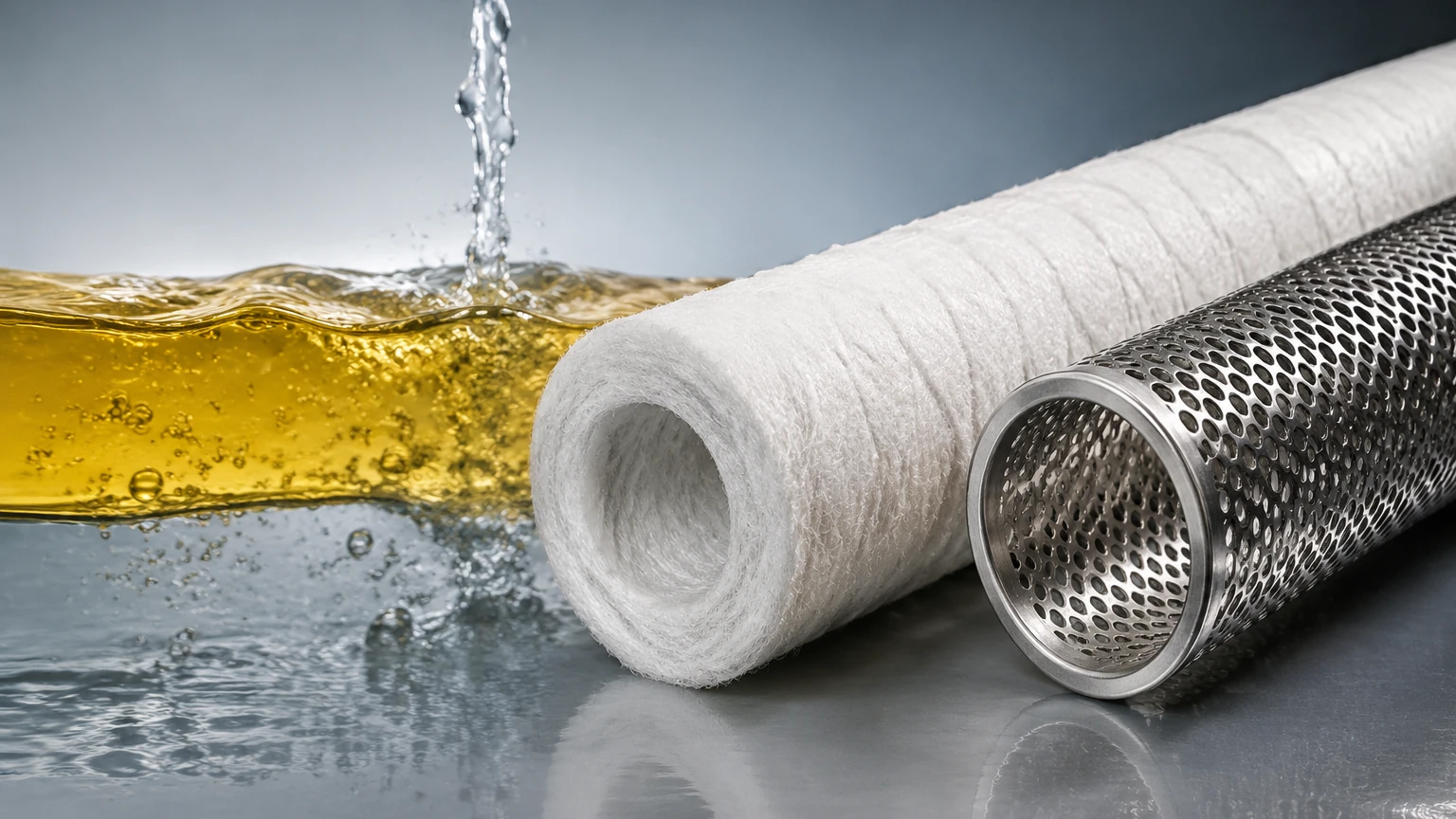
For high-purity applications, such as aviation fuel filtration or precision hydraulic systems, cartridge-style coalescers are utilized. These often feature a graded pore structure, moving from a fine inner layer for initial coalescence to a coarser outer layer for droplet growth. These components require precise manufacturing to ensure that the pore size distribution is consistent throughout the service life.
Key Engineering Considerations for Filter Selection
When engineers evaluate what is a coalescer of an oil water separator for a specific project, several technical variables must be confirmed to ensure performance:
* Fluid Viscosity: Higher viscosity fluids resist the movement of droplets, requiring larger coalescing surfaces or slower flow velocities to achieve the same separation efficiency.
* Interfacial Tension (IFT): This is a measure of the force keeping the two liquids separate. Low IFT (often caused by the presence of surfactants or detergents) makes coalescence much more difficult, as the droplets are less likely to merge upon contact.
* Specific Gravity Differential: The greater the difference in density between the oil and the water, the faster the separation will occur once the droplets have coalesced.
* Operating Temperature: Temperature affects both viscosity and interfacial tension. A coalescer designed for room temperature may fail if the process fluid is heated, as the physical properties of the emulsion change.
For customized solutions that address these specific variables, technical teams often consult manufacturers to develop bespoke media configurations. Detailed engineering support for such requirements can be found on the Main Page.
Evaluating Performance: Efficiency and Pressure Drop
The performance of a coalescer is typically measured by two metrics: separation efficiency and differential pressure (ΔP).
Separation Efficiency
Efficiency is usually expressed as the concentration of the dispersed phase in the effluent, often measured in parts per million (ppm). For example, a high-efficiency coalescer might take an inlet concentration of 1,000 ppm of oil and reduce it to less than 5 ppm. It is important to note that efficiency is not static; it depends on the flow rate. Exceeding the design flow rate can lead to "re-entrainment," where the velocity of the fluid is so high that it breaks apart the large droplets before they can separate.
Pressure Drop Considerations
Every coalescer introduces a restriction to the flow. A well-designed system balances the need for a dense, high-surface-area media with the need to minimize energy consumption and pump wear. In stainless steel systems, the pressure drop can often be managed through precision weaving and layering techniques. Monitoring the differential pressure is the primary method for determining when a coalescer media is becoming fouled with solid contaminants and requires cleaning or replacement.
Maintenance, Cleaning, and Service Life
A common question regarding what is a coalescer of an oil water separator involves the maintenance cycle. Unlike simple filters, coalescers can be sensitive to solid particulate matter. If a fluid contains high levels of suspended solids, these solids can coat the coalescing media, preventing the oil droplets from making contact with the surface. This is known as "blinding."
To protect the coalescer, a pre-filter is almost always recommended. This pre-filter removes solids, allowing the coalescer to focus solely on liquid-liquid separation.
In terms of service life, stainless steel coalescers offer a significant advantage over disposable fiberglass or polymer versions. Metal media can often be cleaned using ultrasonic baths, chemical cleaning agents, or backwashing, depending on the nature of the contaminants. This capability significantly reduces the long-term operational costs and waste generation of a facility. Engineers should establish a baseline differential pressure for a clean system and schedule maintenance when the ΔP reaches a predetermined limit, typically 15-25 psi above the clean drop, depending on the system design.
Customization for Specific Industrial Applications
No two industrial streams are identical. A coalescer used in a food processing plant to recover fats and oils from wash water faces different challenges than one used in an offshore oil rig to treat produced water.
Customization options include:
* Alloy Selection: Using 304, 316L, or even exotic alloys like Hastelloy for highly corrosive environments.
* Layering Configurations: Combining different mesh densities to handle a wide range of droplet sizes in a single housing.
* Structural Reinforcement: Designing the coalescer elements to withstand high-pressure surges or mechanical vibrations common in heavy machinery.
When determining the specifications for a new or replacement coalescer, it is vital to provide the manufacturer with a full fluid analysis. This includes the chemical composition, the expected range of oil concentrations, and the presence of any surfactants or solid particles.
Conclusion
In summary, understanding what is a coalescer of an oil water separator is essential for any professional involved in industrial fluid management. It is a sophisticated component that relies on the physics of surface tension and droplet growth to achieve what gravity alone cannot. By selecting high-quality, durable media—specifically stainless steel options for demanding environments—facilities can ensure consistent separation performance, meet environmental regulations, and protect downstream equipment.
For those ready to specify a system or seeking technical consultation on custom filtration components, the Main Page serves as a gateway to professional-grade solutions and manufacturing expertise. Investing in the right coalescing technology today prevents the costly operational failures and environmental non-compliance issues of tomorrow.
Download What Is a Coalescer of an Oil Water Separator as a PDF
