


Lube Filtration
In industrial engineering and machinery maintenance, lube filtration represents a critical process for ensuring the longevity and operational efficiency of rotating equipment, hydraulic systems, and internal combustion engines. Lubrication oil serves multiple functions: it reduces friction between moving parts, dissipates heat, prevents corrosion, and carries away contaminants. However, as the oil circulates, it inevitably picks up particulate matter, moisture, and chemical byproducts. Without an effective filtration strategy, these contaminants accelerate component wear, leading to premature failure and costly downtime.
Selecting the appropriate filtration solution requires a deep understanding of fluid dynamics, material compatibility, and the specific environmental conditions of the application. For engineers and procurement teams, the goal is to balance filtration efficiency with system pressure requirements and long-term maintenance costs. This guide examines the technical foundations of lube filtration, the engineering considerations for filter selection, and the role of high-performance materials in demanding industrial environments.
The Mechanics of Contamination in Lubrication Systems
Contamination is the primary cause of failure in lubricated systems. Even in seemingly clean environments, microscopic particles can enter the system through seals, breathers, or during routine maintenance. These contaminants are generally categorized into three types: solid particulates, water, and chemical degradation products.
Solid Particulate Matter
Solid particles, such as metal shavings, silica (dust), and soot, are the most common threats. In high-precision machinery, particles as small as 5 to 15 microns can bridge the lubricant film between moving surfaces, causing abrasive wear. This process, often referred to as "three-body abrasion," occurs when a hard particle is trapped between two sliding surfaces, gouging the metal and creating more wear debris. This creates a destructive feedback loop that degrades the equipment's internal tolerances.
Moisture and Water Ingress
Water contamination can occur through condensation or cooling system leaks. Water reduces the lubricant's load-carrying capacity, promotes the oxidation of the oil, and leads to the corrosion of metal surfaces. In some systems, water can also lead to the formation of sludge or microbial growth, which can quickly blind (clog) filter elements.
Chemical Degradation and Varnish
Over time, heat and oxygen cause lubricating oil to break down. This chemical degradation results in the formation of organic acids and insoluble resins, commonly known as varnish. Varnish can deposit on valves, bearings, and filter surfaces, increasing friction and reducing the effectiveness of the filtration system.
Engineering Criteria for Filter Selection
When specifying a filter for a lube filtration system, engineers must look beyond simple dimensions. The performance of a filter is defined by its ability to remove specific particle sizes while maintaining a manageable pressure drop. Key technical metrics include the Beta ratio, micron rating, and dirt-holding capacity.
Understanding the Beta Ratio (Efficiency)
The Beta ratio ($β$) is the industry standard for expressing the filtration efficiency of a filter element based on the Multi-Pass Test (ISO 16889). It is calculated by dividing the number of particles of a given size upstream of the filter by the number of particles of the same size downstream. For example, a $β_{10} = 200$ means that for every 200 particles of 10 microns entering the filter, only one passes through, representing 99.5% efficiency. For critical industrial applications, high Beta ratios are essential to maintain the required ISO 4406 cleanliness codes.
Nominal vs. Absolute Micron Ratings
It is important to distinguish between nominal and absolute ratings. A nominal rating is an arbitrary micrometer value indicated by the manufacturer, often representing a 50% to 95% efficiency. An absolute rating, however, refers to the diameter of the largest hard spherical particle that will pass through the filter under specified test conditions. In precision lube filtration, absolute-rated filters are preferred to ensure consistent protection of sensitive components.
Pressure Drop and Flow Rate
Every filter element introduces resistance to the fluid flow, resulting in a pressure drop ($ΔP$). This resistance increases as the filter captures contaminants. If the initial pressure drop is too high, it can trigger bypass valves or starve the machinery of oil. Engineers must ensure the filter housing and element are sized to handle the maximum system flow rate at the lubricant's highest viscosity (typically during cold starts) without exceeding the recommended $ΔP$.
The Role of Stainless Steel in Lube Filtration
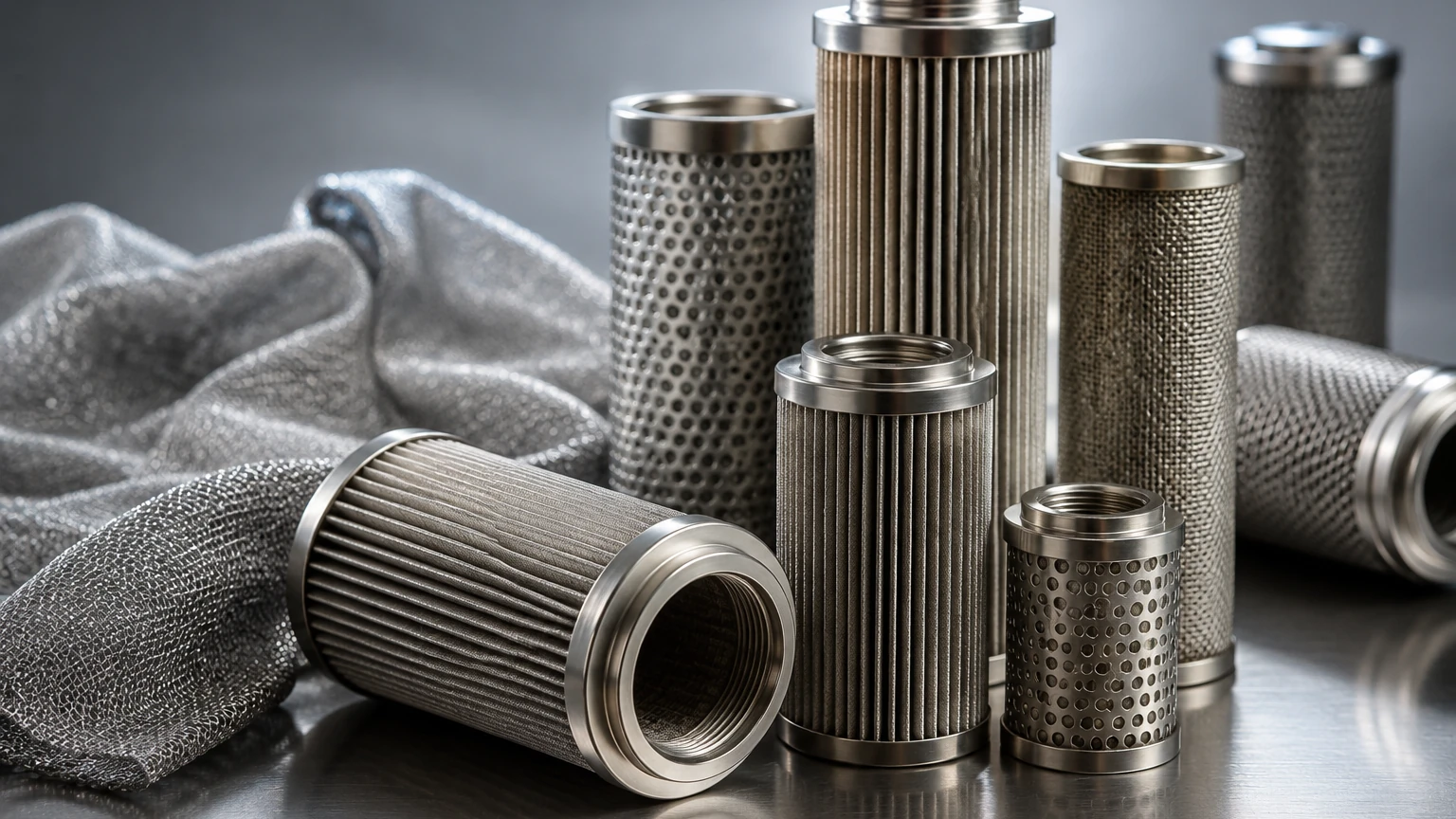
While disposable cellulose or synthetic glass fiber elements are common in many applications, stainless steel wire mesh filters offer distinct advantages in demanding industrial environments. As a manufacturer specializing in custom stainless steel filtration solutions, Kaifil provides components designed for durability and precision.
Thermal and Chemical Stability
Industrial lubricants often operate at elevated temperatures or contain aggressive additives. Stainless steel (typically Grade 304 or 316L) maintains its structural integrity and filtration accuracy across a wide temperature range where synthetic media might soften or degrade. Furthermore, stainless steel is highly resistant to the chemical additives found in modern synthetic oils, preventing media migration—a phenomenon where filter fibers break off and enter the clean oil stream.
Cleanability and Reusability
One of the primary benefits of stainless steel wire mesh is that it is cleanable. In systems with high contaminant loading or where the cost of specialized disposable elements is prohibitive, stainless steel cartridges can be ultrasonically cleaned or backflushed and returned to service. This not only reduces the total cost of ownership but also minimizes the environmental impact of filter disposal.
High Structural Strength
In high-pressure lube systems, such as those found in heavy hydraulic machinery or large-scale turbines, filter elements are subjected to significant mechanical stress. Stainless steel mesh can be pleated and supported by internal cores and external cages to withstand high differential pressures without collapsing. This ensures that the filtration remains effective even during system surges or when the filter is nearing its dirt-holding capacity.
Performance Evaluation and Maintenance Strategies
A lube filtration system is only as effective as its maintenance program. Monitoring the condition of both the oil and the filter is essential for preventing unexpected failures. To learn more about specific filter configurations and technical support for your system, you can Main Page to review product options and application support.
Differential Pressure Monitoring
Most industrial filter housings are equipped with differential pressure indicators or transducers. These devices provide a visual or electronic signal when the pressure drop across the element reaches a predetermined limit. Monitoring these trends allows maintenance teams to schedule filter changes before the bypass valve opens, which would allow unfiltered oil to reach the machinery.
Oil Analysis
Regular oil analysis is a cornerstone of proactive maintenance. By measuring the particle count, water content, and chemical health of the oil, engineers can determine if the current filtration system is meeting the required cleanliness standards. If particle counts remain high despite frequent filter changes, it may indicate a need for a higher-efficiency media or a larger filter housing to increase residence time.
Replacement Cycles
The replacement cycle for a lube filter depends on the environment, the duty cycle of the machine, and the quality of the filter media. In stable environments, cycles can be predicted based on operating hours. However, in variable conditions, such as mobile hydraulic equipment or chemical processing plants, replacement should be driven by condition monitoring rather than a fixed calendar schedule.
Customization and OEM Solutions for Industrial Applications
No two industrial applications are identical. Factors such as space constraints, specialized fluid types, and extreme operating pressures often necessitate customized filtration designs. Customization allows for the optimization of the filter's surface area, micron rating, and connection types to fit seamlessly into existing equipment.
Tailored Micron Ratings and Mesh Weaves
Depending on the sensitivity of the bearings or gears being protected, the filtration mesh can be tailored. Plain weave, twilled weave, or Dutch weave patterns offer different combinations of flow capacity and filtration fineness. For instance, a Dutch weave provides a tortuous path for particles, offering higher filtration accuracy for fine lube systems, while a square mesh might be used for coarse suction strainers.
Integration with OEM Equipment
Original Equipment Manufacturers (OEMs) often require filtration components that meet specific footprint and performance envelopes. Custom-engineered stainless steel cartridges can be designed with specialized end caps, seals (such as Viton or EPDM), and internal bypass mechanisms to meet the rigorous standards of the aerospace, pharmaceutical, or food and beverage industries.
Total Cost of Ownership (TCO) Considerations
When evaluating lube filtration options, it is a mistake to focus solely on the initial purchase price of the filter element. The Total Cost of Ownership (TCO) includes the cost of the oil, the cost of replacement elements, the labor for maintenance, the cost of disposal, and, most importantly, the cost of equipment downtime.
1. Extended Oil Life: High-efficiency filtration keeps the oil cleaner for longer, extending the interval between full oil changes. Given the rising cost of high-performance lubricants, this provides a significant return on investment.
2. Reduced Component Wear: By maintaining lower particle counts, the wear rate on expensive components like pumps, valves, and bearings is drastically reduced, extending the mean time between overhauls (MTBO).
3. Energy Efficiency: A well-sized filter with a low clean pressure drop reduces the energy required by the pump to circulate the oil through the system.
In conclusion, effective lube filtration is a multi-faceted engineering challenge. By selecting the right materials—such as durable stainless steel wire mesh—and adhering to rigorous technical specifications, industrial operators can ensure their machinery operates at peak performance. Whether for chemical processing, hydraulic power, or large-scale manufacturing, the investment in high-quality filtration components pays dividends in reliability and reduced operational risk.
