


Air Oil Filter Separators
In industrial compressed air systems, particularly those utilizing oil-injected rotary screw or vane compressors, the efficiency of the separation process is critical to both the quality of the downstream air and the operational longevity of the equipment. Air oil filter separators are specialized components designed to remove lubricant aerosols from the compressed air stream before it exits the compressor package. Achieving high-purity air while maintaining low energy consumption requires a deep understanding of the coalescence principle, material science, and the mechanical design of the filter element.
For engineers and procurement professionals, selecting the correct air oil filter separators involves balancing filtration efficiency (measured in parts per million of residual oil carryover) against the pressure drop across the media. As a professional manufacturer specializing in custom stainless steel filtration solutions, Kaifil provides the technical expertise necessary to navigate these variables, ensuring that filtration components meet the rigorous demands of chemical processing, pharmaceutical production, and heavy industrial applications.
The Role of Air Oil Filter Separators in Industrial Systems
Most modern industrial compressors use oil for three primary functions: sealing the compression chamber, lubricating the bearings, and cooling the air during the compression process. However, this oil becomes entrained in the compressed air as a fine mist or aerosol. If this oil is not effectively removed, it can contaminate downstream pneumatic tools, foul sensitive instruments, and compromise the quality of manufactured products, particularly in the food and beverage or pharmaceutical sectors.
Air oil filter separators function as the final stage of the internal separation process. While the primary separator tank uses centrifugal force and gravity to remove the bulk of the oil (typically up to 99%), the filter separator is responsible for capturing the remaining sub-micron droplets. High-quality separators can reduce oil carryover to levels as low as 1 to 3 ppm (parts per million), ensuring the air is suitable for a wide range of industrial uses.
Technical Principles of Coalescence Separation
The operation of air oil filter separators relies on the principle of coalescence. Unlike standard particulate filters that simply block solids, coalescing filters merge small liquid droplets into larger ones. This process occurs through three distinct physical mechanisms:
1. Direct Interception: Larger oil droplets traveling in the air stream collide directly with the filter fibers. Because the fibers are wetted with oil, the droplets adhere to them.
2. Inertial Impaction: Droplets with higher mass cannot follow the rapid changes in air direction as the stream weaves through the fiber matrix. Their momentum carries them into the fibers, where they are captured.
3. Brownian Diffusion: Extremely small droplets (typically less than 0.1 microns) move erratically due to collisions with air molecules. This random motion increases the probability that they will contact a fiber and be captured.
Once captured, these droplets migrate along the fibers and accumulate at the intersections of the filter media. As they merge, they form larger drops that eventually reach the outer surface (or inner surface, depending on the flow direction) of the separator. Gravity then pulls these heavy drops to the bottom of the filter, where they are collected and returned to the compressor’s lubrication circuit via a scavenge line.
Engineering and Material Selection
The performance of air oil filter separators is heavily dependent on the materials used in their construction. Because these components must withstand high temperatures, pressure fluctuations, and potential chemical exposure from synthetic lubricants, the structural integrity of the filter is paramount.
Filter Media
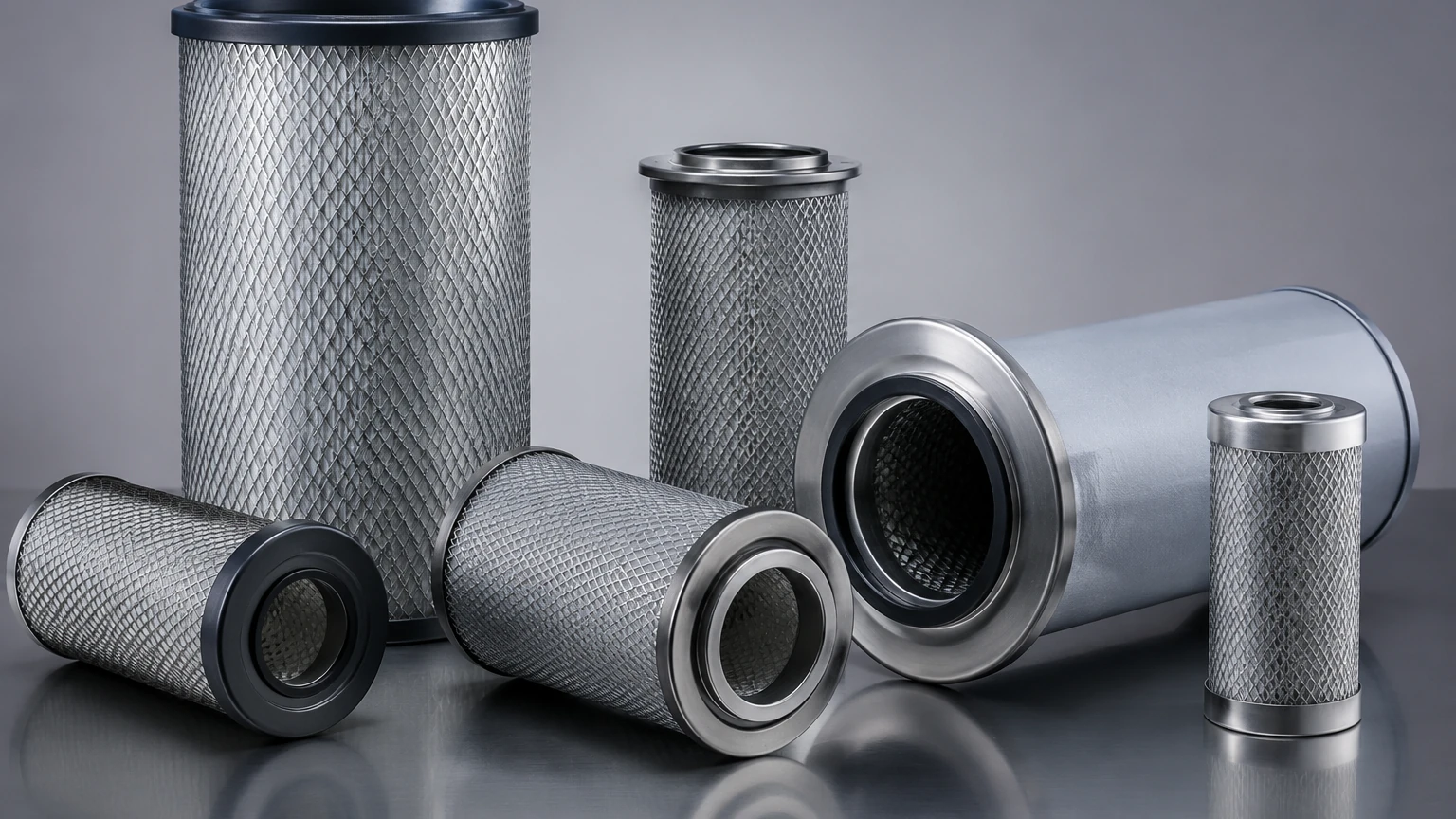
High-performance separators typically utilize multi-layered borosilicate glass fibers. These fibers are chosen for their high void volume and small diameter, which maximize the surface area available for coalescence. In many specialized industrial environments, these media layers are supported by stainless steel mesh or perforated metal to prevent media migration and ensure the element does not collapse under high differential pressure.
Structural Components
At Kaifil, the focus on stainless steel components provides a significant advantage in durability. Stainless steel end caps and inner/outer support cores offer superior resistance to corrosion compared to standard galvanized steel. This is particularly important in environments where moisture levels are high or where the compressor is located in a corrosive atmosphere, such as a chemical plant or coastal facility. For more information on material specifications and custom engineering, you can visit the Main Page to review product options and application support.
Sealing and Grounding
Proper sealing is critical to prevent air from bypassing the filter media. High-temperature gaskets, often made from Viton or specialized elastomers, are used to ensure a leak-proof fit. Additionally, because the high-speed flow of air and oil can generate static electricity, air oil filter separators must be properly grounded. Most industrial designs include metal staples or grounding clips to dissipate static charges, preventing the risk of internal fires or explosions within the separator tank.
Key Performance Indicators for Selection
When specifying air oil filter separators for an OEM application or a replacement cycle, engineers must evaluate several key performance indicators (KPIs) to ensure the component is fit for purpose.
1. Residual Oil Carryover
This is the amount of oil remaining in the air after it passes through the separator. It is usually expressed in mg/m³ or ppm. For most industrial applications, a carryover of 3 ppm is acceptable, but high-precision industries may require even lower levels. It is important to note that carryover is affected by the air velocity; if the compressor is over-speeded or the separator is undersized, the velocity will be too high for effective coalescence.
2. Initial and Terminal Pressure Drop
Pressure drop (differential pressure) represents energy loss. Every 1 PSI of pressure drop increases the power consumption of the compressor by approximately 0.5%. A high-quality separator should have a low initial pressure drop (typically 0.15 to 0.25 bar). The "terminal" pressure drop is the point at which the filter is considered fouled and must be replaced, usually around 0.7 to 1.0 bar.
3. Flow Capacity
Separators are rated for a specific flow range (CFM or m³/min). Operating a separator significantly above its rated capacity will lead to "re-entrainment," where the high-speed air strips oil off the discharge side of the filter and carries it downstream, defeating the purpose of the separator.
Common Risks and Failure Modes
Understanding why air oil filter separators fail is essential for maintaining system reliability. Several factors can lead to premature failure or poor performance:
* Oil Contamination: If the compressor oil is not changed according to the manufacturer's schedule, it can oxidize and form varnish. This varnish coats the filter fibers, reducing the effective surface area and rapidly increasing the pressure drop.
* Water Emulsification: Excessive moisture in the oil (often caused by running the compressor at too low a temperature) can lead to the formation of an oil-water emulsion. This thick mixture can clog the separator media and lead to high oil carryover.
* Mechanical Damage: Sudden pressure surges or improper installation can damage the filter media or the seals. Even a small pinhole in the media can lead to a massive increase in oil carryover.
* Scavenge Line Blockage: If the scavenge line—the small tube that returns collected oil to the compressor—becomes blocked, the oil will build up in the bottom of the separator housing until it is sucked out by the air stream.
Customization and OEM Solutions
Standard off-the-shelf separators do not always meet the specific requirements of specialized industrial machinery. In many cases, custom-designed air oil filter separators are required to fit unique housing geometries, handle extreme temperatures, or provide higher filtration grades for sensitive processes.
Kaifil specializes in these custom solutions, utilizing advanced manufacturing capabilities to produce stainless steel filtration components that are tailored to the specific flow dynamics and chemical environments of the client's system. By working closely with engineers during the design phase, it is possible to optimize the pleat density, media composition, and structural reinforcement of the separator to maximize service life and minimize total cost of ownership.
Maintenance and Replacement Cycles
The replacement cycle for air oil filter separators varies depending on the environment and the quality of the incoming air and oil. In a clean, well-maintained environment, a high-quality separator can last between 4,000 and 8,000 operating hours. However, monitoring the differential pressure is the most reliable way to determine when a change is necessary.
Modern compressor controllers often include a differential pressure sensor that alerts the operator when the limit is reached. If such a system is not in place, manual gauges should be checked regularly. Replacing a separator before it reaches its terminal pressure drop can often pay for itself in energy savings alone, as the reduced load on the compressor motor lowers electricity consumption.
Conclusion
Air oil filter separators are a vital link in the chain of industrial compressed air production. Their ability to efficiently remove oil aerosols through coalescence protects downstream equipment and ensures product quality. By selecting separators constructed with high-grade materials like stainless steel and borosilicate glass, and by adhering to rigorous maintenance schedules, industrial facilities can achieve reliable, cost-effective filtration performance.
For technical professionals seeking to optimize their filtration systems, understanding the nuances of pressure drop, flow velocity, and material compatibility is the first step toward better system design. Whether you are designing a new compressor system or looking to improve the performance of an existing installation, focusing on the engineering details of your filtration components will yield long-term operational benefits. For further technical resources and product details, visit the Main Page to explore how specialized stainless steel filtration solutions can support your specific industrial requirements.
