


Diffuser Stone for Beer
In the commercial brewing and beverage industry, precision and consistency are the hallmarks of a successful production line. Among the various components that contribute to the final quality of the product, the diffuser stone for beer—often referred to as a carbonation stone or aeration stone—plays a critical role in gas management. Whether it is used for oxygenating wort prior to fermentation or carbonating the finished beer in a bright tank, the efficiency of the diffusion process directly impacts flavor profile, head retention, and production timelines.
As a manufacturer specializing in custom stainless steel filtration and precision metal components, Kaifil understands that these stones are more than just simple porous weights. They are engineered tools designed to manipulate gas-to-liquid interfaces at a microscopic level. This guide examines the technical specifications, engineering considerations, and maintenance protocols essential for technical professionals and purchasing teams evaluating these components for industrial use.
Understanding the Role of Diffuser Stones in Industrial Brewing
The primary function of a diffuser stone for beer is to increase the surface area of the gas being introduced into the liquid. In brewing, this is generally carbon dioxide (CO2) for carbonation or oxygen (O2) for aeration. According to Henry’s Law, the amount of dissolved gas in a liquid is proportional to its partial pressure above the liquid. However, in a production environment, simply increasing pressure is often inefficient and slow.
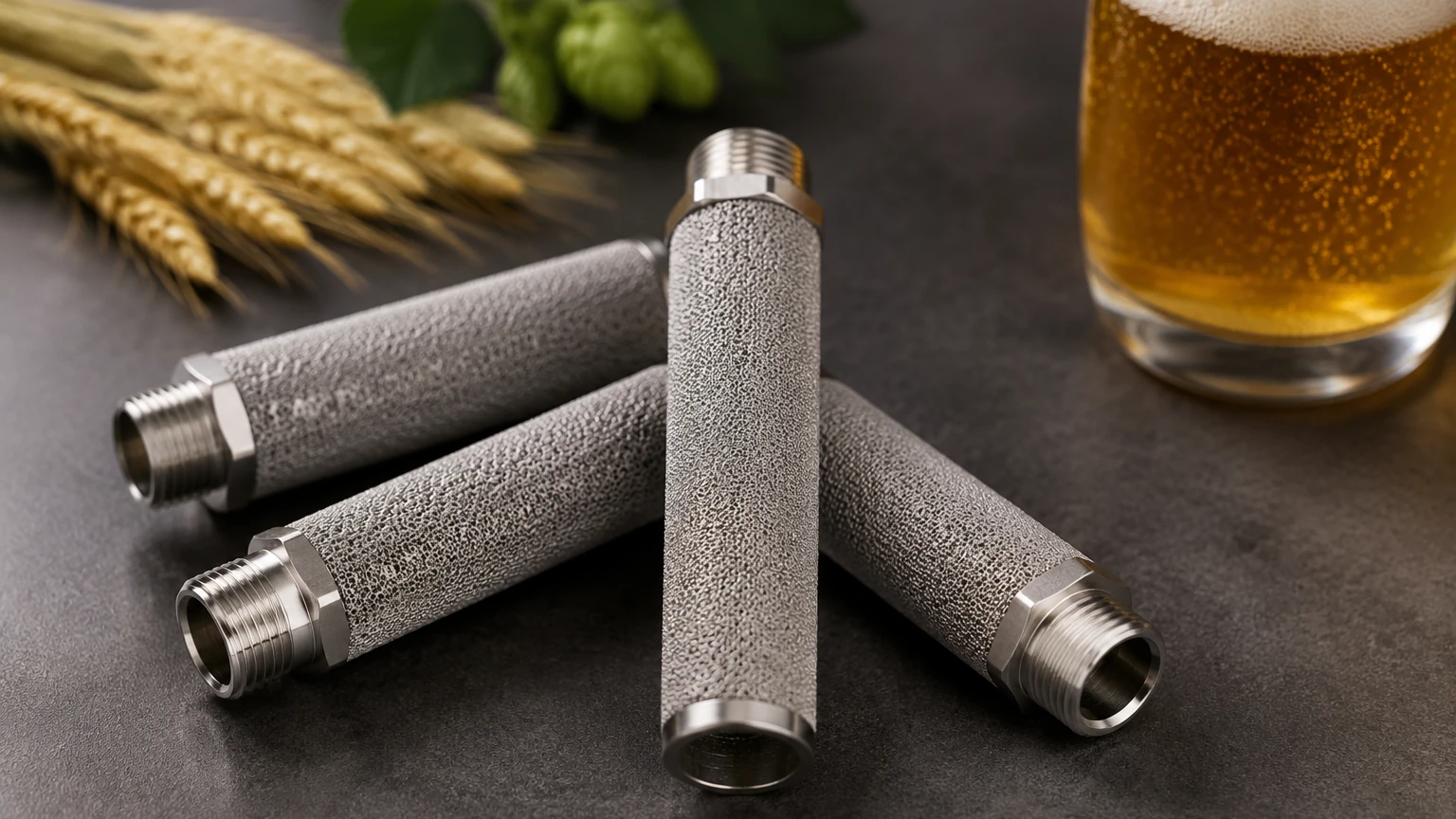
A diffuser stone bypasses the limitations of surface-level gas absorption by forcing the gas through millions of tiny pores in a sintered metal matrix. This creates a "curtain" of micro-bubbles. Because smaller bubbles have a much higher surface-area-to-volume ratio than larger bubbles, they dissolve into the beer or wort almost instantly as they rise through the tank. This process, known as diffusion, ensures that the gas is evenly distributed and fully integrated, preventing the "burping" of gas at the surface and reducing the time required to reach desired carbonation levels or oxygen saturation.
Material Science and Construction of Sintered Metal Stones
For industrial applications, the material of construction is non-negotiable. Stainless steel, specifically Grade 316L, is the industry standard for several reasons:
1. Corrosion Resistance: 316L stainless steel contains molybdenum, which provides superior resistance to the acidic environment of beer (typically pH 3.8 to 4.5) and the aggressive chemicals used in Clean-in-Place (CIP) cycles.
2. Durability: Unlike ceramic or plastic alternatives, sintered metal stones can withstand high pressure differentials and mechanical shocks without cracking or shedding particles into the product stream.
3. Thermal Stability: These components must often withstand high-temperature sterilization or boiling without losing structural integrity or altering pore size.
The manufacturing process involves sintering, where spherical stainless steel powders are placed in a mold and heated to a temperature just below their melting point. Under controlled pressure, the particles fuse at their contact points. This creates a rigid, porous structure with a highly controlled interconnected porosity. At Kaifil, our expertise in precision metal filter components allows for the creation of stones with uniform pore distribution, which is essential for preventing "channeling"—where gas escapes through a single large hole rather than being evenly diffused.
Technical Specifications: Micron Ratings and Pore Distribution
When selecting a diffuser stone for beer, the most critical specification is the micron rating. This rating defines the average size of the pores in the sintered material. In the brewing industry, two ratings are standard:
0.5 Micron Stones
These are primarily used for carbonation. The extremely small pores produce the finest possible bubbles, which is necessary for CO2 to dissolve efficiently into cold beer. Because the bubbles are so small, they stay in suspension longer, providing more time for the gas to cross the liquid interface. A 0.5-micron stone requires a higher "wetting pressure" (the minimum pressure needed to push gas through the pores) but results in a more stable and refined carbonation.
2.0 Micron Stones
These are typically used for wort aeration. When oxygenating wort before yeast pitch, a slightly larger bubble is acceptable, and the higher flow rate allowed by 2.0-micron pores is often preferred to quickly reach the 8–15 ppm oxygen levels required for healthy yeast propagation. These stones are also easier to clean if any wort solids manage to penetrate the outer surface.
Engineers must also consider the total surface area of the stone. For larger tanks (e.g., 100 BBL and above), a longer stone or a multi-stone manifold may be required to handle the volume of gas needed without exceeding the breakthrough pressure of the pores.
Engineering Considerations for Carbonation and Aeration
Integrating a diffuser stone into a professional brewing system requires careful calculation of flow and pressure. There are three primary pressures to consider:
* Tank Head Pressure: The pressure exerted by the gas already in the headspace of the tank.
* Hydrostatic Pressure: The pressure exerted by the height of the liquid column above the stone (approximately 1 PSI for every 28 inches of liquid depth).
* Wetting Pressure: The inherent resistance of the stone itself based on its micron rating.
To achieve flow, the gas supply pressure must exceed the sum of these three values. If the supply pressure is too high, the bubbles will merge into larger bubbles (coalescence), defeating the purpose of the stone. If it is too low, no gas will flow, and beer may even backflow into the stone, leading to internal clogging.
Furthermore, the placement of the stone is vital. It should be located at the lowest point of the tank, typically on the side of the cone or via a dedicated port on the bottom, to maximize the "hang time" of the bubbles as they rise. In-line carbonation systems, where the stone is housed in a T-junction within a transfer pipe, require precise flow meter control to ensure the gas is absorbed during the short transit time.
Installation, Cleaning, and Maintenance Protocols
The longevity of a diffuser stone for beer depends almost entirely on handling and sanitation. Because the pores are so small, they are easily clogged by oils, proteins, and mineral scale.
Handling Precautions
Technicians should never touch the porous section of the stone with bare hands. The oils from human skin can clog the micro-pores and create "dead spots" where no gas escapes. Always handle the stone by the threaded or flanged ends, or wear powder-free nitrile gloves.
Cleaning Procedures
Standard CIP cycles are often insufficient for deep-cleaning a sintered stone. The following protocol is recommended for industrial environments:
1. Rinse: Use hot, deionized water to flush out residual beer or wort.
2. Caustic Soak: Soak the stone in a 2-3% caustic soda solution at 60-80°C to dissolve organic proteins and oils.
3. Acid Wash: Periodically, an acid soak (e.g., phosphoric or nitric acid) is necessary to remove mineral buildup or beer stone (calcium oxalate).
4. Sterilization: The stone can be autoclaved, boiled, or chemically sanitized with peracetic acid (PAA). If using PAA, ensure the stone is thoroughly rinsed, as residual acid can affect the beer's flavor.
Replacement Cycles
While stainless steel stones are durable, they are not infinite. Over hundreds of cycles, the internal matrix can become permanently fouled with "beer stone" that cannot be reached by chemicals. If you notice an increase in the pressure required to achieve the same carbonation levels, or if the bubble pattern becomes uneven, it is time to replace the component. Many high-volume breweries replace stones annually as part of a preventative maintenance schedule.
Selection Criteria for Commercial Brewing Operations
When sourcing components, purchasing teams should look beyond the initial price and consider the total cost of ownership. A poorly manufactured stone with inconsistent pore sizes will lead to wasted CO2, inconsistent product quality, and frequent downtime for cleaning.
Key questions to ask suppliers include:
* What is the alloy grade? Ensure it is 316L for maximum longevity.
* What is the connection type? Common options include NPT threads, Tri-Clamp (sanitary) flanges, or hose barbs. Tri-Clamp is preferred for ease of removal and sanitation.
* Is the stone welded or bonded? High-quality stones use TIG welding to attach the porous section to the solid fittings, ensuring a hygienic, crevice-free joint.
For those looking to optimize their filtration and gas diffusion systems, reviewing specialized manufacturing capabilities is essential. You can Review product options and application support on our Main Page to see how custom-engineered sintered metal solutions can be tailored to your specific tank geometry and production requirements.
Conclusion
The diffuser stone for beer is a small but technologically sophisticated component that sits at the intersection of fluid dynamics and microbiology. By selecting the correct micron rating, ensuring high-quality 316L stainless steel construction, and adhering to strict sanitation protocols, breweries can achieve precise carbonation and robust yeast health. As industrial filtration needs become more complex, partnering with a manufacturer that understands the nuances of sintered metal technology ensures that your production line remains efficient, consistent, and capable of producing world-class beverages.
