


Dual Basket Strainers
In industrial fluid handling and process engineering, the requirement for continuous operation is often a non-negotiable parameter. System downtime, even for routine maintenance like cleaning a filter element, can lead to significant production losses, pressure surges, or downstream equipment damage. Dual basket strainers, also known as duplex strainers, are engineered specifically to address this challenge. By utilizing two separate filtration chambers connected by a diverter valve, these components allow for the cleaning or replacement of one basket while the fluid continues to flow through the other without interruption.
For engineers and procurement teams, selecting the right dual basket strainer involves a deep understanding of fluid dynamics, material compatibility, and the specific mechanical requirements of the application. This guide provides a technical overview of the design, selection, and operational considerations for industrial-grade dual basket strainers.
The Mechanical Design and Changeover Mechanism
The defining characteristic of dual basket strainers is their ability to switch flow between two identical chambers. The efficiency of this switch is governed by the diverter valve mechanism. There are several common designs used in industrial settings, each with specific advantages depending on the pressure and fluid type.
Plug Valve Design
One of the most robust designs for duplex strainers is the tapered plug valve. In this configuration, a single plug is rotated to redirect flow. This design is favored for its simplicity and durability in high-pressure environments. The plug is often spring-loaded or mechanically seated to ensure a tight seal, preventing bypass—where unfiltered fluid leaks into the clean side of the system.
Ball Valve Design
Ball valve diverters are common in smaller-diameter piping or applications requiring quick, low-torque operation. They provide an excellent seal and are generally easier to automate with pneumatic or electric actuators. However, in very high-viscosity fluids, the cavities around the ball can sometimes trap debris, requiring more frequent internal inspection.
Sliding Gate and Butterfly Valves
For large-diameter pipelines, sliding gate or butterfly valve configurations may be used to manage the duplexing function. These are typically more complex and may involve multiple valves linked by a common actuator. Regardless of the valve type, the goal remains the same: a "no-leak" transition that maintains system pressure during the changeover.
Engineering Considerations for Sizing and Pressure Drop
When specifying dual basket strainers, the most critical technical metric is the pressure drop (ΔP). Every filtration component introduces resistance to the flow, and in a duplex system, this resistance must be calculated for both the "clean" state and the "maximum dirt loading" state.
The Role of Cv Factors
The flow coefficient (Cv) represents the volume of water at 60°F that will flow through a valve or strainer with a pressure drop of 1 psi. Engineers must use the manufacturer’s Cv ratings to ensure that the strainer does not become a bottleneck. If the strainer is undersized, the velocity of the fluid increases, leading to excessive turbulence, potential erosion of the filter mesh, and a rapid increase in pressure drop that forces frequent cleaning cycles.
Viscosity Adjustments
It is a common mistake to size a strainer based on water-like viscosity. In industries such as oil and gas or food processing (e.g., syrups or resins), the fluid viscosity can be significantly higher. Higher viscosity increases the friction through the basket mesh, requiring a larger strainer body or a coarser mesh to maintain the same flow rate. Professional manufacturers provide correction factors to adjust the expected pressure drop based on the Centistoke (cSt) or Saybolt Universal Seconds (SSU) values of the process fluid.
Material Selection and Filtration Media
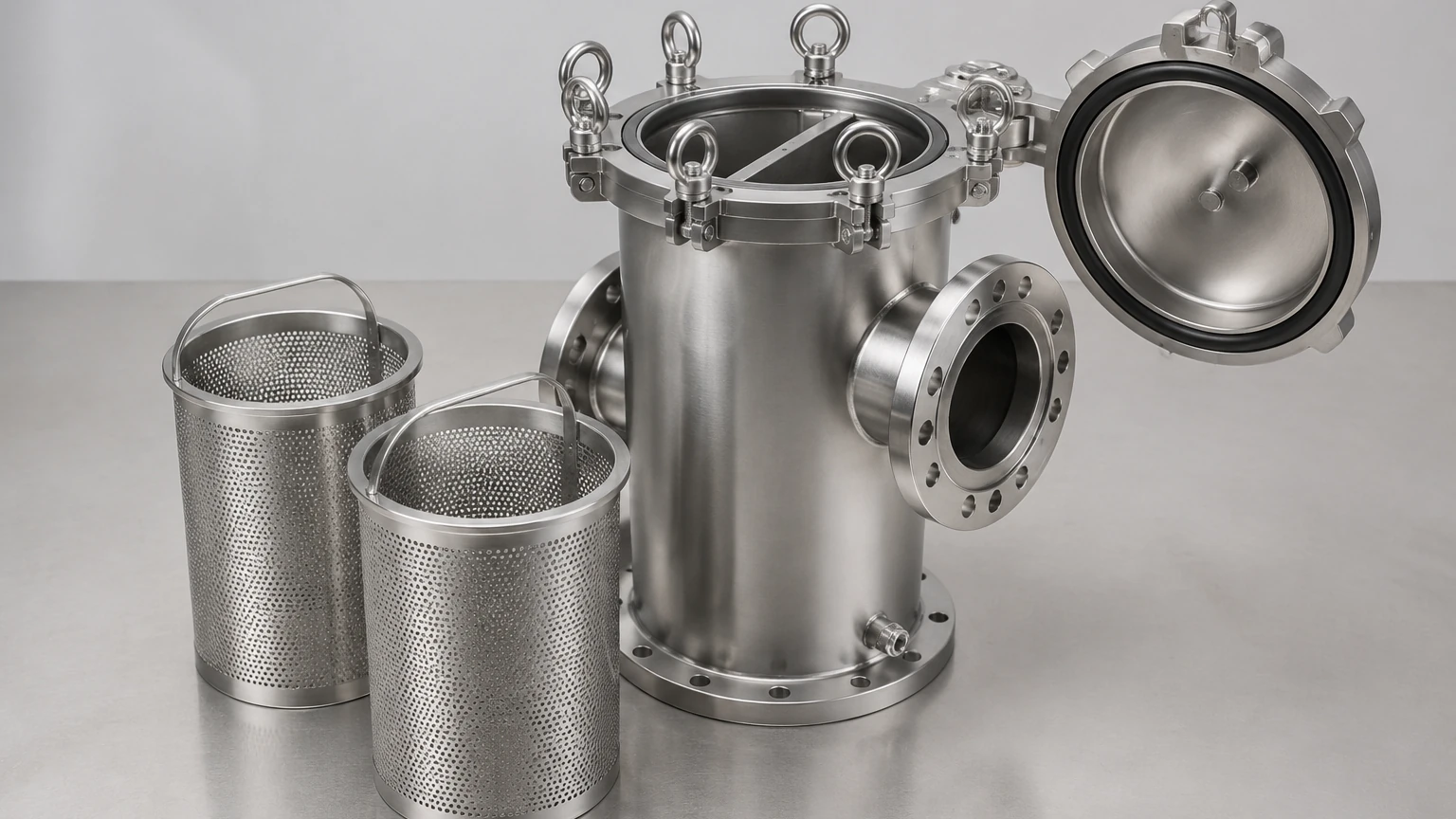
The longevity of a dual basket strainer is largely determined by its materials of construction. While the outer housing (body) must withstand the system pressure and external environment, the internal basket is the component that performs the critical work. Stainless steel is the industry standard for high-performance filtration due to its corrosion resistance and structural integrity.
Housing Materials
* Carbon Steel: Suitable for non-corrosive fluids like oils and some lubricants.
* Stainless Steel (304/316L): Essential for chemical processing, pharmaceuticals, and food and beverage applications where hygiene and resistance to aggressive cleaning agents are required.
* Specialty Alloys: For highly corrosive environments, such as seawater or concentrated acids, materials like Duplex stainless steel or Monel may be specified.
Basket Construction
The internal basket typically consists of a perforated metal support sheet lined with a fine wire mesh. The mesh count—the number of openings per linear inch—determines the filtration accuracy. For precision applications, multi-layered sintered wire mesh provides superior strength and can be cleaned back to its original state more effectively than single-layer mesh.
As a specialized manufacturer, Kaifil provides a wide range of custom stainless steel filtration solutions, including precision-engineered baskets designed for high-pressure environments. For more detailed technical specifications on custom filter components, engineers can refer to the Main Page for a comprehensive overview of manufacturing capabilities and material options.
Operational Maintenance and Safety Protocols
One of the primary advantages of dual basket strainers is the ability to perform maintenance while the system is live. However, this requires strict adherence to safety protocols to prevent operator injury or system contamination.
The Equalization Line
In high-pressure systems, switching the diverter valve can be difficult due to the pressure differential between the active chamber and the idle (cleaned) chamber. An equalization line—a small bypass valve—is often used to fill the idle chamber and equalize the pressure before the main diverter valve is turned. This prevents "water hammer" and reduces the wear on the valve seals.
Venting and Draining
Before a basket can be removed from the idle chamber, the chamber must be vented and drained. The vent valve at the top of the chamber allows air to enter so the fluid can be drained through the bottom port. Failure to vent properly can create a vacuum, making it impossible to remove the chamber cover, while failure to drain can result in hazardous fluid spills when the cover is opened.
Differential Pressure Monitoring
To take the guesswork out of maintenance, dual basket strainers should be equipped with differential pressure (DP) gauges. These gauges measure the pressure at the inlet and the outlet. When the DP reaches a pre-set limit (typically 5-10 psi over the clean drop), it signals the operator that the active basket is clogged and a changeover is required.
Common Risks and Mitigation Strategies
Even with a high-quality duplex strainer, certain operational risks can compromise filtration performance. Understanding these risks during the design phase is essential for long-term reliability.
1. Gasket and Seal Failure: The seals on the chamber covers and the diverter valve are the most common points of failure. Engineers should ensure that the seal material (Buna-N, Viton, EPDM, or PTFE) is chemically compatible with the process fluid and can withstand the operating temperature.
2. Basket Collapse: If the pressure drop across a clogged basket exceeds the structural strength of the perforated support, the basket can collapse. This allows unfiltered fluid and metal debris to bypass the strainer and enter downstream pumps or instrumentation. Specifying heavy-duty reinforced baskets is critical for high-pressure applications.
3. Air Entrainment: During the changeover process, if the idle chamber is not properly vented of air, that air can be pushed into the process line. In some hydraulic or chemical systems, air pockets can cause pump cavitation or localized overheating.
Confirming Technical Requirements Before Purchase
Before initiating a procurement request for dual basket strainers, technical professionals should confirm the following data points to ensure the equipment meets the application's demands:
* Design Pressure and Temperature: Must meet or exceed the maximum possible system surges, not just the nominal operating pressure.
* Filtration Grade (Micron Rating): Determine the smallest particle size that must be removed to protect downstream equipment. Over-filtering (selecting a mesh that is too fine) leads to unnecessarily frequent cleaning.
* Connection Type: Specify whether the strainer requires flanged, NPT (threaded), or socket-weld connections to match existing piping.
* Compliance Standards: Confirm if the vessel needs to be manufactured to ASME Section VIII, PED (Pressure Equipment Directive), or other regional industrial standards.
* Customization Needs: In many OEM scenarios, standard off-the-shelf strainers may not fit the available footprint. Custom nozzle orientations or specialized basket handles may be required for ergonomic maintenance.
Conclusion
Dual basket strainers are indispensable for maintaining the continuity of industrial processes. By allowing for offline cleaning without stopping the flow, they protect expensive downstream equipment and ensure product quality across industries ranging from water treatment to pharmaceutical manufacturing. Successful implementation relies on accurate sizing, appropriate material selection, and a clear understanding of the maintenance requirements.
When sourcing these components, partnering with a manufacturer that understands the nuances of stainless steel fabrication and precision filtration is vital. For engineers looking to integrate high-performance filtration into their systems, reviewing the technical resources available at the Main Page can provide the necessary foundation for selecting a solution that balances durability with cost-effective performance.
