


Filters High Temperature
In industrial processing, temperature is a critical variable that dictates the selection of every component within a fluid or gas system. Standard filtration solutions, often relying on polymer-based media or organic fibers, typically fail when operating temperatures exceed 100°C to 150°C. For industries involving steam, hot gases, molten polymers, or aggressive chemical reactions, the requirement for filters high temperature environments can handle becomes a matter of both operational efficiency and safety. Metal-based filtration, specifically utilizing stainless steel and specialized alloys, provides the mechanical strength and thermal stability necessary to maintain precise filtration ratings under extreme heat.
Selecting the correct filtration media for high-temperature applications involves an understanding of material science, thermal expansion, and the specific rheology of the fluid being processed. This guide examines the technical considerations engineers must evaluate when integrating high-temperature filters into industrial systems.
Material Selection for Thermal Stability
The foundation of any high-temperature filter is the material from which it is constructed. While carbon steel may suffice for some low-heat applications, it is prone to oxidation and scaling at elevated temperatures. Therefore, stainless steel and high-nickel alloys are the industry standards for filters high temperature applications.
Stainless Steel 304 and 316L
Stainless steel 304 is suitable for temperatures up to approximately 425°C in continuous service. However, for more demanding environments, 316L is preferred due to its superior corrosion resistance and better creep strength. 316L is commonly used in steam filtration and pharmaceutical applications where the filter must withstand both the process heat and the temperatures required for sterilization (SIP/CIP).
Specialized Alloys: 310S and Inconel
When temperatures exceed 500°C, standard stainless steels may begin to lose their structural integrity or suffer from rapid oxidation. In these instances, 310S stainless steel—a high-chromium, high-nickel alloy—is utilized for its excellent oxidation resistance up to 1100°C. For even more extreme conditions, such as hot gas filtration in petrochemical refining or power generation, Inconel (a nickel-chromium-based superalloy) is specified. Inconel maintains high tensile strength at temperatures where most metals would soften and fail.
Engineering Considerations: Thermal Expansion and Mechanical Strength
Designing filters high temperature systems can accommodate requires more than just picking a heat-resistant metal. Engineers must account for the physical changes that occur as the filter heats and cools.
Thermal Expansion Differentials
Every metal has a coefficient of thermal expansion (CTE). In a filter housing, the filter element and the housing itself may be made of different materials or have different thicknesses, causing them to expand at different rates. If the design does not account for this, the filter element can buckle, or the seals can fail, leading to bypass—where unfiltered fluid escapes around the media. Precision engineering ensures that the tolerances between the filter cartridge and the housing remain secure across the entire operating temperature range.
Creep and Stress Rupture
At high temperatures, metals undergo "creep," which is the tendency of a solid material to move slowly or deform permanently under the influence of persistent mechanical stresses. In a filtration context, the pressure differential across the filter media acts as that stress. High-quality metal filters are engineered with reinforced inner cores and outer support shrouds to prevent the media from collapsing or deforming over long-term exposure to high-heat, high-pressure environments.
Types of Metal Media for High-Temperature Filtration
Depending on the required micron rating and the nature of the contaminants, different types of metal media are employed. On the Main Page of technical filtration resources, you will often find three primary categories of metal filters.
Sintered Wire Mesh
Sintered wire mesh is created by layering multiple sheets of stainless steel wire cloth and bonding them together through a vacuum sintering process. This process creates a robust, integrated structure where the individual wires are fused at every contact point. The result is a filter medium that offers excellent permeability and a fixed pore size that will not shift under high temperature or high pressure. It is ideal for surface filtration where easy cleaning and backwashing are required.
Sintered Metal Fiber (Felt)
For applications requiring depth filtration and high dirt-holding capacity, sintered metal fibers are used. These consist of extremely fine stainless steel fibers that are non-woven and sintered into a porous metallic "felt." This media provides high porosity (up to 80%), which translates to lower pressure drops and longer service life between cleaning cycles. It is frequently used in the filtration of molten polymers and high-temperature gases.
Sintered Metal Powder
Sintered powder filters are made by compressing and sintering metallic powders into a rigid structure. These filters are characterized by their extreme mechanical strength and are often used in gas sparging or as flame arrestors. Because they are thick-walled and rigid, they are highly resistant to thermal shock, though they typically have a higher pressure drop than mesh or fiber-based filters.
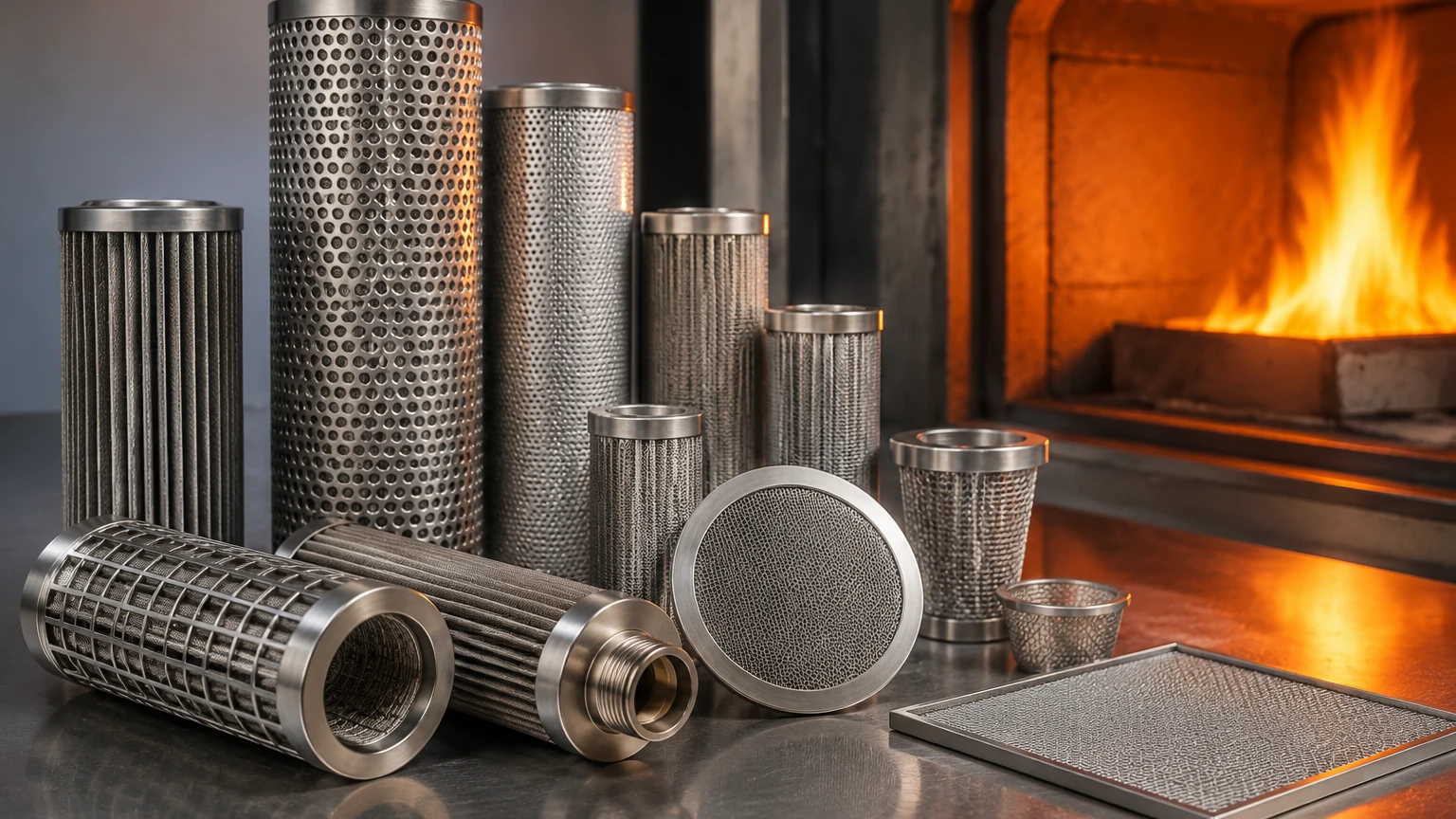
Applications of High-Temperature Filters
The necessity for filters high temperature resistant properties are found across several critical industrial sectors. Each application presents unique challenges regarding the state of the fluid and the nature of the particulates.
Chemical and Petrochemical Processing
In many chemical syntheses, reactions occur at high temperatures to maintain catalysts in a specific state or to keep the reactants in a gaseous phase. Metal filters are used to recover expensive catalysts from the product stream or to protect downstream equipment from particulate wear. The ability to withstand aggressive solvents at boiling points is a prerequisite in these environments.
Food and Beverage: Frying Oil and Steam
In large-scale food production, frying oils must be continuously filtered to remove food particles that would otherwise carbonize and degrade the oil quality. These oils typically operate between 170°C and 200°C. Furthermore, "culinary grade" steam, used for direct injection into food products or for sterilizing equipment, requires stainless steel filtration to remove pipe scale and rust while operating at high saturation temperatures.
Polymer and Plastic Production
Molten polymers are highly viscous and must be processed at temperatures often exceeding 300°C. Filtration is essential to remove gels and degraded polymer particles that would cause defects in the final product (such as film or fiber). The filters used here must withstand extreme differential pressures (sometimes exceeding 100 bar) while maintaining their pore structure at heat.
Maintenance, Cleaning, and Total Cost of Ownership
One of the primary advantages of metal filters high temperature environments utilize is their cleanability. Unlike disposable cartridges, stainless steel and alloy filters represent a long-term capital investment.
Cleaning Methodologies
Because metal filters are structurally robust, they can be cleaned using methods that would destroy other media. Common techniques include:
* Ultrasonic Cleaning: Using high-frequency sound waves in a chemical bath to dislodge deep-seated particulates.
* Backwashing/Backpulsing: Reversing the flow of fluid through the filter to push contaminants off the surface.
* Chemical Cleaning: Using acids, caustics, or solvents to dissolve specific types of fouling.
* Thermal Cleaning (Burn-off): In applications like polymer filtration, the filter may be placed in a controlled furnace to oxidize and remove organic contaminants.
Evaluating the Investment
While the initial cost of a stainless steel filter is significantly higher than a polypropylene or glass fiber equivalent, the total cost of ownership (TCO) is often lower in high-temperature applications. The reduction in downtime for filter changes, the elimination of disposal costs for contaminated cartridges, and the consistent performance over hundreds of cleaning cycles make metal filtration the more sustainable and cost-effective choice for industrial operations.
Selection Criteria for Engineers
Before finalizing a specification for a high-temperature filtration system, purchasing teams and engineers should confirm the following technical parameters with their manufacturer:
1. Continuous vs. Peak Temperature: Is the temperature constant, or are there spikes? The filter must be rated for the highest possible excursion.
2. Thermal Cycling Frequency: How often does the system ramp up and down? Frequent cycling can lead to fatigue in the metal structure if not properly designed.
3. Chemical Compatibility at Temperature: Corrosion rates often accelerate as temperature increases. A material that is resistant to a chemical at 25°C may fail at 200°C.
4. Allowable Pressure Drop: High-temperature fluids may have different viscosities than at room temperature, which directly affects the flow rate and pressure drop across the media.
For those seeking customized solutions that address specific micron ratings and mechanical configurations, consulting with a specialist manufacturer is essential. You can Review product options and application support to better understand how customized stainless steel components can be integrated into your existing high-temperature infrastructure.
In conclusion, high-temperature filtration is a specialized field where material integrity and engineering precision are paramount. By selecting the appropriate metal media and accounting for the thermal dynamics of the process, industrial operators can ensure reliable, long-term performance even in the most challenging thermal environments.
