


Dust Collector Bag in Filtration Process Equipment
In industrial environments, the management of airborne particulates is not merely a matter of housekeeping but a critical engineering requirement for environmental compliance, worker safety, and process efficiency. The dust collector bag in filtration process equipment serves as the primary barrier between contaminated process air and the clean atmosphere. Whether used in chemical processing, cement production, or food manufacturing, these components must be engineered to withstand specific thermal, chemical, and mechanical stresses while maintaining high collection efficiencies.
Selecting the appropriate filtration media requires a deep understanding of the interaction between the dust particles and the filter fabric. This guide examines the technical specifications, material considerations, and operational parameters that engineers must evaluate when integrating dust collector bags into industrial filtration systems.
The Role of Dust Collector Bags in Industrial Filtration Systems
Dust collector bags, often housed within a baghouse or a pulse-jet collector, function as a surface or depth filtration medium. In a typical filtration process, dust-laden gas enters the housing and passes through the filter bags. The particulates are trapped on the surface of the bag, forming a "dust cake," while the cleaned gas exits through the bag's interior.
The efficiency of a dust collector bag in filtration process equipment is measured by its ability to capture specific particle sizes (typically measured in micrometers) while maintaining a manageable pressure drop. A well-designed system ensures that the velocity of the air passing through the media—known as the air-to-cloth ratio—is optimized to prevent premature blinding of the fabric or excessive energy consumption by the system's fan.
Engineering Parameters for Material Selection
Material selection is perhaps the most critical decision in the procurement of filtration components. Industrial processes vary significantly in temperature and chemical composition, requiring materials that can maintain structural integrity under harsh conditions. Common materials used in dust collector bags include:
1. Polyester (PE)
Polyester is the most common material for ambient temperature applications (up to 135°C/275°F). It offers excellent dimensional stability and good resistance to most oxidizing agents. However, it is susceptible to hydrolysis in high-moisture environments at elevated temperatures, which can lead to fiber degradation.
2. Polypropylene (PP)
Polypropylene is favored for its exceptional chemical resistance, particularly in acidic and alkaline environments. It is limited to lower temperature applications (up to 90°C/194°F) but is widely used in the chemical and pharmaceutical industries where corrosion resistance is paramount.
3. Aramid (Nomex®)
Aramid fibers are utilized in high-temperature applications, such as asphalt plants and metal smelting, where operating temperatures can reach 200°C (400°F). While they provide excellent thermal stability, they are sensitive to moisture and acidic gases, which can cause chemical breakdown over time.
4. Polyphenylene Sulfide (PPS)
PPS is an ideal choice for coal-fired boilers and incinerators due to its high temperature resistance (up to 190°C/375°F) and superior resistance to acids and alkalis. It is particularly effective in environments with high sulfur content where other fibers might fail.
5. PTFE (Teflon®)
PTFE provides the highest level of chemical and thermal resistance (up to 260°C/500°F). It is often used as a membrane coating on other fabrics to enhance surface filtration and dust cake release, significantly reducing the pressure drop across the system.
Filtration Mechanisms and Efficiency Ratings
Understanding how a dust collector bag in filtration process equipment captures particles is essential for optimizing system performance. Filtration occurs through four primary mechanisms:
* Inertial Impaction: Larger particles, due to their momentum, fail to follow the gas streamlines around the fiber and instead strike the fiber directly.
* Interception: Medium-sized particles follow the gas streamlines but come close enough to a fiber to be captured by its surface.
* Diffusion (Brownian Motion): Extremely small particles (less than 0.1 microns) move erratically due to molecular collisions, increasing their likelihood of contacting a fiber.
* Electrostatic Attraction: Charges on the dust particles and the filter fibers can attract one another, enhancing the capture of fine dust.
Engineers must also consider the "dust cake" formation. Initially, a new bag has lower efficiency; however, as a layer of dust builds up, this cake becomes the primary filter medium, capable of capturing much finer particles than the fabric alone. The challenge lies in balancing this cake buildup with the need for periodic cleaning to prevent excessive airflow resistance.
Pulse-Jet Cleaning and Maintenance Cycles
The longevity of a dust collector bag is largely determined by the cleaning mechanism of the filtration equipment. The most common method in modern industrial applications is the pulse-jet system. This involves a high-pressure burst of compressed air (typically 60-100 PSI) injected into the top of the bag, creating a shockwave that travels down the length of the fabric, flexing it and dislodging the dust cake.
Key factors affecting the cleaning cycle include:
* Pulse Duration: Usually between 0.1 and 0.2 seconds. Excessive pulsing can cause mechanical wear on the fabric.
* Pulse Frequency: Determined by the differential pressure across the bags. Cleaning should ideally be triggered when the pressure drop reaches a specific set point.
* Compressed Air Quality: Moisture or oil in the cleaning air can lead to "mudding" on the bag surface, where the dust becomes a sticky paste that cannot be removed by pulsing.
Regular monitoring of the differential pressure is the most effective way to track the health of the filtration system. A sudden drop in pressure may indicate a torn bag (leakage), while a steady increase that cannot be reversed by cleaning suggests that the bags have reached the end of their service life and are "blinded."
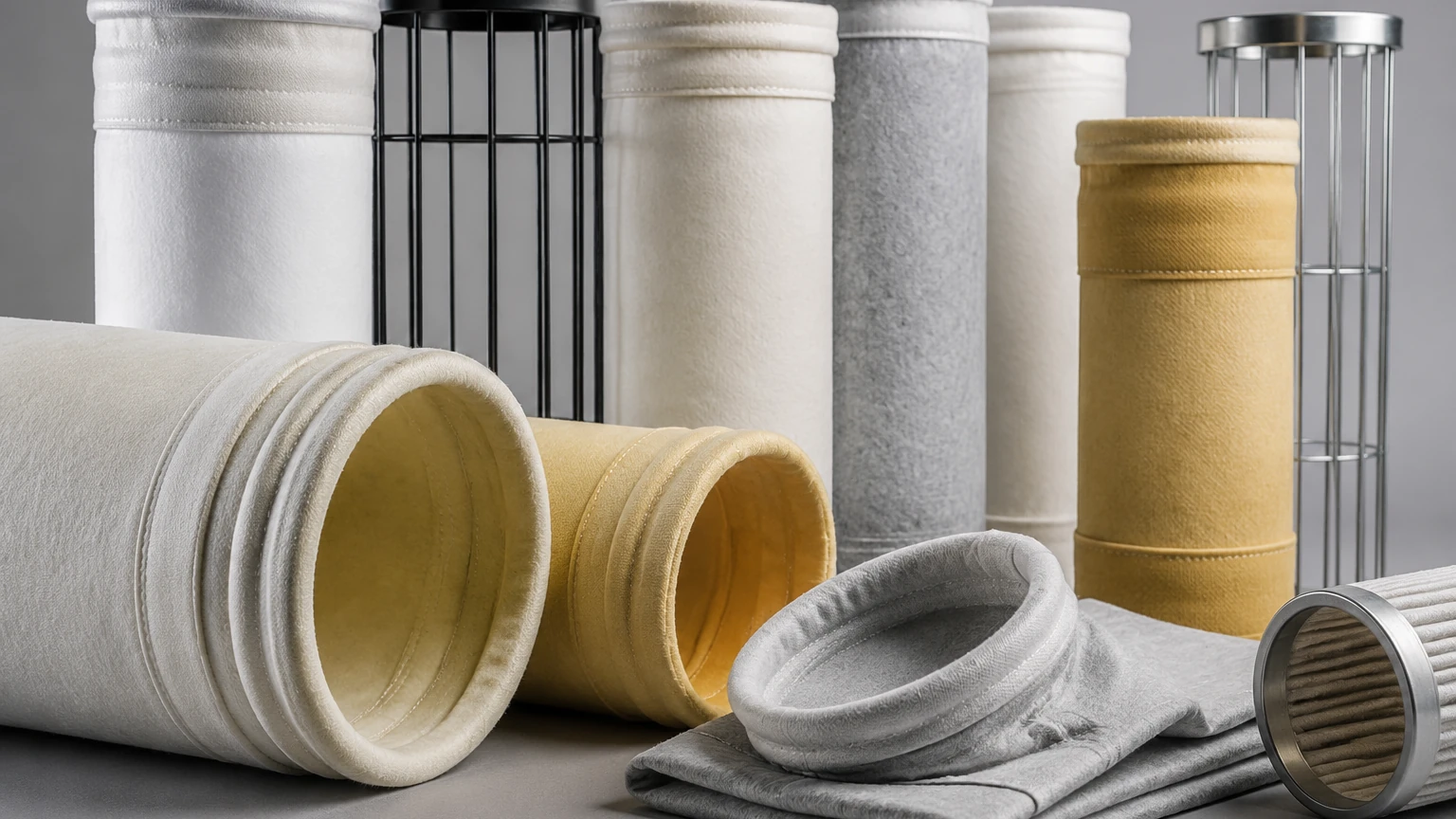
Integration with Stainless Steel Support Structures
While the fabric bag is the primary filter, its performance is heavily dependent on the internal support structure, usually a metal cage. For demanding industrial applications, stainless steel cages are preferred over galvanized steel due to their corrosion resistance and ability to withstand high-temperature cleaning cycles.
In some specialized processes, traditional fabric bags are replaced or supplemented by stainless steel wire mesh filters or sintered metal cartridges. These components offer superior durability in extreme environments where synthetic fibers would melt or corrode. For engineers looking to upgrade their filtration systems or source high-precision metal components, the Main Page of Kaifil provides a comprehensive overview of custom stainless steel filtration solutions designed for these rigorous applications.
Stainless steel support structures ensure that the bag remains open during the filtration cycle, preventing collapse and ensuring uniform airflow. The design of the cage—specifically the number of vertical wires and the spacing of the horizontal rings—must be matched to the fabric type to prevent "flex fatigue," which is a common cause of bag failure at the cage contact points.
Cost Considerations and Lifecycle Management
When evaluating the total cost of ownership (TCO) for a dust collector bag in filtration process equipment, engineers must look beyond the initial purchase price. A low-cost bag that requires frequent replacement or consumes excessive energy due to high pressure drop will ultimately be more expensive than a premium, high-efficiency alternative.
Factors influencing TCO include:
* Energy Consumption: Higher pressure drops require the system fan to work harder, increasing electricity costs.
* Labor Costs: The time required to change out hundreds of bags can be significant, especially in large-scale baghouses.
* Production Downtime: Frequent bag failures lead to unplanned maintenance and lost production capacity.
* Disposal Costs: Spent filter bags, especially those contaminated with hazardous dust, can be expensive to dispose of according to environmental regulations.
By selecting a bag material and support structure optimized for the specific gas chemistry and temperature of the process, facilities can extend the lifecycle of their filtration components from months to years.
Technical Confirmation Before Procurement
Before finalizing a purchase for filtration equipment components, technical teams should confirm several key data points with their manufacturer:
1. Gas Stream Chemistry: Identify all gases present, including trace amounts of moisture, SOx, or NOx, which can cause chemical degradation.
2. Particle Size Distribution: Knowing the percentage of sub-micron particles helps in deciding whether a membrane coating (like PTFE) is necessary.
3. Operating vs. Surge Temperatures: Ensure the material can handle the maximum possible temperature during a process upset, not just the average operating temperature.
4. Mechanical Interface: Confirm the exact dimensions and attachment method (e.g., snap-band, raw top, or flange) to ensure a leak-free seal within the tubesheet.
In conclusion, the dust collector bag in filtration process equipment is a sophisticated engineering component that requires careful selection based on thermal, chemical, and mechanical requirements. By integrating high-quality fabric media with robust stainless steel support structures, industrial facilities can achieve reliable, long-term filtration performance that meets both environmental standards and operational goals. For those seeking specialized metal filtration components to complement their systems, reviewing the options on the Main Page can provide technical insights into the latest custom manufacturing capabilities.
Download Dust Collector Bag in Filtration Process Equipment as a PDF
