


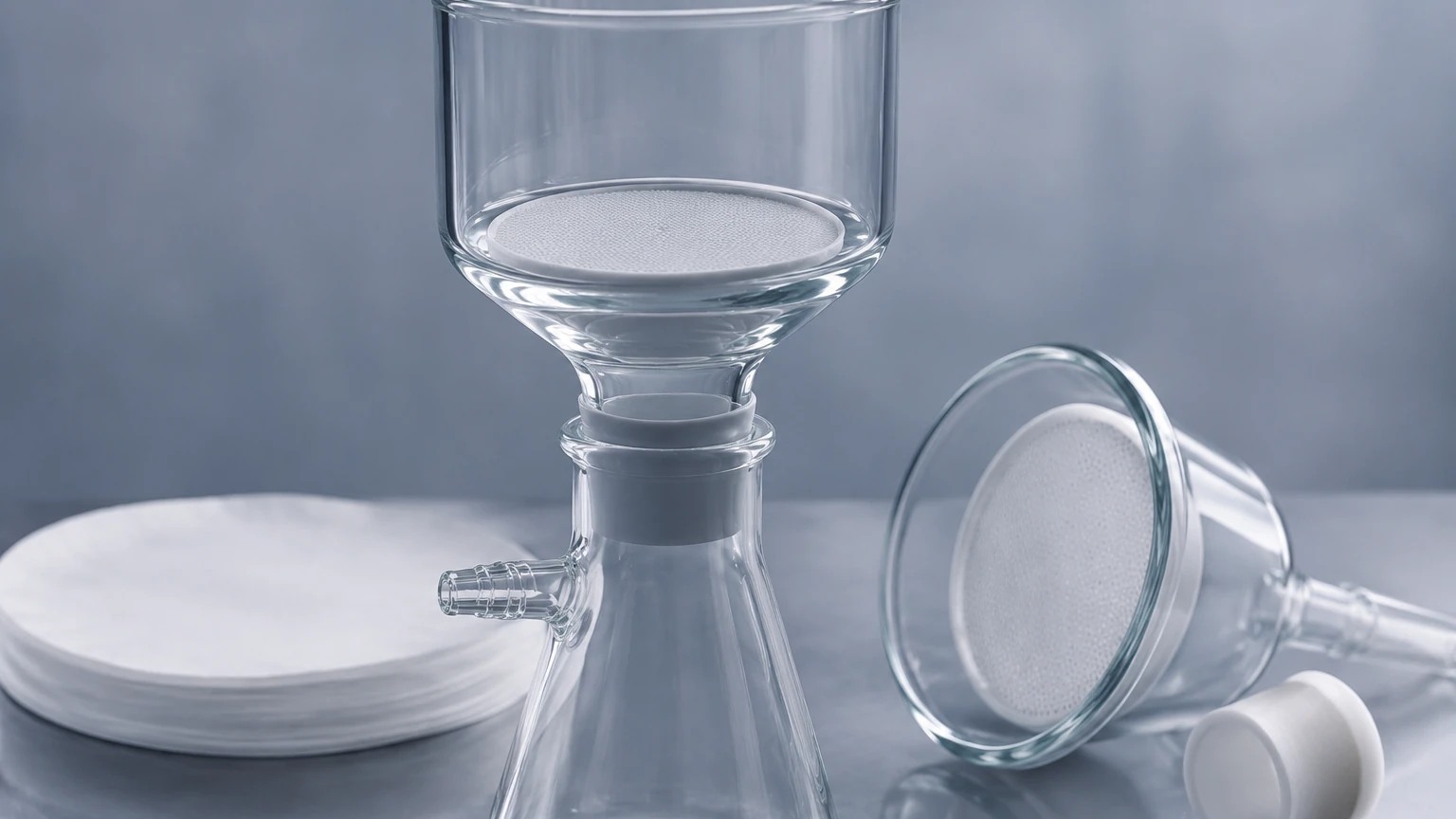
Hirsch and Buchner Funnel
In the realm of industrial and laboratory filtration, the ability to efficiently separate solids from liquids under vacuum pressure is a fundamental requirement. Two of the most critical tools used for this purpose are the hirsch and buchner funnel. While they share a common goal—accelerating the filtration process through suction—their design nuances, volume capacities, and specific application strengths differ significantly. For engineers and technical professionals transitioning from laboratory-scale experiments to industrial-scale production, understanding these differences is essential for selecting the right filtration medium and equipment.
At the heart of these filtration processes lies the need for a reliable support structure and a precise filter medium. Whether using traditional ceramic funnels or high-performance stainless steel filtration components, the selection of the filtration interface determines the purity of the filtrate and the recovery rate of the solid. As a leading manufacturer of custom stainless steel filtration solutions, Kaifil provides the technical expertise and precision components required to scale these filtration principles into demanding industrial environments.
The Mechanics of Vacuum Filtration
Vacuum filtration, often referred to as suction filtration, is preferred over gravity filtration when speed is a priority or when the solid material needs to be dried as much as possible. In this setup, a vacuum is created in a receiving flask, which pulls the liquid phase (the filtrate) through a filter medium, leaving the solid residue (the cake) on the surface.
Both the Hirsch and Buchner designs utilize a perforated plate to support the filter medium—typically filter paper in a lab setting or precision wire mesh in industrial applications. The effectiveness of this process depends on several engineering factors:
* Pressure Differential: The delta between the atmospheric pressure and the vacuum pressure.
* Surface Area: The available area for liquid passage, which dictates the flow rate.
* Pore Size and Distribution: The precision of the filter medium in retaining particles of a specific micron rating.
* Chemical Compatibility: The resistance of the funnel and filter material to the solvents or acids being processed.
Understanding the Buchner Funnel
The Buchner funnel is the more common of the two in large-scale laboratory work. Characterized by its cylindrical shape and vertical sidewalls, it features a flat, perforated plate at the bottom.
Design and Capacity
Buchner funnels are designed for handling relatively large volumes of liquid and solid. The vertical walls allow for the accumulation of a thick filter cake without the risk of the material overflowing or sliding. This makes them ideal for bulk crystallization and large-scale synthetic chemistry.
Industrial Scaling
In industrial settings, the geometry of the Buchner funnel is often replicated in larger "Nutsche" filters. For these applications, the traditional ceramic or plastic material is replaced with stainless steel to ensure durability and prevent contamination. When scaling up, engineers must consider the mechanical strength of the perforated plate. Kaifil specializes in manufacturing precision metal filter components that can withstand the high pressure differentials associated with industrial vacuum filtration, ensuring that the support structure does not deform under load.
Understanding the Hirsch Funnel
The Hirsch funnel is essentially a smaller, specialized version of the Buchner funnel. Its most distinguishing feature is its sloped, outward-flaring sides, which create a conical shape rather than a cylindrical one.
Small-Scale Precision
Hirsch funnels are primarily used for collecting small amounts of solids (typically less than 1 gram to a few grams). The sloped walls are an engineering choice designed to minimize the surface area of the filter paper relative to the volume of the solid. This design ensures that the solid is concentrated in a smaller area, making it easier to recover the material with minimal loss—a critical factor when working with expensive pharmaceutical compounds or rare catalysts.
Applications in Micro-Filtration
Because of their smaller size, Hirsch funnels are often used in microscale chemistry. The filter plate is much smaller than that of a standard Buchner funnel, which reduces the amount of liquid retained in the filter medium itself (the "hold-up volume"). This leads to higher yields in sensitive chemical processes.
Material Selection: Ceramic vs. Stainless Steel
While laboratory hirsch and buchner funnel sets are traditionally made of porcelain or glass, industrial filtration demands more robust materials. The choice of material impacts the total cost of ownership, cleaning protocols, and the risk of batch contamination.
The Advantages of Stainless Steel
For industrial-grade filtration, stainless steel (typically 304 or 316L) is the gold standard. Unlike ceramic, stainless steel is:
1. Non-Porous: It does not absorb chemicals, making it easier to sterilize in pharmaceutical and food-grade applications.
2. Durable: It is resistant to thermal shock and mechanical impact, reducing the frequency of replacement.
3. Customizable: Stainless steel components can be engineered with specific micron ratings and flow characteristics.
Kaifil's expertise in stainless steel wire mesh and filter cartridges allows for the creation of customized filtration interfaces that replace traditional paper filters. These metal filters offer superior longevity and can be backwashed or ultrasonically cleaned, providing a sustainable alternative to disposable media. For those looking to optimize their industrial filtration systems, you can Review product options and application support on the Kaifil Main Page to find the right material specifications for your process.
Key Evaluation Criteria for Industrial Filtration
When selecting or designing a filtration system based on the principles of the hirsch and buchner funnel, engineers should evaluate the following criteria to ensure performance and cost-effectiveness:
1. Filtration Accuracy (Micron Rating)
In a lab, the choice of filter paper determines the micron rating. In an industrial environment, this is achieved through precision-woven wire mesh or sintered metal fibers. It is vital to define the absolute vs. nominal micron rating required for the process to prevent "pass-through" of unwanted solids.
2. Flow Rate and Pressure Drop
As the filter cake builds up on the plate of a Buchner or Hirsch funnel, the resistance to flow increases. This is known as the pressure drop. Engineering the support plate with the correct open area percentage is crucial to maintaining an efficient flow rate throughout the filtration cycle.
3. Cake Recovery and Discharge
The geometry of the funnel affects how easily the solid cake can be removed. While the sloped walls of a Hirsch funnel aid in small-scale recovery, industrial systems often require automated discharge mechanisms. The surface finish of the stainless steel (such as electropolishing) can significantly reduce the adhesion of the cake to the filter surface.
4. Chemical and Thermal Compatibility
Industrial processes often involve aggressive solvents or high-temperature filtrations that would degrade standard laboratory equipment. Selecting the correct grade of stainless steel and ensuring the integrity of welds and seals is paramount for safety and longevity.
Common Risks in Vacuum Filtration
Even with the correct hirsch and buchner funnel setup, certain risks can compromise the filtration quality:
* Paper Bypass: In lab funnels, if the vacuum is applied too quickly, the liquid may bypass the filter paper around the edges. In industrial metal filters, this is mitigated by precision-engineered seals and gaskets.
* Media Blinding: This occurs when fine particles become trapped within the pores of the filter medium, drastically reducing the flow rate. Selecting a multi-layered sintered mesh can provide depth filtration that resists blinding better than a single layer of mesh.
* Structural Failure: Under high vacuum, a poorly supported filter plate can bow or crack. This is why the thickness and reinforcement of the perforated support plate must be calculated based on the maximum expected pressure differential.
Transitioning to High-Performance Solutions
For many organizations, the journey begins with a standard hirsch and buchner funnel in the R&D lab. However, as production scales, the limitations of lab-scale equipment become apparent. Manual filtration becomes a bottleneck, and the fragility of glass or ceramic components poses a risk to continuous operations.
This is where custom-engineered stainless steel filtration components become indispensable. By integrating precision wire mesh and robust filter housings, companies can achieve the same separation results as a Buchner funnel but at a much higher throughput and with greater consistency.
When planning the next step in your filtration project, it is important to confirm the specific flow requirements, the chemical nature of your filtrate, and the desired moisture content of your solid cake. Working with a specialized manufacturer allows for the development of filtration solutions that are tailored to these exact parameters, rather than relying on "off-the-shelf" components that may not provide optimal performance.
Kaifil supports this transition by offering a wide range of stainless steel filter cartridges, wire mesh filters, and custom metal components designed for the most demanding industrial environments. By applying the fundamental principles of vacuum filtration to advanced manufacturing techniques, Kaifil helps engineers achieve reliable, durable, and cost-effective filtration performance across the chemical, pharmaceutical, and food processing industries.
