


Sparger Pipe Design
In industrial process engineering, the efficiency of gas-liquid mass transfer is often the determining factor in the overall productivity of a system. Whether the application involves oxygenating a bioreactor, stripping volatile organic compounds from a solvent, or injecting steam for rapid heating, the mechanical configuration of the injection system is critical. Sparger pipe design refers to the engineering of specialized piping systems—often utilizing porous or perforated materials—to introduce gas into a liquid phase in the form of discrete bubbles.
Properly engineered spargers ensure uniform gas distribution, maximize the interfacial surface area, and minimize energy consumption through optimized pressure drops. For engineers and technical procurement teams, understanding the nuances of material selection, pore geometry, and fluid dynamics is essential for selecting a system that provides long-term reliability and performance. As a manufacturer specializing in stainless steel filtration and fluid control components, Kaifil provides the technical foundation required to optimize these systems for demanding industrial environments.
Fundamentals of Sparger Pipe Engineering
The primary objective of any sparger pipe design is to facilitate the transfer of a gas into a liquid. This process is governed by the principles of mass transfer, specifically Fick's Law, which states that the rate of transfer is proportional to the concentration gradient and the available surface area. In a sparging context, the "available surface area" is the sum of the surface areas of all gas bubbles present in the liquid.
Smaller bubbles yield a significantly higher surface-area-to-volume ratio than larger bubbles. For example, a specific volume of gas broken into 0.5 mm bubbles provides ten times the surface area of the same volume of gas released as 5 mm bubbles. Consequently, the design focus is usually on creating the smallest stable bubbles possible for the given flow conditions. However, design is not merely about bubble size; it must also account for the rise velocity of those bubbles. Smaller bubbles rise more slowly, increasing the "residence time" or the duration the gas remains in contact with the liquid, further enhancing mass transfer efficiency.
Key Parameters in Sparger Pipe Design
When designing a sparger system, several technical variables must be balanced to achieve the desired process outcome. Engineers must evaluate the following factors during the initial specification phase:
1. Gas Flow Rate and Exit Velocity
The volume of gas required per unit of time (SCFM or Nm³/h) dictates the size of the sparger and the number of exit points (pores or holes). If the exit velocity is too high, bubbles may coalesce (merge) immediately upon leaving the sparger surface, resulting in large, inefficient bubbles. Conversely, if the velocity is too low, the gas may not be distributed evenly across the entire length of the sparger pipe.
2. Pore Size and Porosity
For precision applications, sintered stainless steel is often preferred over drilled pipe. Sintered media allow for pore sizes ranging from 0.5 to 100 microns. The selection of pore size is a trade-off between mass transfer efficiency and the pressure required to overcome the "bubble point" of the media. For more information on material capabilities, you can visit the Main Page to review technical specifications for porous metal components.
3. Pressure Drop ($ΔP$)
The total pressure drop across a sparger includes the pressure required to force gas through the porous media and the hydrostatic pressure of the liquid column above the sparger. A well-designed sparger pipe maintains a uniform internal pressure to ensure that gas exits evenly from all parts of the pipe, preventing "dead zones" where no gas is introduced.
Material Selection for Industrial Spargers
Industrial environments often involve corrosive chemicals, high temperatures, and high-pressure differentials. Therefore, material durability is a primary concern in sparger pipe design. Stainless steel, particularly Grade 316L, is the industry standard for most chemical, food and beverage, and pharmaceutical applications.
* Corrosion Resistance: 316L stainless steel contains molybdenum, which enhances resistance to pitting and crevice corrosion in chloride-rich environments. For highly aggressive media, exotic alloys like Hastelloy or Monel may be used.
* Thermal Stability: Metal spargers can withstand extreme temperature fluctuations that would cause polymer-based alternatives to degrade or deform. This is vital in steam sparging or high-temperature chemical synthesis.
* Structural Integrity: Unlike ceramic spargers, which are brittle and prone to cracking under mechanical stress or thermal shock, stainless steel sparger pipes offer the mechanical robustness required for high-vibration environments or systems with high liquid cross-flows.
Sintered Metal vs. Drilled Pipe Spargers
One of the most significant decisions in sparger pipe design is the choice between a drilled pipe (perforated) and a sintered metal sparger. Each has a specific role depending on the application requirements.
Drilled Pipe Spargers
Drilled pipes feature mechanically machined holes, typically no smaller than 1 mm in diameter. These are suitable for applications where high gas volumes are required and precise mass transfer is less critical, such as simple agitation or large-scale tank mixing. The primary disadvantage is the production of large bubbles and the potential for uneven distribution if the pipe is long and the internal pressure is not carefully managed.
Sintered Metal Spargers
Sintered metal spargers are constructed from metal powders that are pressed and fused to create a porous structure. This design allows for millions of tiny pores to be distributed across the surface.
* Superior Mass Transfer: By producing micron-sized bubbles, sintered spargers provide the highest possible interfacial area.
* Uniformity: The high resistance of the porous media ensures that the gas is forced out of every pore simultaneously, providing a very uniform "curtain" of bubbles.
* Mechanical Strength: Despite being porous, sintered stainless steel retains high structural strength, allowing it to function as a self-supporting pipe within a vessel.
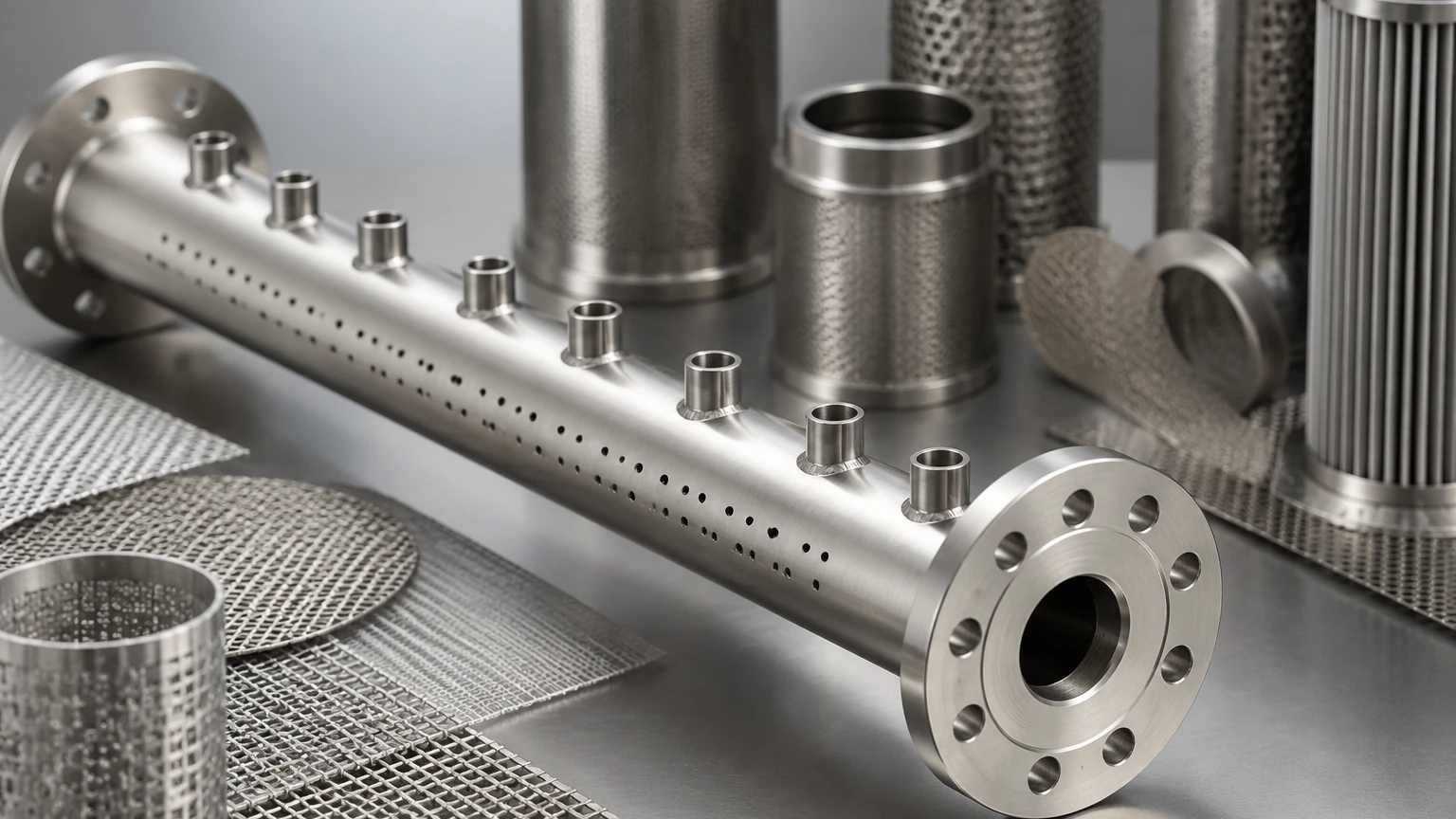
Structural Configurations and Layouts
The physical layout of the sparger pipe must be tailored to the geometry of the vessel and the flow patterns of the liquid. Common configurations include:
* Linear/Bayonet Spargers: A single pipe extending into the vessel. These are easy to install and remove for maintenance but may not provide uniform coverage in very large tanks.
* Ring Spargers: A circular pipe located at the bottom of a tank, often surrounding an agitator. This layout is excellent for ensuring that bubbles are caught in the impeller's flow and distributed throughout the entire volume.
* Sparger Arrays: For large-scale water treatment or aeration basins, multiple sparger pipes are arranged in a grid pattern to cover the entire floor area, ensuring no stagnant zones exist.
In each of these designs, the internal diameter of the pipe must be calculated to ensure that the gas velocity remains within a range that prevents excessive friction loss while maintaining enough pressure to drive the gas through the pores.
Maintenance and Operational Longevity
A common challenge in sparger pipe design is the potential for clogging or fouling. This can occur from the "inside out" (particulates in the gas stream) or the "outside in" (solids in the liquid phase or biological growth).
Clogging Prevention
To prevent internal clogging, the gas supply should be filtered to a level finer than the sparger's pore size. To prevent external fouling, particularly in bioreactors or wastewater applications, the sparger should be designed for easy cleaning. Stainless steel spargers are compatible with various cleaning methods, including:
* Chemical Cleaning: Soaking in caustic or acidic solutions to dissolve mineral scales or organic deposits.
* Ultrasonic Cleaning: Using high-frequency sound waves in a solvent bath to dislodge particles from deep within the porous structure.
* Backpulsing: Briefly reversing the flow (liquid or gas) to push contaminants out of the pores.
Replacement Cycles
While stainless steel spargers are highly durable, they are considered process consumables in certain aggressive environments. Monitoring the pressure drop over time is the most effective way to determine when a sparger requires cleaning or replacement. An unexpected increase in the required injection pressure usually indicates pore constriction due to fouling.
Technical Checklist for Custom Sparger Design
When collaborating with a manufacturer like Kaifil to develop a custom filtration or sparging solution, engineers should have the following data points confirmed:
1. Gas Properties: Type of gas, molecular weight, and operating temperature.
2. Liquid Properties: Viscosity, density, surface tension, and chemical composition (to ensure material compatibility).
3. Flow Requirements: Minimum, normal, and maximum gas flow rates.
4. Vessel Dimensions: Tank height, diameter, and the liquid level above the sparger.
5. Connection Type: NPT, flange, or sanitary Tri-Clamp fittings to match existing infrastructure.
6. Target Bubble Size: Based on the required mass transfer efficiency of the process.
By addressing these factors, the resulting sparger pipe design will not only meet the immediate process needs but also contribute to the long-term efficiency and lower total cost of ownership of the industrial system. For technical assistance and to explore customized stainless steel filtration components, visiting the Main Page provides access to professional engineering support and product catalogs.
Conclusion
Effective sparger pipe design is a sophisticated balance of fluid dynamics, material science, and mechanical engineering. By moving beyond simple perforated pipes and utilizing advanced sintered metal technologies, industrial operators can achieve significant improvements in gas-liquid contact efficiency. Whether the goal is to enhance a chemical reaction, improve fermentation yields, or ensure thorough water aeration, the precision of the sparger is the key to success. Selecting high-quality stainless steel components and adhering to rigorous design standards ensures that these systems perform reliably in the most demanding industrial environments.
