


Disk Filters
In industrial filtration, the selection of a filter medium is dictated by the specific demands of the environment, including temperature, pressure, chemical compatibility, and the required level of particulate retention. Disk filters, particularly those constructed from stainless steel wire mesh or sintered metal, represent a critical component in precision filtration systems. These components are engineered to provide high-efficiency separation in applications ranging from hydraulic systems and polymer melt filtration to pharmaceutical and food processing. Unlike disposable alternatives, metal disk filters offer durability and reusability, making them a cornerstone of cost-effective industrial operations.
Understanding the technical nuances of disk filters is essential for engineers and procurement teams who must balance filtration accuracy with system longevity. This guide explores the engineering principles, material considerations, and performance metrics necessary to optimize filtration processes.
Understanding the Construction of Industrial Disk Filters
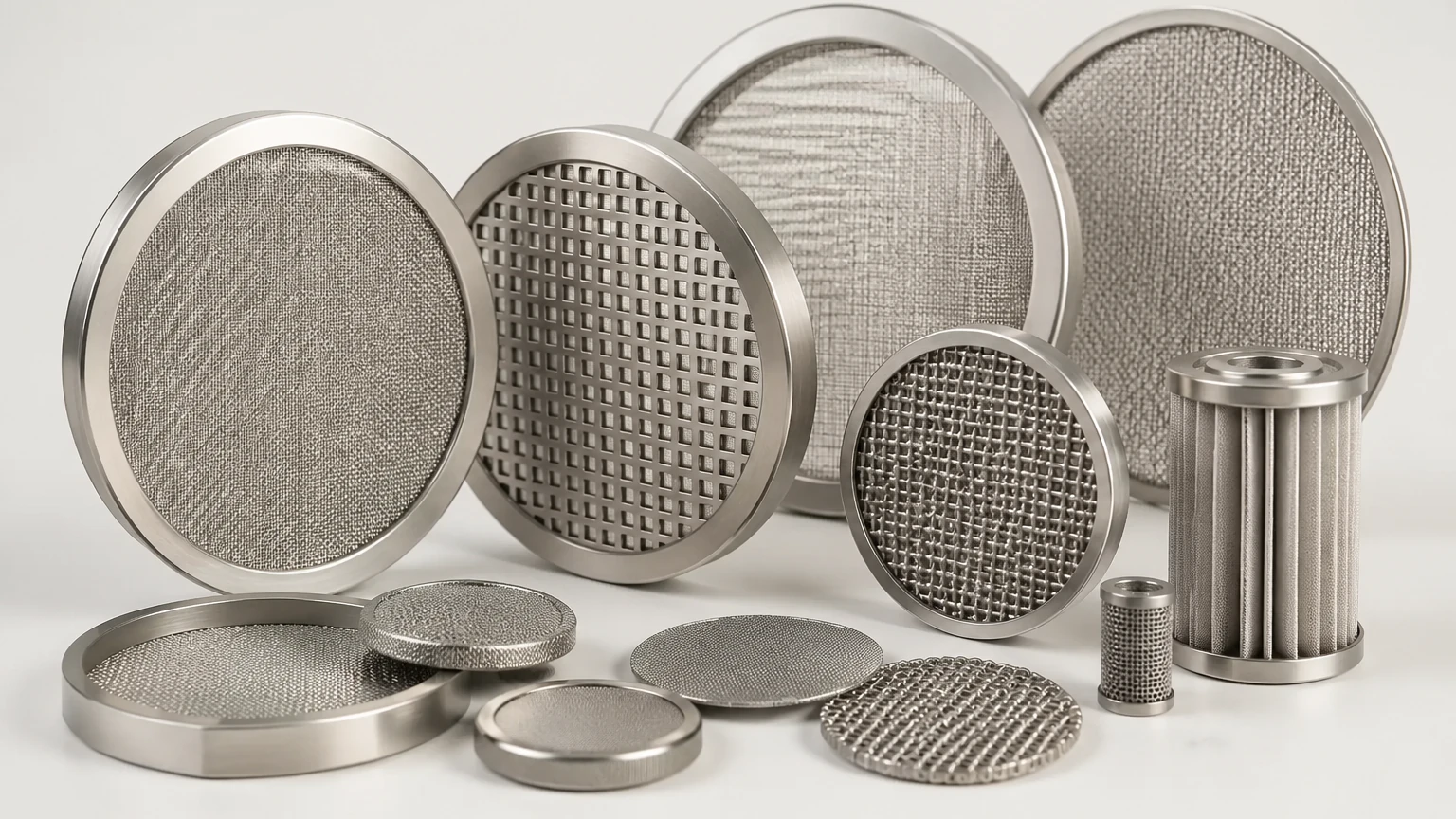
The performance of a disk filter is fundamentally tied to its construction. Industrial disk filters are typically categorized by their structure: single-layer, multi-layer, or sintered.
Single-Layer Wire Mesh Disks
Single-layer disks are the most straightforward design, consisting of a single ply of woven wire mesh. These are primarily used for coarse filtration or as support layers. While they offer the lowest pressure drop, they lack the structural integrity required for high-pressure applications unless supported by a perforated plate or a coarser mesh.
Multi-Layer Mesh Disks
Multi-layer disks involve stacking several layers of wire mesh. This configuration allows for a combination of different mesh counts. For example, a fine inner layer provides the necessary filtration accuracy, while outer coarse layers provide mechanical support and protection. These layers can be spot-welded together or held in place by a metal rim.
Sintered Metal Disks
Sintering is a process where multiple layers of wire mesh are bonded together using heat and pressure in a vacuum furnace without the use of binders. This creates a monolithic structure that is incredibly strong and dimensionally stable. Sintered disk filters are ideal for high-pressure environments where mesh migration or pore deformation cannot be tolerated. They provide precise pore size distribution and excellent resistance to mechanical stress.
Material Selection for Demanding Environments
Material compatibility is a primary concern for engineers when specifying disk filters. The choice of alloy affects not only the filter's resistance to corrosion but also its thermal stability and mechanical strength.
1. Stainless Steel 304: The standard choice for general industrial applications. It offers good corrosion resistance and is suitable for most water treatment and food-grade applications where high acidity or chloride levels are not present.
2. Stainless Steel 316L: Containing molybdenum, 316L provides superior resistance to pitting and crevice corrosion, particularly in chloride-rich environments. It is the preferred material for pharmaceutical and chemical processing due to its enhanced chemical stability.
3. Specialty Alloys: In extreme cases involving highly corrosive acids or high-temperature oxidation, alloys such as Hastelloy, Monel, or Inconel may be utilized. These materials ensure that the disk filters maintain their structural integrity in environments where standard stainless steel would fail.
When selecting materials, engineers must also consider the "L" grade (low carbon) in stainless steels if welding is involved in the assembly process, as this prevents carbide precipitation and maintains corrosion resistance at the weld sites.
Performance Evaluation: Micron Ratings and Flow Dynamics
To ensure a disk filter meets the requirements of a specific application, it must be evaluated based on its filtration efficiency and its impact on system hydraulics.
Absolute vs. Nominal Filtration Ratings
* Nominal Rating: This indicates the ability of the filter to retain a majority of particles of a specific size (usually 60% to 90%). It is a less precise measure and is often used for pre-filtration stages.
* Absolute Rating: This refers to the diameter of the largest hard spherical particle that will pass through the filter under specified test conditions. In critical applications, such as protecting high-pressure nozzles or sensitive hydraulic valves, an absolute rating is required to prevent catastrophic component failure.
Differential Pressure (ΔP)
Differential pressure is the difference in pressure between the upstream and downstream sides of the filter. A well-designed disk filter should offer a low initial clean pressure drop to maximize the available energy in the system. As the filter accumulates contaminants, the ΔP will increase. Engineers must define the maximum allowable differential pressure before the filter requires cleaning or replacement to avoid collapsing the filter element or triggering a system bypass.
Dirt-Holding Capacity
The geometry of the mesh weave—whether it is a plain weave, twill weave, or Dutch weave—significantly impacts the dirt-holding capacity. Dutch weaves, for instance, provide a denser structure with smaller triangular openings, offering high filtration precision and a larger surface area for particle entrapment compared to standard square weaves.
Application-Specific Engineering Requirements
Disk filters are versatile components, but their design must be tailored to the specific industry they serve.
* Chemical and Petrochemical Processing: In these sectors, disk filters are often used for catalyst recovery or the filtration of aggressive solvents. The primary focus here is chemical compatibility and the ability to withstand high operating temperatures.
* Hydraulic and Lubrication Systems: These filters protect sensitive pumps and valves from wear-inducing particulates. The disks must be able to handle high-frequency pressure pulsations without fatigue.
* Food and Beverage Industry: Filtration components must meet stringent hygiene standards. Stainless steel disk filters are preferred because they do not shed fibers and can be easily sterilized using steam-in-place (SIP) or clean-in-place (CIP) protocols.
* Pharmaceutical Manufacturing: Precision is paramount. Sintered disk filters are often used in chromatography and active pharmaceutical ingredient (API) production to ensure the highest levels of purity and batch consistency.
Customization and Edge Sealing Techniques
For many B2B applications, standard off-the-shelf disk filters are insufficient. Customization is often required to fit existing housing dimensions or to meet unique flow requirements. Key customization options include:
* Dimensional Accuracy: Precise outer and inner diameters are critical for ensuring a leak-proof seal within the filter housing. CNC cutting and laser cutting technologies are used to achieve tight tolerances.
* Edge Treatments: To prevent fraying and ensure a secure fit, disk filters can be finished with various edge treatments. Common methods include spot welding the layers together, applying a metal rim (aluminum, stainless steel, or copper), or using specialized gaskets. The choice of edging depends on the sealing mechanism of the filter holder.
* Layer Configuration: Engineers can specify the exact sequence of mesh layers. For example, a five-layer sintered disk might include a drainage layer, a support layer, a fine filtration layer, and two protective outer layers to optimize both flow and strength.
For organizations looking to integrate these components into larger systems, reviewing technical specifications and OEM capabilities on the Main Page of a specialized manufacturer can provide the necessary data for integration.
Maintenance and Longevity: The Economics of Reusable Metal Filters
One of the primary advantages of stainless steel disk filters over polymer or paper media is their cleanability. While the initial capital expenditure for metal filters is higher, the total cost of ownership (TCO) is often lower due to their extended service life.
Cleaning Methods
1. Ultrasonic Cleaning: This is the most effective method for removing fine particulates lodged deep within the mesh pores. High-frequency sound waves create cavitation bubbles that dislodge contaminants without damaging the metal structure.
2. Backwashing: In automated systems, reverse flow can be used to flush particles from the surface of the disk. This is particularly effective for surface-loading filters.
3. Chemical Cleaning: Soaking the disks in compatible solvents or acids can dissolve organic or mineral deposits that mechanical cleaning cannot reach.
Determining Replacement Cycles
Despite their durability, metal disk filters are not permanent. Over time, repeated cleaning cycles and exposure to high pressures can lead to "work hardening" of the metal or gradual erosion of the wire strands. Engineers should monitor the "recovered" differential pressure after cleaning. If the pressure drop remains high even after thorough cleaning, it indicates that the filter is reaching the end of its functional life and should be replaced to maintain process efficiency.
Conclusion
Selecting the right disk filter involves a comprehensive analysis of the operating environment, the nature of the contaminants, and the desired filtration outcome. By focusing on material science, structural integrity, and precise micron ratings, technical professionals can ensure their systems operate with maximum reliability. Whether for protecting downstream equipment or ensuring product purity, high-quality stainless steel disk filters provide the robust performance required in modern industrial settings. For detailed product options and engineering support tailored to specific filtration challenges, professionals are encouraged to consult the Main Page for comprehensive technical resources and customization guidance.
