


Panel Air Filters
In industrial environments, air quality and process purity are critical variables that directly impact equipment longevity and product integrity. Panel air filters serve as the primary line of defense in air intake systems, HVAC units, and specialized process exhausts. Unlike standard residential filters, industrial-grade panel air filters are engineered to withstand high face velocities, corrosive atmospheres, and extreme temperature fluctuations while maintaining precise filtration efficiency.
Selecting the appropriate panel filtration solution requires an understanding of mechanical design, material science, and fluid dynamics. For engineers and procurement teams, the decision-making process involves balancing initial pressure drop against dirt-holding capacity and determining whether a disposable or a permanent, washable solution offers the best total cost of ownership (TCO). As a manufacturer specializing in stainless steel filtration, Kaifil provides technical insights into the construction and application of these essential components.
Structural Components of Panel Air Filters
A standard panel air filter consists of three primary elements: the frame, the filter media, and the support grid. Each component must be selected based on the specific demands of the operating environment.
The Frame
In industrial settings, frame rigidity is paramount to prevent air bypass. If a frame flexes or warps under high static pressure, contaminated air will take the path of least resistance around the edges of the filter. Common materials include:
* Galvanized Steel: Provides basic corrosion resistance and high structural strength for standard HVAC applications.
* Aluminum: Lightweight and resistant to moisture, making it suitable for high-humidity environments.
* Stainless Steel (304/316L): The gold standard for pharmaceutical, food processing, and chemical industries where caustic cleaning agents or corrosive process gases are present.
Filter Media
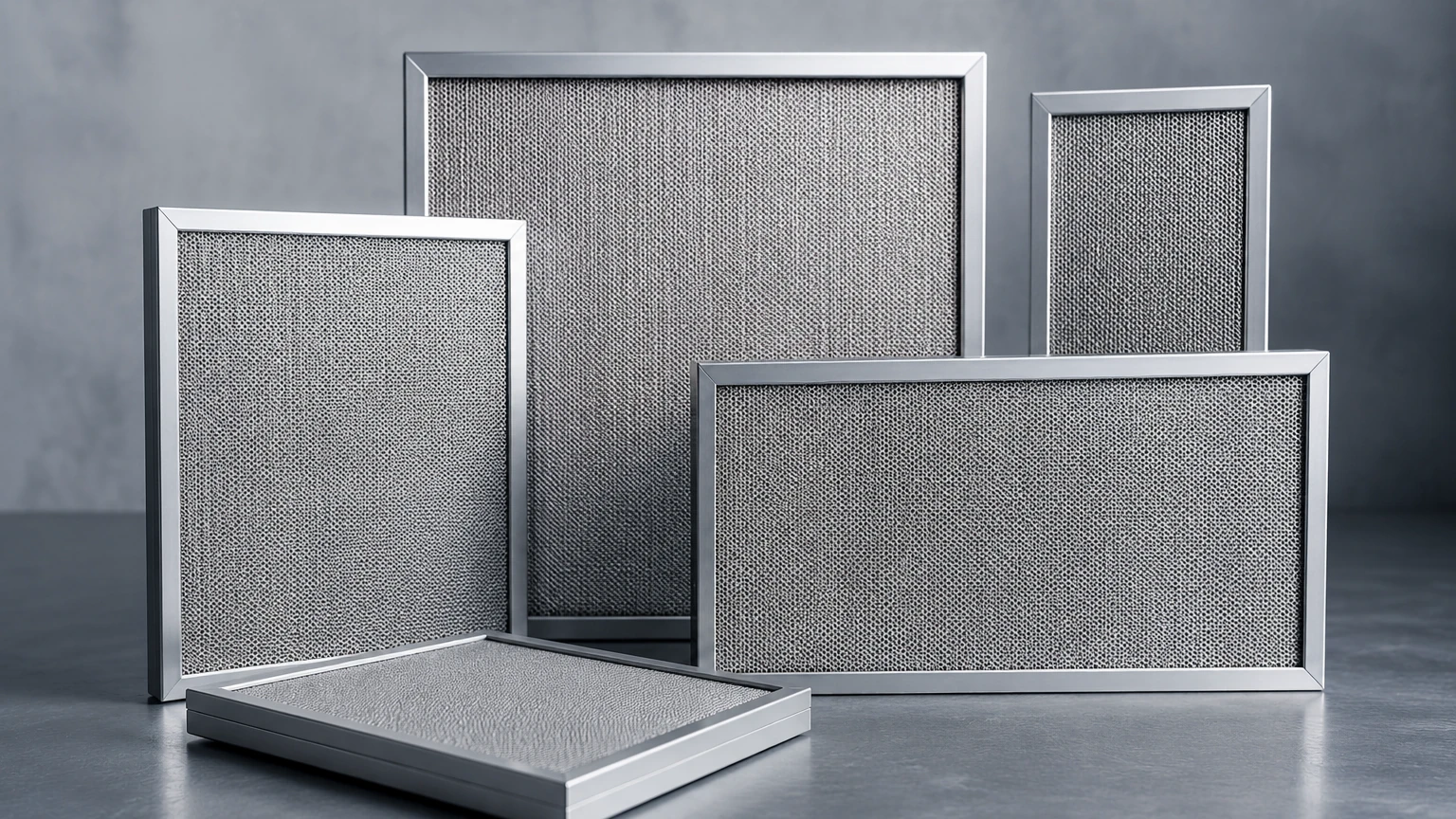
The media determines the filtration efficiency and the types of particles captured. For industrial panel air filters, media options range from synthetic fibers and glass microfibers to multi-layered stainless steel wire mesh. Metal mesh media is particularly valued in heavy-duty applications due to its ability to be cleaned and reused multiple times without degrading the filtration rating.
Support Grids and Gaskets
To prevent media migration or collapse, industrial panels often feature expanded metal or welded wire grids on both the upstream and downstream sides. Additionally, high-quality gaskets—often made of EPDM, silicone, or neoprene—are applied to the frame perimeter to ensure a gas-tight seal within the filter housing.
Material Engineering: Why Stainless Steel Matters
While synthetic panel air filters are common in general ventilation, many industrial processes require the specific properties of metal filtration. Stainless steel panel air filters offer distinct advantages in demanding scenarios:
1. Temperature Resistance: Synthetic filters typically fail or off-gas at temperatures exceeding 70°C (158°F). Stainless steel panels can operate effectively in exhaust streams or kilns reaching several hundred degrees Celsius.
2. Chemical Compatibility: In chemical processing plants, airborne solvents or acidic vapors can degrade polymer-based media. Stainless steel 316L provides superior resistance to pitting and crevice corrosion.
3. Mechanical Strength: In high-pressure hydraulic or pneumatic systems, the filter must withstand significant differential pressure (ΔP) without shedding fibers or collapsing. The structural integrity of a welded stainless steel panel is significantly higher than that of a cardboard or plastic-framed alternative.
For more detailed specifications on material grades and their performance in specific industrial contexts, you can refer to our Main Page.
Technical Performance Metrics
When evaluating panel air filters, engineers must look beyond simple dimensions. The following technical metrics are essential for performance validation:
Arrestance and Efficiency (MERV Ratings)
The Minimum Efficiency Reporting Value (MERV) scales from 1 to 16, indicating the filter's ability to capture particles between 0.3 and 10 microns. Industrial panels used as pre-filters typically fall in the MERV 8 to 11 range, while those used in cleanroom or sensitive process air applications may reach higher efficiencies.
Initial vs. Final Pressure Drop
Every filter introduces resistance to airflow, known as pressure drop. The "initial pressure drop" is the resistance of a clean filter. As the filter loads with contaminants, the pressure drop increases. The "final pressure drop" is the point at which the filter must be cleaned or replaced to prevent excessive energy consumption or system failure. Engineering a system to operate at a low initial ΔP is crucial for reducing the load on fan motors.
Face Velocity
This is the speed of the air as it approaches the face of the filter, usually measured in feet per minute (FPM) or meters per second (m/s). Most industrial panel air filters are rated for velocities between 250 and 500 FPM. Exceeding the rated face velocity can lead to "particle re-entrainment," where captured dust is forced through the media by the sheer force of the air.
Filtration Mechanisms in Metal Mesh Panels
Metal mesh panel air filters operate through four primary mechanical filtration principles. Understanding these helps in selecting the right mesh density and weave pattern:
* Straining (Sieving): Particles larger than the aperture between the wires are physically blocked. This is the primary mechanism for coarse dust and large debris.
* Inertial Impaction: Heavier particles cannot follow the fluid streamlines as the air weaves through the mesh layers. Their inertia causes them to strike the wire surface and become trapped.
* Interception: Smaller particles that follow the streamline may still come within one particle-radius of a wire, causing them to adhere to the surface.
* Diffusion (Brownian Motion): For extremely fine particles, random molecular motion increases the likelihood of the particle contacting the filter media. This is most effective at lower air velocities.
By layering different mesh counts—such as a coarse outer layer for large particles and a fine inner layer for precision filtration—manufacturers can create a gradient density that maximizes dirt-holding capacity.
Application Scenarios for Industrial Panel Filters
Food and Beverage Processing
In food production, filters must be non-toxic and resistant to frequent wash-downs with sanitizing chemicals. Stainless steel panel air filters are often used in air intake systems for spray dryers or cooling tunnels where hygiene is non-negotiable. They prevent the ingress of insects, dust, and environmental contaminants while meeting FDA or equivalent material standards.
Chemical and Petrochemical Refineries
Refineries often deal with aggressive atmospheres. Panel filters used in control room HVAC or turbine air intakes must resist salt-air corrosion (in offshore rigs) and sulfurous gases. 316L stainless steel mesh panels are the preferred choice for these high-salinity and high-corrosion environments.
Hydraulic and Heavy Machinery
In heavy equipment, panel air filters protect the air breathers of hydraulic reservoirs. These filters prevent airborne particulates from entering the hydraulic fluid, which would otherwise cause abrasive wear on pumps and valves. Metal mesh panels are ideal here because they can withstand the oil mist often present near heavy machinery.
Commercial Kitchens and Grease Extraction
High-velocity grease filters are a specialized type of panel air filter. They use a series of baffles or multi-layered mesh to extract grease aerosols from cooking exhaust. The fire-resistant nature of stainless steel is a critical safety requirement in these applications.
Maintenance, Cleaning, and Replacement Cycles
A significant advantage of stainless steel panel air filters is their cleanability. While disposable synthetic filters represent a lower upfront cost, they generate significant waste and recurring procurement expenses. Permanent metal panels can be cleaned via several methods:
* Ultrasonic Cleaning: The most effective method for removing fine particulates trapped deep within the mesh layers. High-frequency sound waves create cavitation bubbles that dislodge contaminants.
* Pressure Washing: Suitable for removing coarse dust and grease. Care must be taken not to deform the mesh with excessive pressure.
* Chemical Soaking: Used when the contaminants are oils or resins that require a solvent for removal.
Engineers should monitor the pressure drop across the filter bank using a manometer. Once the ΔP reaches the manufacturer’s recommended limit (often double the initial ΔP), the filter should be serviced. Regular maintenance not only ensures air quality but also prevents the fan motors from overworking, leading to significant energy savings over the life of the system.
Customization and OEM Considerations
Off-the-shelf panel air filters often fail to meet the specific spatial or performance requirements of specialized industrial machinery. Customization is frequently necessary for:
* Non-Standard Dimensions: Many older machines or compact modular systems require filters with unique height, width, or depth profiles.
* Multi-Stage Media Loading: Custom-layering mesh counts to target specific particle size distributions found in a particular process.
* Integrated Mounting Hardware: Adding handles, locking tabs, or specialized flange designs to facilitate rapid change-outs in tight spaces.
As an OEM partner, Kaifil works with engineering teams to develop bespoke filtration components that integrate seamlessly into their equipment designs. By controlling the entire manufacturing process—from wire weaving to final assembly—we ensure that each panel air filter meets the exact tolerances required for critical industrial applications.
Total Cost of Ownership (TCO) Analysis
When specifying panel air filters, the purchasing department often focuses on the unit price. However, the engineering team must emphasize the Total Cost of Ownership. A TCO analysis for panel filters includes:
1. Purchase Price: The initial capital outlay.
2. Energy Costs: The cost of electricity required to pull air through the filter. Lower-quality filters often have higher resistance, increasing energy bills.
3. Maintenance Labor: The time required for technicians to replace or clean the filters.
4. Disposal Costs: The expense associated with sending used synthetic filters to a landfill, which may include hazardous waste fees if the filters have captured toxic substances.
5. Equipment Downtime: The cost of lost production during filter changes.
In many high-volume or high-purity industrial settings, the durability and reusability of stainless steel panel air filters result in a much lower TCO over a 3-to-5-year period compared to disposable alternatives.
Conclusion
Panel air filters are more than simple consumables; they are engineered components vital to industrial efficiency. Whether the goal is protecting a gas turbine from dust or ensuring the sterile air supply in a pharmaceutical lab, the choice of frame material, media density, and seal integrity is paramount. By selecting high-performance metal filtration solutions, facilities can achieve better air quality, lower energy consumption, and a more sustainable maintenance model.
For technical consultation on custom filtration designs or to review our standard product range, please visit our Main Page.
