


Porous Filters
In industrial process engineering, the selection of filtration media is a critical decision that impacts system efficiency, product purity, and operational longevity. Porous filters, specifically those constructed from stainless steel and other high-performance alloys, represent a specialized class of filtration technology designed to withstand extreme environments where polymer-based or disposable media fail. These components are characterized by a controlled network of interconnected voids that allow for the passage of fluids while capturing particulate matter based on precise micron ratings.
For engineers and procurement teams, understanding the technical nuances of porous filters—ranging from pore morphology to mechanical integrity under high differential pressure—is essential for optimizing industrial systems. This guide examines the engineering principles, material considerations, and performance criteria that define high-quality porous filtration solutions.
Understanding Porous Filtration Media
Porous filters operate on the principle of depth or surface filtration, depending on the specific construction of the media. Unlike simple screens, industrial porous filters often utilize a complex internal structure that creates a tortuous path for the fluid. This path increases the probability of particle entrapment through several mechanisms, including mechanical sieving, inertial impaction, and diffusion.
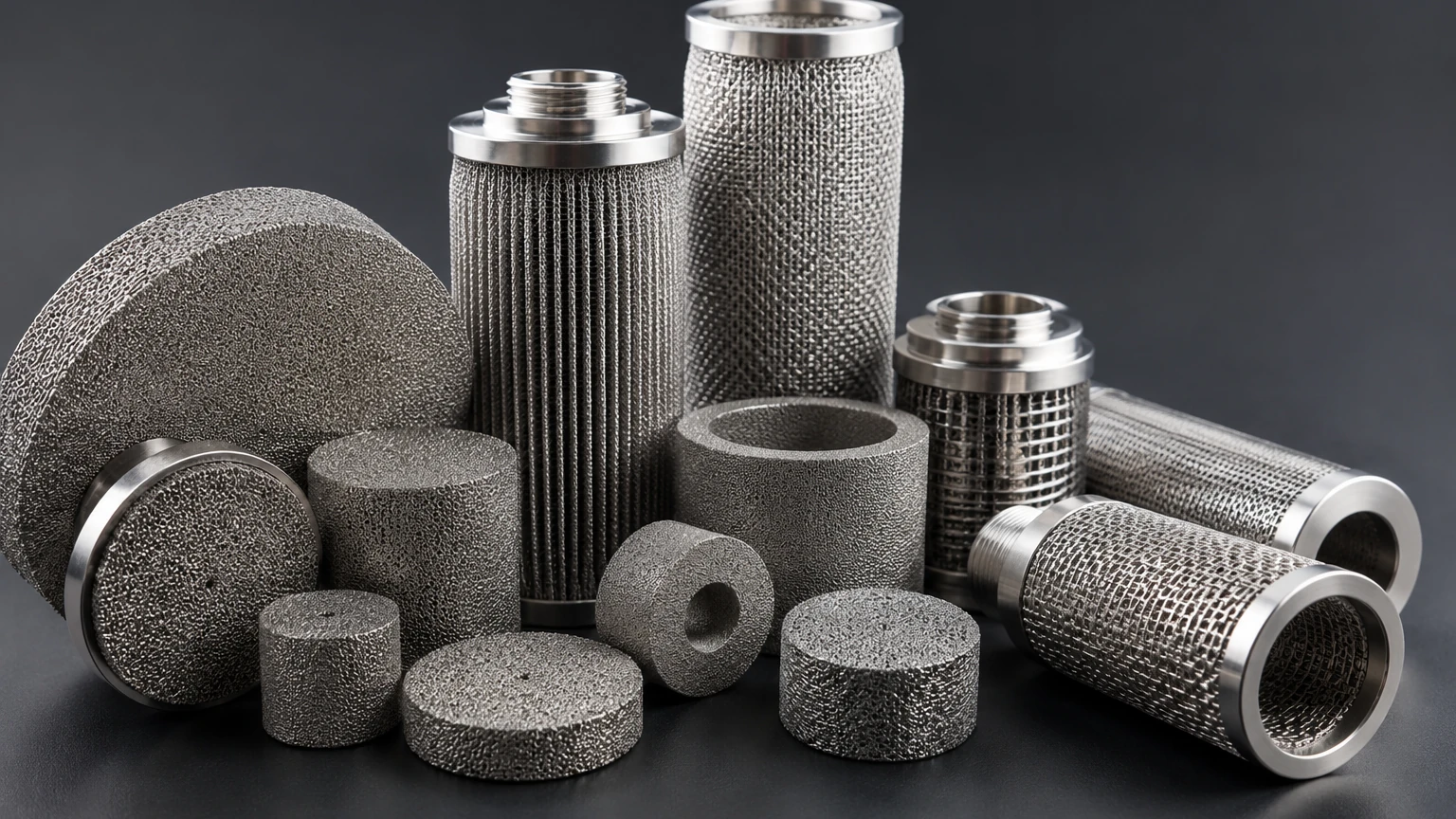
In stainless steel applications, these filters are typically manufactured through sintering or advanced wire mesh layering. The resulting structure is a rigid, self-supporting component that maintains its pore geometry even under significant mechanical stress. This stability is a primary reason why porous metal filters are preferred in high-pressure hydraulic systems, chemical reactors, and steam filtration applications.
When evaluating porous filters, it is important to distinguish between "open porosity" and "closed porosity." Open porosity refers to the voids that are interconnected and open to the surface, allowing fluid flow. Closed porosity consists of isolated voids within the material that do not contribute to filtration but can affect the overall density and thermal properties of the component. For filtration purposes, maximizing effective open porosity while maintaining structural strength is the primary engineering goal.
Engineering Considerations for Pore Structure and Permeability
The performance of porous filters is governed by the relationship between pore size, porosity, and permeability. These factors determine how effectively a filter can remove contaminants without excessively restricting the flow of the process fluid.
Pore Size and Micron Ratings
In the context of industrial filtration, pore size is often expressed as a micron rating. Engineers must differentiate between nominal and absolute ratings:
* Nominal Rating: Indicates the ability of the filter to retain a majority percentage (typically 60% to 90%) of particles of a specific size. It is a helpful guideline but does not guarantee total containment.
* Absolute Rating: Refers to the diameter of the largest hard spherical particle that will pass through the filter under specified test conditions. This is critical for applications requiring high-level sterilization or protection of sensitive downstream equipment.
Permeability and Pressure Drop
Permeability is a measure of the ease with which a fluid can flow through the porous medium. It is mathematically described by Darcy’s Law, which relates the flow rate to the fluid viscosity, the thickness of the filter, and the pressure drop (differential pressure). A high-quality porous filter is designed to provide the required filtration accuracy with the lowest possible initial pressure drop. As the filter accumulates debris, the pressure drop increases; therefore, understanding the "clean pressure drop" versus the "terminal pressure drop" is vital for sizing pumps and monitoring system health.
Material Science: The Role of Stainless Steel in Porous Filters
Material selection is perhaps the most significant factor in the durability of porous filters. While various materials can be made porous, stainless steel remains the industry standard for B2B industrial applications due to its versatile chemical and mechanical properties.
Grade 304 vs. 316L
* Stainless Steel 304: Offers excellent strength and basic corrosion resistance. It is suitable for many food and beverage applications and general industrial water treatment.
* Stainless Steel 316L: Contains molybdenum, which provides superior resistance to pitting and crevice corrosion in chloride-rich environments. The "L" denotes low carbon content, which minimizes carbide precipitation during welding, ensuring the integrity of the porous structure in chemical processing and pharmaceutical manufacturing.
Thermal and Chemical Stability
Porous metal filters can operate at temperatures exceeding 400°C (750°F) in oxidizing environments and even higher in reducing environments. This thermal stability allows for the filtration of hot gases and molten polymers, applications where synthetic fibers would melt or degrade. Furthermore, the chemical inertness of stainless steel ensures that the filter does not leach contaminants into the process stream, maintaining high purity levels in sensitive pharmaceutical or semiconductor processes.
Manufacturing Techniques for Industrial Porous Components
The method used to create the porous structure determines the filter's mechanical characteristics and filtration efficiency. Kaifil utilizes advanced manufacturing processes to ensure consistency across custom designs.
Sintered Metal Powder
In this process, spherical or irregular metal powders are compacted and then heated in a controlled-atmosphere furnace to a temperature below their melting point. The particles bond at their contact points (a process known as "necking"), creating a rigid, porous matrix. This method allows for very fine control over pore size distribution and is ideal for producing small, high-precision filter elements.
Sintered Metal Fiber Felt
Metal fibers are laid down in a non-woven web and then sintered. This results in a medium with very high porosity (up to 80% or more) and high permeability. Fiber felt filters offer excellent dirt-holding capacity and are frequently used in high-viscosity polymer filtration and hydraulic systems.
Multi-layer Wire Mesh
By diffusion-bonding multiple layers of stainless steel wire cloth, manufacturers can create a filter that combines the fine filtration of a thin mesh with the mechanical strength of a heavy support mesh. These structures are highly resistant to pressure surges and are easily cleaned through backwashing.
Performance Metrics and Selection Criteria for Engineers
Selecting the right porous filter requires a comprehensive analysis of the operating environment. Engineers should confirm the following parameters before finalizing a specification:
1. Fluid Compatibility: Beyond the primary fluid, consider trace chemicals or cleaning agents (such as caustic soda or nitric acid) that the filter will encounter during maintenance cycles.
2. Operating Pressure and Temperature: Ensure the filter housing and the porous element itself are rated for the maximum expected system pressure, including potential spikes.
3. Contaminant Characteristics: Is the particulate hard or soft? What is the particle size distribution? Soft, deformable particles may require a different pore structure than hard, crystalline solids.
4. Flow Velocity: High face velocities can lead to premature clogging or even particle "breakthrough" if the filter is not sized correctly.
To explore specific configurations and technical data sheets for these components, engineers can visit the Main Page for detailed product specifications and application support.
Operational Maintenance and Cleaning Protocols
One of the primary advantages of stainless steel porous filters is their cleanability. Unlike disposable cartridges, these units can be regenerated multiple times, significantly reducing the total cost of ownership (TCO) and environmental impact.
Cleaning Methods
* Backpulsing/Backwashing: Reversing the flow of fluid through the filter to dislodge accumulated particles. This is often done in-situ and is highly effective for surface-loading filters.
* Ultrasonic Cleaning: Using high-frequency sound waves in a solvent bath to remove fine particles trapped deep within the porous matrix.
* Chemical Cleaning: Utilizing acids, alkalis, or specialized solvents to dissolve organic or inorganic scaling. This is common in the food and beverage industry to remove protein buildup.
* Thermal Burn-off: In applications like polymer filtration, the filter may be heated to high temperatures to carbonize and remove organic residues.
Determining Replacement Cycles
While cleanable, porous filters do have a finite lifespan. Repeated cleaning cycles and mechanical stress can eventually lead to pore enlargement or structural fatigue. Monitoring the "recovered pressure drop" (the pressure drop after cleaning) is the best way to track the filter's health. When the recovered pressure drop exceeds a certain threshold, the filter has reached its end-of-life.
Customization and OEM Integration in Filtration Systems
Industrial filtration is rarely a one-size-fits-all requirement. Customization is often necessary to integrate porous filters into existing machinery or to meet the demands of a proprietary process. Customization options typically include:
* Geometry and Form Factor: Porous filters can be manufactured as cylinders, discs, plates, or complex conical shapes to fit specific housing designs.
* End Fittings: Custom threads, flanges, or O-ring grooves (such as 222 or 226 configurations) ensure a leak-proof seal within the system.
* Reinforcement: In high-vibration or high-pressure environments, internal or external support cores (perforated tubes) can be added to the porous element to prevent collapse or bursting.
By working closely with a manufacturer like Kaifil, engineering teams can develop filtration components that are optimized for their specific flow rates and retention requirements, ensuring that the final solution provides the best balance of performance and durability.
Conclusion
Porous filters are foundational components in modern industrial processing, offering a level of reliability and precision that is essential for high-stakes environments. From the chemical resistance of 316L stainless steel to the intricate engineering of sintered metal structures, these filters provide the robust performance required to protect equipment and ensure product quality. By focusing on technical specifications such as absolute micron ratings, permeability, and cleanability, professionals can implement filtration strategies that maximize uptime and minimize operational costs. For more information on custom filtration solutions, please refer to the resources available on the Main Page.
