


Hydrocyclone Filters
In industrial fluid management, the efficient removal of suspended solids is critical for protecting downstream equipment, maintaining product purity, and ensuring the longevity of precision filtration media. Hydrocyclone filters, often categorized as centrifugal separators, represent a specialized class of filtration technology that utilizes fluid dynamics rather than a physical barrier to achieve solid-liquid separation. For engineers and technical procurement teams, understanding the mechanical principles, operational limitations, and strategic integration of these units is essential for optimizing system performance.
While traditional media filters rely on the pore size of a mesh or membrane, hydrocyclone filters leverage the density differential between the liquid phase and the particulate matter. This makes them particularly effective for high-load applications where traditional filters would suffer from rapid blinding or excessive pressure drop. When combined with precision stainless steel components, hydrocyclones serve as a robust first line of defense in complex industrial processes.
Principles of Centrifugal Separation in Industrial Filtration
The operation of hydrocyclone filters is governed by the principles of centrifugal force and fluid vortex dynamics. The process begins when the contaminated fluid enters the cylindrical chamber of the hydrocyclone tangentially at high velocity. This tangential entry transforms the linear flow into a high-speed rotating vortex.
As the fluid spirals downward toward the conical section of the housing, the centrifugal force pushes the heavier solid particles outward toward the inner wall. Because these particles possess a higher density than the carrier liquid, they lose velocity due to wall friction and eventually slide down the cone toward the underflow discharge (the apex). Simultaneously, the liquid phase, being less dense, moves toward the center of the vortex. As the cone narrows, the increasing pressure forces the clarified liquid to reverse direction, forming an inner upward-spiraling vortex that exits through the vortex finder at the top (the overflow).
From an engineering perspective, the efficiency of this separation is influenced by the "cut point" or d50 value. This metric defines the particle size at which 50% of the particles are recovered in the underflow. Factors such as fluid viscosity, particle shape, and the specific gravity of the solids directly impact this cut point. For systems requiring high-precision filtration, the hydrocyclone is typically configured to remove the bulk of heavy contaminants (sand, scale, or metal fines) before the fluid reaches secondary precision mesh filters.
Structural Components and Design Engineering
A standard industrial hydrocyclone filter consists of several critical components, each of which must be engineered to withstand specific hydraulic stresses and abrasive forces:
1. The Inlet Chamber: This is where the tangential entry occurs. The geometry of the inlet is crucial for establishing a stable vortex. Improper design can lead to turbulence, which disrupts the separation process and decreases efficiency.
2. The Vortex Finder: This tube extends into the cylindrical section to prevent the short-circuiting of the feed directly into the overflow. Its length and diameter are calibrated to ensure only the clarified inner vortex is captured.
3. The Conical Section: The angle of the cone determines the residence time and the intensity of the centrifugal force. Steeper angles are generally used for finer particle separation.
4. The Apex (Underflow Orifice): This is the discharge point for concentrated solids. In many industrial designs, the apex is adjustable or replaceable to accommodate varying solid loads.
For manufacturers like Kaifil, the focus remains on the durability of these components. While the outer shell may be heavy-duty carbon steel, the internal surfaces and the downstream integration points often require high-grade stainless steel to resist both the corrosive nature of the process fluid and the mechanical wear caused by high-velocity particulates.
Material Compatibility: Stainless Steel vs. Abrasive Media
One of the primary challenges in hydrocyclone filter application is erosion. Because the separation mechanism relies on high-velocity contact between particles and the filter walls, the internal surfaces are subject to continuous abrasive wear. In industries such as chemical processing or mining, this wear is often compounded by chemical corrosion.
Selecting the correct material grade is vital for the total cost of ownership. Stainless steel 304 and 316L are frequently utilized for internal components and connecting flanges due to their superior resistance to oxidation and localized corrosion. In applications involving saline water or acidic chemicals, 316L is preferred for its molybdenum content, which provides enhanced resistance to pitting.
Furthermore, the surface finish of the internal components plays a role in hydraulic efficiency. A smooth, precision-machined stainless steel surface reduces friction losses, allowing for a more consistent vortex and lower energy consumption. When evaluating a Main Page for filtration solutions, engineers should prioritize manufacturers who offer customized material selections tailored to the specific pH levels and abrasive characteristics of their process stream.
Optimizing Efficiency: The Relationship Between Flow Rate and Pressure Drop
Unlike barrier filters where pressure drop increases as the filter cake builds up, hydrocyclone filters operate at a relatively constant pressure drop during steady-state operation. However, the efficiency of a hydrocyclone is highly dependent on maintaining a specific flow rate range.
If the flow rate is too low, the centrifugal force will be insufficient to move particles to the wall, resulting in poor separation efficiency. Conversely, if the flow rate is too high, the pressure drop (delta P) increases exponentially, leading to higher energy costs and potential turbulence that can re-entrain solids into the overflow.
Engineers must calculate the "equilibrium orbit" of the target particles. This involves balancing the centrifugal force pushing the particle out and the inward drag force of the liquid moving toward the center. A well-designed system will typically operate within a pressure drop range of 5 to 15 PSI. If the process requires handling varying flow rates, a manifold of multiple smaller hydrocyclones (a multicyclone) is often more effective than a single large unit, as individual cyclones can be brought online or offline to maintain optimal velocity.
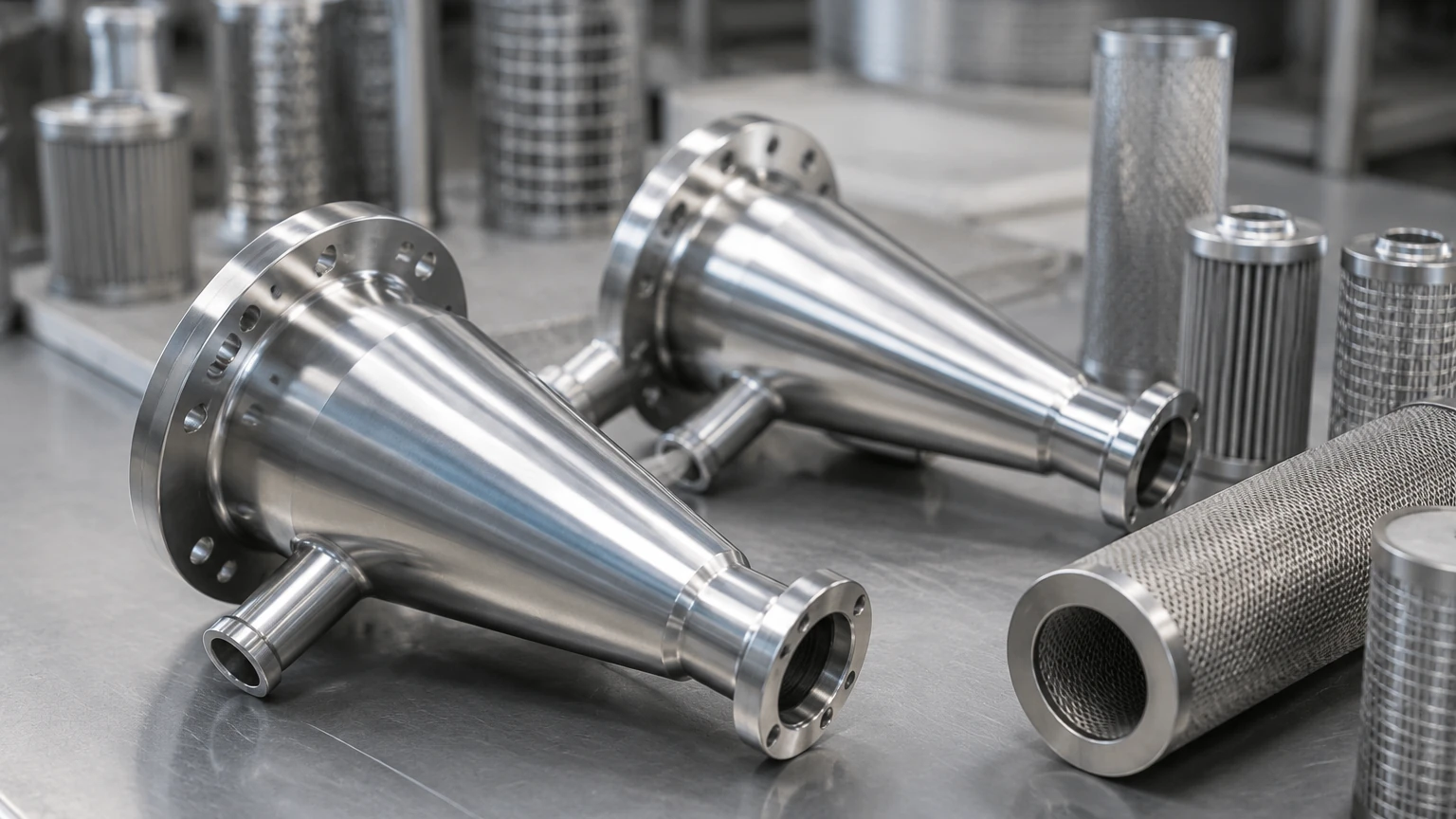
Strategic Integration: Hydrocyclones as Pre-filters for Precision Mesh
In many B2B industrial environments, hydrocyclone filters are not used in isolation. Instead, they serve as the primary stage in a multi-stage filtration architecture. This is particularly common in hydraulic systems, cooling water loops, and food processing lines.
When a hydrocyclone is placed upstream of a stainless steel wire mesh filter or a pleated filter cartridge, it significantly extends the service life of those precision components. By removing 90% or more of the heavy solids (typically 50 microns and larger), the hydrocyclone prevents the secondary filter from becoming overwhelmed. This reduces the frequency of backwashing cycles or manual cartridge replacements, thereby lowering labor costs and reducing downtime.
For example, in a water treatment application, a hydrocyclone might remove sand and grit, while a Kaifil stainless steel wire mesh filter provides the final polish at 10 or 20 microns. This synergy ensures that the precision mesh is only handling the "fines," which it is designed to do, rather than being subjected to the mechanical impact of larger, heavier debris.
Maintenance Protocols and Troubleshooting Common Issues
While hydrocyclone filters have no moving parts, they are not maintenance-free. Technical teams should establish a routine monitoring schedule focusing on the following areas:
* Apex Plugging: The most common failure mode is the blockage of the apex orifice. If the solids concentration in the feed increases suddenly, the underflow can "rope" (becoming a thick, solid stream) or plug entirely. This forces all contaminants into the overflow, potentially damaging downstream equipment.
* Erosion Monitoring: Internal diameters should be checked periodically. Even a small increase in the vortex finder's diameter or a change in the cone's interior profile can drastically alter the separation efficiency.
* Pressure Differential Tracking: A sudden drop in pressure differential often indicates a leak or a pump failure, while an unexpected increase may suggest an internal obstruction at the inlet.
Because stainless steel components are more resistant to the "scouring" effect of the vortex, they generally require less frequent replacement than polymer-lined or cast-iron alternatives. However, in high-velocity applications, even stainless steel components should be inspected for signs of thinning or pitting.
Selection Guide: Technical Specifications for Purchasing Teams
When sourcing hydrocyclone filters or integrated filtration systems, purchasing teams must provide manufacturers with a comprehensive data sheet to ensure the equipment is fit for purpose. Key data points include:
* Fluid Properties: Viscosity, density, and temperature. High-viscosity fluids significantly reduce separation efficiency.
* Solids Characteristics: Specific gravity of the solids, particle size distribution (PSD), and concentration (PPM or percentage by weight).
* Flow Requirements: Minimum, normal, and maximum flow rates.
* Separation Requirements: The desired cut point (d50) and the maximum allowable solids concentration in the overflow.
* Material Standards: Requirements for stainless steel grades (e.g., 304, 316, 316L) and connection types (NPT, Flanged, Victaulic).
By providing these specifications, engineers can ensure that the hydrocyclone is sized correctly to provide the necessary centrifugal acceleration without causing excessive system backpressure.
Conclusion
Hydrocyclone filters are an indispensable tool for industrial solids separation, offering a low-maintenance, high-capacity solution for removing heavy contaminants from liquid streams. Their effectiveness is not universal, however; it depends on the precise balance of fluid dynamics, material science, and system integration. By utilizing hydrocyclones as a pre-filtration stage, industrial facilities can protect their precision stainless steel filtration assets, reduce operational costs, and maintain higher standards of fluid purity. For those seeking to optimize their filtration processes, it is advisable to consult with specialists who understand the nuances of custom metal filtration components and their role in complex hydraulic environments. To explore specific component options and technical support for your filtration project, visit the Kaifil Main Page.
