


Industrial Filters and Strainers
In industrial processing, the integrity of a fluid system depends heavily on the efficiency of its separation technology. Industrial filters and strainers serve as the primary line of defense against particulate contamination, protecting sensitive downstream equipment such as pumps, valves, and heat exchangers. While the terms are often used interchangeably in casual conversation, they represent distinct engineering approaches to fluid purification and equipment protection.
Selecting the appropriate filtration or straining solution requires a deep understanding of the physical and chemical properties of the process fluid, the nature of the contaminants, and the operational parameters of the system. This guide examines the technical nuances of industrial filters and strainers, providing engineers and procurement teams with the factual basis needed to optimize their filtration processes.
Distinguishing Between Industrial Filters and Strainers
The primary distinction between industrial filters and strainers lies in the size of the particles they are designed to remove and the media used for separation.
Industrial Strainers
Strainers are typically utilized for the removal of larger, coarse particles, generally those visible to the naked eye (typically 75 microns or larger). They are often installed as a permanent part of the piping system to protect equipment from "tramp" solids like pipe scale, weld beads, or large debris. Strainers are characterized by a relatively low pressure drop and are designed for high-flow applications where the particulate load is significant but the required clarity is not microscopic.
Industrial Filters
Filters are engineered to remove much finer particles, often in the sub-micron to 100-micron range. They utilize more complex media, such as multi-layered wire mesh or sintered metal, to achieve high-precision separation. Industrial filters are essential in applications where fluid purity is critical to the final product or where fine particulates could cause mechanical wear or chemical interference. Unlike simple strainers, filters may involve depth filtration, where particles are trapped within the thickness of the media, rather than just on the surface.
Material Engineering: The Role of Stainless Steel in Filtration
Material selection is perhaps the most critical factor in the longevity and performance of industrial filters and strainers. Stainless steel remains the industry standard due to its mechanical strength, thermal stability, and resistance to corrosion. At Kaifil, the focus is on leveraging high-grade alloys to meet the rigorous demands of industrial environments.
1. AISI 304 Stainless Steel: This is the most common grade used for general industrial applications. It provides excellent strength and good corrosion resistance for water treatment and basic chemical processing.
2. AISI 316 and 316L Stainless Steel: For more aggressive environments, such as those found in the pharmaceutical and marine industries, 316-grade steel is preferred. The addition of molybdenum enhances resistance to pitting and crevice corrosion, particularly in chloride-rich environments. 316L (low carbon) is specifically used in applications requiring extensive welding to prevent carbide precipitation.
3. Specialty Alloys: In extreme cases involving highly acidic or high-temperature processes, alloys like Monel, Hastelloy, or Inconel may be utilized to ensure the structural integrity of the filter element.
The choice of material affects not only the initial cost but also the total cost of ownership, as it determines the replacement frequency and the ability of the filter to withstand aggressive cleaning cycles.
Key Performance Metrics: Flow Rate and Pressure Differential
When evaluating industrial filters and strainers, engineers must balance the need for fine filtration with the requirement for system efficiency. Two metrics are paramount: flow rate and pressure differential (Delta P).
Clean Pressure Drop
Every filter element introduces a degree of resistance to the flow. The "clean pressure drop" is the initial resistance measured when the filter is first installed. A high initial pressure drop indicates that the filter may be undersized for the application or that the media is too restrictive for the fluid's viscosity.
Dirt-Holding Capacity
As particulates accumulate on the surface or within the depth of the media, the pressure drop increases. The dirt-holding capacity refers to the amount of contaminant a filter can retain before the pressure drop reaches a critical terminal point, necessitating cleaning or replacement. For industrial filters and strainers, maximizing surface area—often through pleating—is a common engineering strategy to extend the service life between maintenance intervals.
Viscosity Considerations
The viscosity of the process fluid significantly impacts filter selection. High-viscosity fluids, such as oils or resins, require larger surface areas and more robust support structures to prevent the filter media from deforming under the increased pressure required to force the fluid through the mesh.
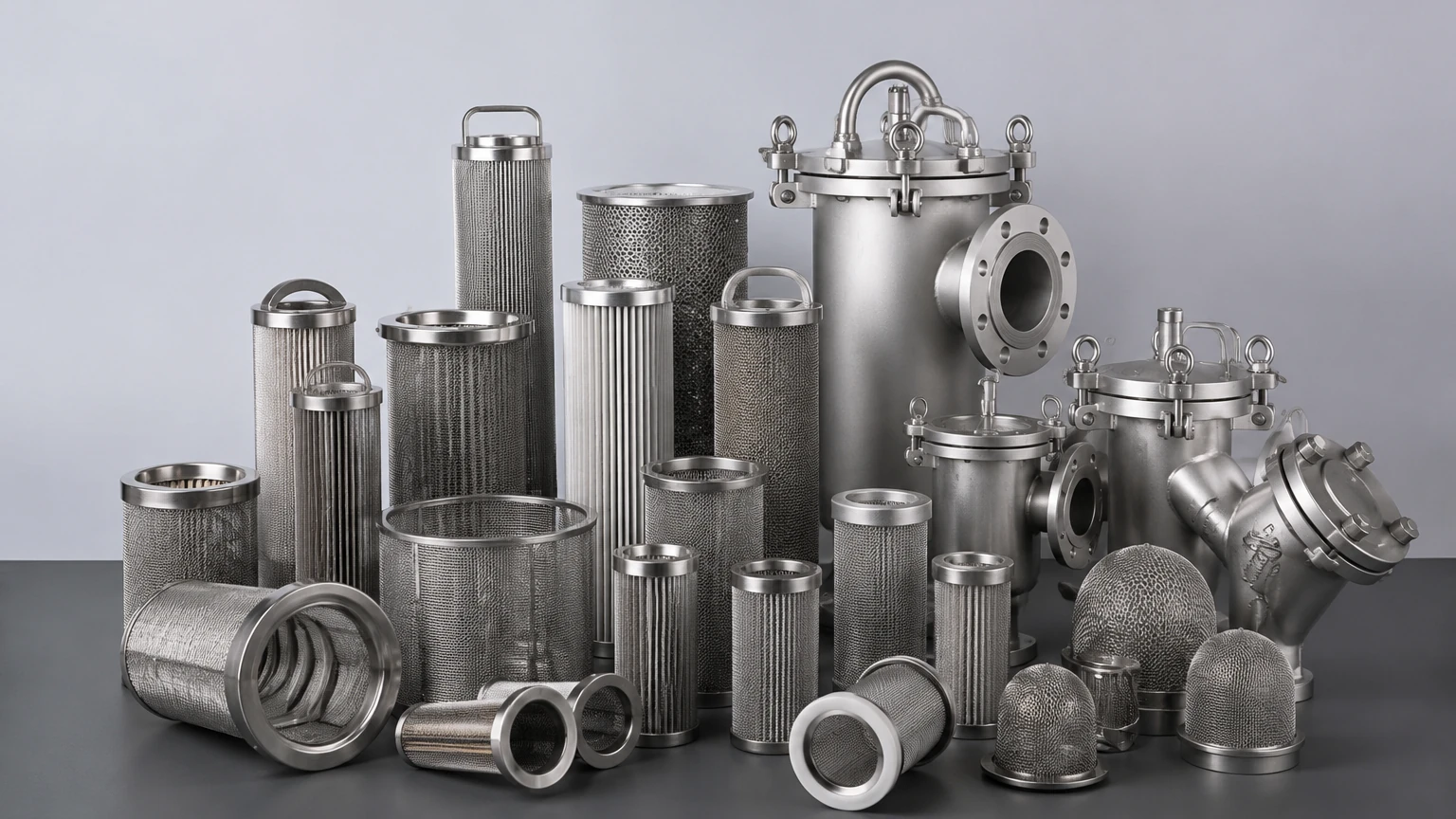
Customization and Precision in Metal Filter Design
Standard off-the-shelf solutions often fail to meet the specific requirements of complex industrial systems. Customization in the design of industrial filters and strainers allows for the optimization of several variables:
* Mesh Weave Patterns: Depending on the application, engineers may choose between Plain Weave, Twill Weave, or Dutch Weave. Dutch weaves, for instance, provide superior strength and finer filtration ratings by using a higher density of smaller diameter wires in one direction.
* Structural Reinforcement: In high-pressure hydraulic or steam applications, the filter media must be supported by perforated metal cores or external cages to prevent collapse.
* End Fitting Configuration: Custom end caps (such as NPT, flange, or sanitary Tri-Clamp fittings) ensure a leak-proof seal and ease of installation within existing piping architectures.
By tailoring these elements, manufacturers can provide filtration solutions that align precisely with the operational realities of the plant. For more detailed technical specifications on available configurations, engineers can refer to the Main Page for a comprehensive overview of custom manufacturing capabilities.
Maintenance Strategies and Lifecycle Management
The sustainability of an industrial filtration system depends on its maintenance profile. Unlike disposable polymer filters, stainless steel industrial filters and strainers are often designed to be cleanable and reusable, which significantly reduces long-term operational costs and environmental impact.
Cleaning Methodologies
* Backwashing: This involves reversing the flow of the fluid to dislodge particles from the surface of the media. It is most effective for surface-type strainers.
* Ultrasonic Cleaning: For precision filters where particles are trapped deep within the mesh, ultrasonic cleaning uses high-frequency sound waves to create cavitation bubbles that strip away contaminants without damaging the delicate wire structures.
* Chemical Cleaning: In industries like food and beverage, CIP (Clean-In-Place) systems use caustic or acidic solutions to dissolve organic or mineral buildup.
Determining Replacement Cycles
While stainless steel elements are durable, they are not infinite. Factors such as fatigue from pressure cycling, erosion from abrasive particles, and chemical degradation eventually necessitate replacement. Monitoring the rate at which the pressure drop increases after each cleaning cycle is an effective way to predict the end of a filter's useful life.
Technical Considerations for Procurement and Implementation
Before finalizing a purchase for industrial filters and strainers, technical teams should confirm several critical data points to ensure the solution is fit for purpose:
1. Micron Rating Accuracy: Is the rating absolute or nominal? An absolute rating implies that 99.9% of particles of a specific size will be captured, whereas a nominal rating is more of an average.
2. Operating Temperature and Pressure: Ensure the filter housing and the element itself are rated for the maximum possible surges in the system, not just the steady-state operating conditions.
3. Chemical Compatibility: Beyond the fluid itself, consider the chemicals used for cleaning and any potential trace elements in the process stream that could cause localized corrosion.
4. Seal Materials: The gaskets and O-rings (Viton, EPDM, PTFE) must be as chemically resistant as the metal media to prevent bypass leakage.
In conclusion, the selection of industrial filters and strainers is a technical decision that impacts the efficiency, safety, and profitability of industrial operations. By focusing on material science, fluid dynamics, and custom engineering, facilities can achieve reliable separation performance even in the most demanding environments. For those seeking to integrate high-performance filtration into their systems, reviewing the engineering options and application support available on the Main Page is a recommended first step in the procurement process.
