


Polypropylene Filter Cartridges
In the landscape of industrial liquid processing, polypropylene filter cartridges represent one of the most versatile and widely utilized components for sediment removal and clarification. As a thermoplastic polymer, polypropylene (PP) offers a unique combination of chemical resistance, thermal stability, and cost-effectiveness that makes it suitable for applications ranging from municipal water treatment to complex chemical manufacturing. For engineers and procurement professionals, selecting the correct cartridge requires an understanding of fiber geometry, bonding techniques, and the specific hydraulic demands of the system.
While high-performance facilities often utilize permanent stainless steel filtration systems for extreme temperatures or aggressive solvents, polypropylene filter cartridges serve as the primary choice for disposable, high-efficiency filtration in aqueous and many chemical environments. Understanding the technical nuances of these components is essential for optimizing process uptime and ensuring product purity.
Technical Properties of Polypropylene as a Filter Medium
Polypropylene is preferred in industrial filtration primarily due to its inert nature. It is a chemically resistant material that withstands a broad spectrum of acids, bases, and organic solvents. This stability ensures that the filter medium does not leach extractables into the process fluid, which is a critical requirement in the pharmaceutical and food and beverage industries.
Chemical Compatibility
Polypropylene is highly resistant to many corrosive agents. It performs exceptionally well with inorganic acids (such as hydrochloric and sulfuric acid at moderate concentrations) and alkaline solutions (such as sodium hydroxide). However, it has limitations when exposed to strong oxidizing agents or certain aromatic and chlorinated hydrocarbons, which can cause the polymer to swell or degrade. Engineers must verify the chemical compatibility of both the filter media and the hardware (core and end caps) with the specific process fluid at operating temperatures.
Thermal Limits
Standard polypropylene filter cartridges are typically rated for continuous operation at temperatures up to 60°C (140°F) to 80°C (176°F). Beyond these temperatures, the structural integrity of the polymer may diminish, leading to fiber migration or bypass. For applications exceeding these limits, metallic filters or specialized high-temperature polymers like PES (polyethersulfone) or PTFE (polytetrafluoroethylene) are generally required.
Structural Variations: Melt-Blown vs. Pleated Cartridges
Industrial polypropylene filter cartridges are generally categorized by their construction method, which dictates their filtration mechanism and performance characteristics. The two most common types are melt-blown depth filters and pleated surface filters.
Melt-Blown Depth Filters
Melt-blown cartridges are produced by extruding molten polypropylene resin through high-velocity air streams, creating a dense web of microfibers. These fibers are thermally bonded, meaning no chemical binders or adhesives are used, maintaining high purity.
These filters utilize "depth filtration," where particles are trapped throughout the entire thickness of the filter wall. High-quality melt-blown cartridges often feature a graded density structure—where the outer layers have larger pores to catch coarse particles and the inner layers have finer pores for final polishing. This structure maximizes the dirt-holding capacity and extends the service life of the cartridge. They are ideal for fluids with a broad particle size distribution.
Pleated Filter Cartridges
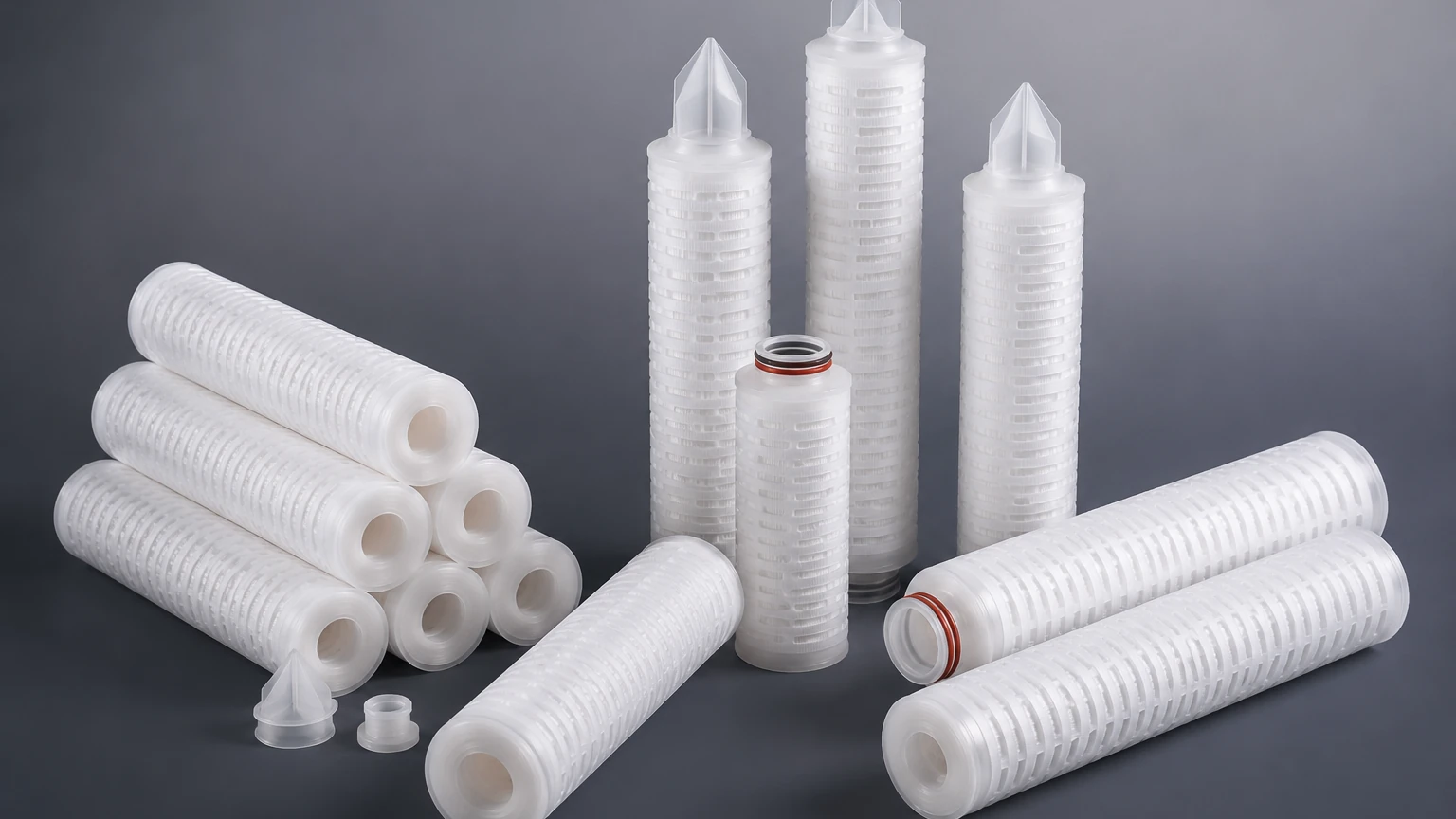
Pleated polypropylene filter cartridges are constructed from a flat sheet of melt-blown or membrane media that is folded to increase the available surface area. This design allows for significantly higher flow rates and lower initial pressure drops compared to depth filters of the same dimensions.
Because the filtration occurs primarily on the surface of the pleats, these cartridges are often used for "absolute" filtration applications where high efficiency and precise particle retention are required. They are particularly effective in protecting downstream equipment, such as membranes or high-precision nozzles, from fine particulate contamination.
Performance Evaluation and Micron Ratings
When evaluating polypropylene filter cartridges, engineers must look beyond simple micron numbers and analyze the efficiency ratings and flow dynamics.
Nominal vs. Absolute Ratings
* Nominal Rating: This indicates the filter's ability to retain a majority percentage (typically 60% to 90%) of particles at a specific micron size. Nominal filters are best suited for pre-filtration where total removal is not critical.
* Absolute Rating: This refers to the diameter of the largest hard spherical particle that will pass through the filter under specified test conditions. High-performance pleated PP cartridges often achieve absolute ratings with efficiencies of 99.9% (Beta 5000). This is crucial for critical processes where even trace contamination can lead to batch failure.
Pressure Drop and Flow Rate
The "clean pressure drop" ($ΔP$) is the resistance the filter offers to the fluid flow when it is new. As the filter accumulates contaminants, the pressure drop increases. In industrial system design, it is standard practice to size the filtration housing so that the initial pressure drop does not exceed 0.1 to 0.2 bar (2-3 psi). Operating a system with an undersized filter leads to frequent change-outs and potential pump strain.
For more specialized industrial filtration needs, including custom-engineered solutions, technical teams often consult the Main Page of specialized manufacturers to compare the performance of synthetic media against metallic alternatives.
Selection Criteria for Industrial Applications
Choosing the right polypropylene filter cartridge involves balancing filtration efficiency with the economic realities of the process. The following factors should be prioritized during the selection process:
1. Fluid Viscosity
High-viscosity fluids create higher resistance as they pass through the filter media. For thick liquids, pleated cartridges are often preferred due to their high surface area, which helps maintain acceptable flow rates. Alternatively, a coarser micron rating may be necessary in the pre-filtration stage to prevent premature blinding of the media.
2. Contaminant Characteristics
Is the contaminant deformable (like gels) or rigid (like sand or metal shavings)? Depth filters are superior for capturing deformable particles because the tortuous path of the fiber matrix can trap them more effectively than a surface filter. For rigid, uniform particles, pleated surface filters provide more predictable results.
3. End-Cap Configurations
To ensure a proper seal within the filter housing, the cartridge must have the correct end-cap configuration. Common industrial standards include:
* DOE (Double Open End): Uses flat gaskets at both ends; common in standard commercial housings.
* Code 7 (226 O-ring/Fin): Features a locking tab and double O-rings for high-purity and high-pressure applications to prevent bypass.
* Code 3 (222 O-ring/Flat): Utilizes double O-rings without the locking tabs.
Selecting the wrong seal material (such as EPDM, Viton, or Silicone) can lead to seal failure and fluid bypass, rendering the filtration process ineffective.
Polypropylene vs. Stainless Steel: Engineering Trade-offs
In many industrial settings, the choice between polypropylene filter cartridges and stainless steel filters is a matter of "disposable vs. cleanable."
Polypropylene is the go-to solution for low-to-medium temperature aqueous applications where the cost of cleaning a permanent filter exceeds the cost of replacing a disposable cartridge. They are particularly useful in batch processes where cross-contamination must be avoided; a new cartridge ensures a sterile or clean start for every batch.
However, stainless steel filters, such as those manufactured by Kaifil, are required when the application involves:
* Extreme Temperatures: Operating environments above 100°C.
* High Differential Pressure: Situations where the filter must withstand significant pressure surges without collapsing.
* Aggressive Solvents: Fluids that would dissolve or swell polypropylene.
* Sustainability Requirements: Applications where minimizing waste is a priority, as stainless steel elements can be ultrasonically cleaned and reused.
Often, a hybrid approach is used: a robust stainless steel strainer or mesh filter is used as a primary stage to remove large debris, followed by a polypropylene melt-blown or pleated cartridge for final polishing.
Maintenance and Replacement Cycles
Monitoring the differential pressure is the most reliable method for determining when a polypropylene filter cartridge needs replacement. Most industrial systems are designed for a cartridge change-out when the differential pressure reaches 1.5 to 2.5 bar (20-35 psi).
Allowing a cartridge to operate beyond its rated terminal pressure drop can lead to several risks:
1. Media Migration: The pressure can force fibers out of the filter and into the downstream process.
2. Unloading: Previously trapped particles can be forced through the media due to high pressure.
3. Structural Failure: The internal core of the cartridge may collapse, leading to a total loss of filtration and potential damage to downstream pumps or instrumentation.
Conclusion: Confirming Specifications Before Purchase
To ensure the successful implementation of polypropylene filter cartridges in an industrial environment, engineers should confirm the following technical details with their supplier:
* Target Particle Size: Determine if the requirement is for nominal or absolute retention.
* Flow Requirements: Calculate the maximum flow rate and ensure the housing/cartridge combination can handle it at a low initial $ΔP$.
* Chemical and Thermal Exposure: Verify that the PP resin and seal materials are compatible with the process fluid and any cleaning chemicals used in the system.
* Regulatory Compliance: For food or pharmaceutical applications, ensure the cartridges are FDA-compliant or meet USP Class VI plastics biological reactivity tests.
By carefully matching the cartridge architecture to the specific hydraulic and chemical demands of the application, facilities can achieve consistent product quality and optimized operational costs. For organizations looking to integrate these components into broader filtration systems, exploring professional resources and manufacturer data on the Main Page provides the necessary technical foundation for informed decision-making.
