


Filtration Strainer
In industrial fluid handling systems, the integrity of downstream equipment—such as pumps, valves, flow meters, and spray nozzles—depends heavily on the removal of unwanted solids from the process stream. A filtration strainer serves as the primary mechanical defense against debris, scale, and particulate matter that could otherwise cause mechanical wear, clogging, or complete system failure. Unlike fine filters designed to remove microscopic contaminants, a filtration strainer is typically utilized to capture larger particles, often as a pre-filtration stage or as a safeguard for high-value components.
Selecting the appropriate filtration strainer requires a deep understanding of fluid dynamics, material compatibility, and the specific mechanical requirements of the application. For engineers and procurement teams, the decision-making process involves balancing filtration precision with system throughput and maintenance accessibility.
Understanding the Role of a Filtration Strainer in Industrial Systems
A filtration strainer is a closed vessel with a cleanable or replaceable screen element designed to remove solids from flowing liquids or gases. While the terms "filter" and "strainer" are sometimes used interchangeably, the industry generally distinguishes them by the size of the particles they target. Strainers are typically used for coarse filtration (measured in mesh or microns) where the pressure drop across the element is a critical design factor.
In chemical processing, water treatment, and hydraulic systems, the filtration strainer prevents "tramp" solids from entering sensitive machinery. For example, in a cooling water loop, a strainer might remove pipe scale or organic debris that would otherwise foul a heat exchanger. In the food and beverage industry, stainless steel strainers ensure that process fluids remain free of physical contaminants while maintaining the hygienic standards required for consumable products.
Classification and Selection of Strainer Configurations
The physical geometry of a filtration strainer determines its suitability for specific piping layouts and operational requirements. The three most common configurations are Y-strainers, Basket (Simplex) strainers, and Duplex strainers.
Y-Strainers
As the name suggests, these are shaped like the letter "Y." They are most commonly used in pressurized lines, either liquid or gas, where the amount of material to be removed is relatively small. The compact design of the Y-strainer makes it ideal for installations where space is limited. They can be installed horizontally or vertically, provided the "leg" of the Y points downward to collect debris. Because of their lower holding capacity compared to basket strainers, they are often used in applications requiring infrequent cleaning.
Basket (Simplex) Strainers
Basket strainers feature a vertical cylinder that houses a large, removable basket-shaped screen. This design offers a significantly higher dirt-holding capacity and a larger total screen area than a Y-strainer. The primary advantage is a lower pressure drop and longer intervals between cleaning cycles. Basket strainers are typically used in horizontal pipelines where the flow can be momentarily shut down for maintenance.
Duplex Strainers
For applications where the process flow cannot be interrupted, a duplex filtration strainer is the standard choice. This system consists of two separate strainer chambers connected by a diversion valve. When one chamber becomes clogged, the flow is diverted to the clean chamber, allowing the operator to service the dirty basket without stopping the system. This is critical in continuous chemical manufacturing and lubrication systems for large turbines.
Material Engineering: Why Stainless Steel is the Standard
Material selection is perhaps the most critical factor in ensuring the longevity of a filtration strainer. While cast iron or carbon steel may be sufficient for non-corrosive water applications, stainless steel is the preferred material for demanding industrial environments.
* Grade 304 Stainless Steel: Offers excellent strength and basic corrosion resistance, making it suitable for general industrial use and many food-grade applications.
* Grade 316/316L Stainless Steel: Contains molybdenum, which provides superior resistance to chlorides and pitting. This is the industry standard for chemical processing, marine environments, and pharmaceutical manufacturing.
Beyond the housing, the internal mesh or perforated plate must also be engineered for durability. Stainless steel wire mesh provides the necessary structural integrity to withstand high differential pressures without deforming. In high-pressure hydraulic systems, the mesh must be reinforced or pleated to increase the surface area and structural rigidity.
Technical Parameters: Sizing, Flow Rates, and Pressure Management
An incorrectly sized filtration strainer can lead to excessive pressure drop (ΔP), which forces pumps to work harder and reduces overall system efficiency. When specifying a strainer, engineers must consider the following:
1. Flow Rate (GPM or m³/h): The strainer must be sized to handle the maximum expected flow without exceeding the recommended velocity limits. High velocity can cause turbulence and accelerate erosion of the strainer element.
2. Clean Pressure Drop: This is the initial resistance to flow when the strainer is clean. Ideally, the clean pressure drop should not exceed 2 psi (0.14 bar) for liquid systems.
3. Terminal Pressure Drop: This is the point at which the strainer must be cleaned. If the ΔP reaches a certain threshold (often 10-15 psi), the structural integrity of the basket may be compromised, or the flow may become insufficient for downstream needs.
4. Viscosity: The thickness of the fluid significantly impacts the pressure drop. Highly viscous fluids, such as heavy oils or syrups, require larger strainers with more open area to maintain flow.
Filtration Precision: Balancing Particle Retention and Flow
The performance of a filtration strainer is defined by its "open area ratio," which is the relationship between the total area of the holes in the screen and the cross-sectional area of the inlet pipe. A high open area ratio (typically 4:1 or higher) ensures that the strainer does not become a bottleneck in the system.
Selection of the mesh size or perforation diameter depends on the smallest particle that must be removed.
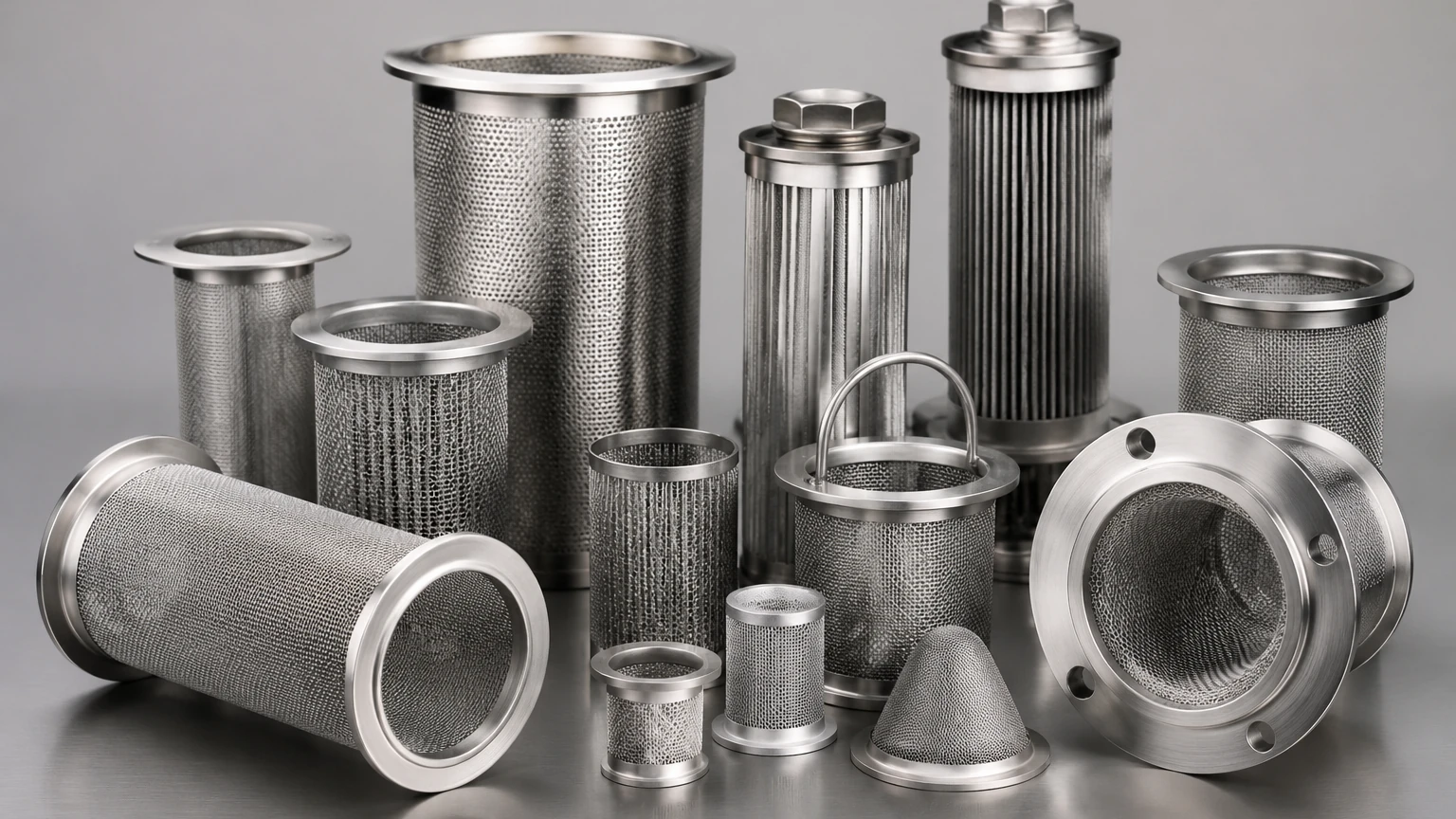
* Perforated Plates: These are used for coarse straining, with hole sizes typically ranging from 1/32" to 1/2". They are robust and easy to clean.
* Wire Mesh: For finer filtration, a stainless steel wire mesh is layered over a perforated metal backup. Mesh counts can range from 20 mesh (approx. 840 microns) to 400 mesh (approx. 37 microns).
Engineers must be cautious not to specify a mesh that is "too fine." While it may seem safer to remove as many particles as possible, an unnecessarily fine mesh will clog rapidly, leading to increased maintenance costs and potential system downtime.
Operational Maintenance and Total Cost of Ownership
The total cost of ownership (TCO) for a filtration strainer extends beyond the initial purchase price. It includes the cost of downtime, labor for cleaning, and the replacement of damaged elements.
To optimize maintenance, many industrial strainers are equipped with differential pressure gauges. These gauges provide a real-time visual or electronic signal when the basket is reaching its capacity. In automated systems, these signals can trigger an alarm or initiate an automatic backwash cycle in self-cleaning strainer models.
Regular inspection of the gaskets and seals is also vital. In chemical and high-temperature applications, the failure of a seal can lead to hazardous leaks. Utilizing high-quality O-rings made of Viton, EPDM, or PTFE ensures that the strainer remains leak-proof throughout its service life.
Custom Engineering and OEM Filtration Solutions
Every industrial facility has unique constraints, whether it is a specific footprint requirement, unusual chemical exposure, or extreme temperature fluctuations. Standard off-the-shelf strainers may not always meet these specialized needs. This is where custom manufacturing becomes essential.
Custom stainless steel filtration solutions allow for the integration of specific flange types, specialized coatings, or reinforced internal structures designed for high-vibration environments. For engineers looking to integrate high-performance filtration components into their equipment designs, consulting with a manufacturer that understands both the metallurgy and the fluid dynamics is paramount.
By focusing on precision manufacturing and material quality, facilities can achieve reliable, long-term protection for their critical infrastructure. For more information on specialized filtration components and custom manufacturing capabilities, you can visit the Main Page to explore technical specifications and application-specific designs.
Conclusion
A filtration strainer is more than just a simple screen; it is a critical engineering component that ensures the reliability and efficiency of industrial processes. By carefully evaluating the type of strainer, the material of construction, and the hydraulic parameters of the system, engineers can prevent costly equipment damage and minimize operational disruptions. Whether in a simple water line or a complex chemical reactor, the right filtration strategy begins with selecting a robust and well-engineered strainer.
