


Woven Wire Fence Knots: A Technical Guide to Structural Integrity and Selection
In the realm of industrial containment, perimeter security, and heavy-duty screening, the structural integrity of a mesh system is determined not just by the material used, but by the mechanical method used to secure the wire intersections. While many engineers are familiar with welded wire or simple interlaced weaves, the use of specialized woven wire fence knots represents a critical engineering choice for applications requiring high impact resistance, flexibility, and long-term tension retention.
For technical professionals and procurement teams, understanding the mechanics of these knots is essential when specifying Woven Wire Mesh for demanding environments. This guide examines the technical characteristics of various knot types, material considerations, and the engineering logic behind selecting specific configurations for industrial use.
The Engineering of Woven Wire Mesh Structures
At its core, woven wire mesh is a structural fabric created by interlacing longitudinal (warp) wires and transverse (shute) wires. In standard industrial filtration or fine screening, this is often achieved through plain or twill weaves where the wires rely on friction and crimping to stay in place. However, in larger-scale applications—such as perimeter fencing for chemical plants, safety barriers in manufacturing facilities, or heavy-duty screening—the mesh must withstand significant mechanical stress without deforming.
This is where the "knot" becomes a vital component. A knot in this context is a mechanical wrap or tie that locks the vertical and horizontal wires together. Unlike welding, which can create heat-affected zones that weaken the base metal, a mechanical knot preserves the full tensile strength of the wire. This allows the mesh to absorb impacts and distribute loads across a wider surface area, making it superior for applications where the mesh might be subjected to physical pressure or environmental shifting.
Comparative Analysis of Woven Wire Fence Knots
Selecting the right knot type requires a balance between structural rigidity, flexibility, and cost-effectiveness. In industrial B2B applications, three primary knot designs dominate the market. Each offers distinct performance characteristics based on how the wires are manipulated at the intersection.
1. The Hinge Joint Knot
The hinge joint is perhaps the most common knot used in woven wire structures. In this design, the vertical stay wire is wrapped around the horizontal line wire at each intersection.
* Mechanical Behavior: As the name suggests, the wrap acts as a hinge. This allows the mesh to "give" under pressure and then return to its original shape.
* Advantages: It is highly adaptable to uneven terrain or irregular industrial footprints. If a section of the mesh is subjected to a heavy load, the hinge joint allows the pressure to be absorbed without snapping the wire.
* Limitations: Under extreme vertical pressure, hinge joints can slide or "bunch," which may require more frequent re-tensioning over the product's lifecycle.
2. The S-Knot (Square Deal)
The S-Knot utilizes a separate piece of wire to tie the vertical and horizontal wires together. This creates a smooth profile on both sides of the mesh.
* Mechanical Behavior: The knot is formed in an "S" shape, locking the wires firmly while maintaining a flat surface.
* Advantages: Because the knot is smooth, it is often specified for safety barriers where personnel might come into contact with the mesh, as it minimizes the risk of snagging or injury. It offers higher rigidity than the hinge joint.
* Limitations: It provides less flexibility than the hinge joint, making it better suited for flat, consistent installations.
3. The Fixed Knot (Solidlock)
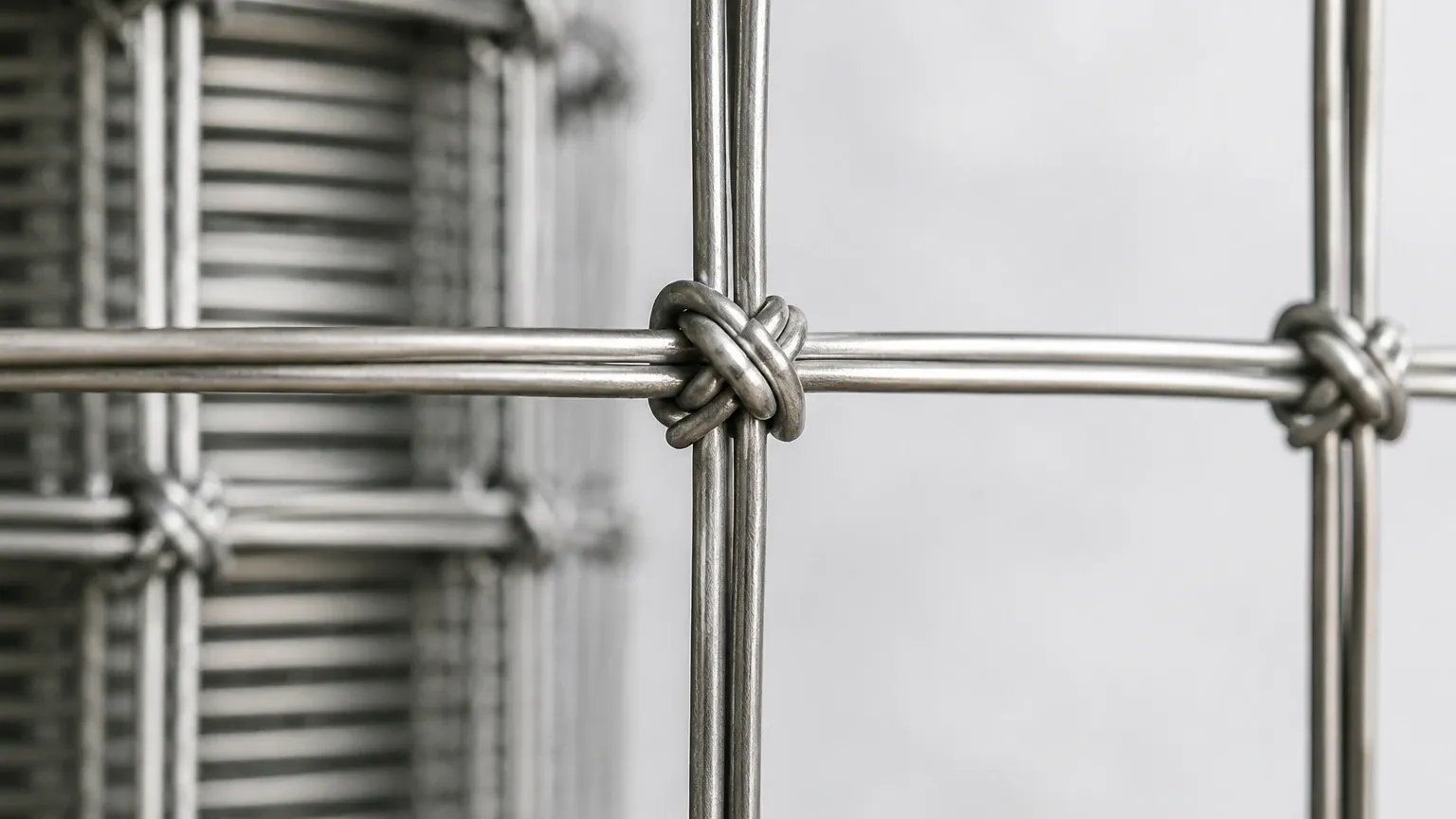
For high-security or high-impact industrial environments, the fixed knot is the gold standard. This design uses a separate, small piece of wire to wrap tightly around the intersection of a continuous vertical stay wire and a horizontal line wire.
* Mechanical Behavior: The fixed knot prevents the wires from sliding in any direction. It essentially creates a rigid grid that behaves like a single piece of steel.
* Advantages: Fixed knot mesh requires fewer support posts because the mesh itself provides significant structural upright strength. It maintains tension far better than other knot types, significantly reducing maintenance costs and replacement cycles.
* Limitations: It is generally more expensive due to the complexity of the manufacturing process and the increased volume of wire required.
Material Performance: Stainless Steel in High-Tension Applications
While the knot type determines the mechanical stability, the material selection determines the longevity of the mesh in corrosive or demanding industrial environments. While galvanized steel is common in agricultural settings, B2B industrial applications—particularly in chemical processing, pharmaceuticals, and marine environments—often demand the superior properties of stainless steel.
SS304 vs. SS316L
* SS304: This is the standard grade for most industrial woven wire mesh. It provides excellent strength and good corrosion resistance for indoor or mild outdoor environments. When used with fixed knots, SS304 provides a durable, high-tensile barrier that resists oxidation.
* SS316L: For facilities exposed to chlorides, acids, or salt spray, SS316L is the preferred choice. The addition of molybdenum enhances its resistance to pitting and crevice corrosion. In high-tension woven wire fence knots, using SS316L ensures that the mechanical integrity of the knot is not compromised by chemical degradation over time.
Load Distribution and Mechanical Stability
One of the primary reasons engineers specify woven wire fence knots over welded mesh is load distribution. In a welded system, an impact at a single point concentrates stress on the weld. If the weld fails, the integrity of the entire panel is compromised.
In a woven system, particularly one utilizing fixed knots, the load is distributed along the continuous horizontal and vertical wires. The knots act as anchors that transfer energy across the entire mesh surface. This is critical for:
1. Impact Barriers: In warehouses or factories, woven mesh can stop moving equipment or falling debris without the catastrophic failure seen in rigid, brittle materials.
2. High-Vibration Environments: Industrial machinery can cause constant vibration. Mechanical knots are less prone to fatigue failure compared to rigid welds, which can crack under harmonic stress.
3. Thermal Expansion: In outdoor industrial sites, temperature fluctuations cause metal to expand and contract. Woven knots allow for microscopic movements that prevent the mesh from warping or buckling.
Selection Criteria for Industrial Perimeter and Containment
When evaluating Woven Wire Mesh options, purchasing teams should confirm several technical specifications to ensure the product meets the application's demands:
* Wire Gauge: The diameter of the wire must be sufficient to handle the calculated load. Heavier gauges are typically paired with fixed knots for maximum security.
* Stay Spacing: The distance between vertical wires (stays) affects both the visibility through the mesh and its structural rigidity. Common spacings include 3-inch, 6-inch, or 12-inch intervals.
* Tensile Strength: High-tensile wire (often exceeding 125,000 psi) is frequently used in fixed knot configurations to allow for greater tensioning and wider post spacing.
* Coating and Finish: Beyond the base metal, consider if additional passivation or specialized coatings are required for specific chemical exposures.
Customization and Technical Procurement for Industrial Projects
Industrial projects rarely fit a "one-size-fits-all" model. Customization is often required to meet specific safety standards or spatial constraints. When working with a professional manufacturer like Kaifil, engineers can specify custom mesh counts, wire diameters, and knot configurations tailored to their specific environment.
Before finalizing a procurement order, technical teams should confirm:
* Environmental Compatibility: Will the mesh be exposed to cleaning agents, extreme temperatures, or salt air?
* Installation Requirements: Does the site allow for the high-tensioning equipment required for fixed knot mesh, or is the flexibility of a hinge joint more practical?
* Total Cost of Ownership (TCO): While fixed knot stainless steel mesh has a higher initial purchase price, its reduced maintenance needs and longer replacement cycle often result in a lower TCO compared to cheaper, galvanized hinge-joint alternatives.
Conclusion
The choice of woven wire fence knots is a fundamental engineering decision that impacts the safety, durability, and cost-effectiveness of industrial mesh installations. Whether utilizing the flexibility of the hinge joint, the safety-conscious profile of the S-knot, or the uncompromising strength of the fixed knot, selecting the right mechanical intersection is as important as selecting the right alloy.
For engineers looking to optimize their filtration or containment systems, Kaifil provides precision-manufactured solutions. Plain, twill and dutch woven wire mesh in SS304/316L — rolls, cut mesh and framed panels. Send mesh count or micron target for a technical quote. By focusing on technical accuracy and material quality, facilities can ensure their mesh systems perform reliably under the most demanding industrial conditions.
