


Nordson Filters
In high-precision industrial environments, the integrity of fluid delivery systems depends heavily on the quality of filtration components. Nordson filters are widely recognized in industries involving hot melt adhesives, sealants, and liquid coatings, where even microscopic contaminants can lead to significant downtime, equipment damage, or product defects. For engineers and maintenance professionals, understanding the technical nuances of these filtration systems is essential for maintaining operational efficiency and ensuring the longevity of expensive dispensing equipment.
Industrial filtration is not merely about removing debris; it is about managing the rheology of the fluid while protecting sensitive components such as pumps, hoses, and nozzles. When sourcing or replacing filtration components, technical teams must evaluate material compatibility, pressure ratings, and the specific geometry of the filter media to ensure seamless integration into existing workflows.
The Critical Function of Filtration in Fluid Delivery Systems
Filtration serves as the primary defense mechanism in fluid management systems. In applications involving Nordson equipment, the primary goal is to prevent charred material, degraded adhesive, or external contaminants from reaching the dispensing nozzles. Because these nozzles often have extremely small orifices—sometimes measured in thousandths of an inch—even a minor amount of particulate matter can cause a partial or total blockage.
Beyond preventing clogs, effective filtration protects the internal mechanical seals and check valves within the pump assembly. In a high-pressure hydraulic or adhesive system, abrasive particles can cause premature wear on metal surfaces, leading to internal leakage and a loss of volumetric efficiency. By implementing high-quality stainless steel wire mesh filters, operators can significantly extend the Mean Time Between Failures (MTBF) for the entire system.
Engineering Specifications of Stainless Steel Wire Mesh Filters
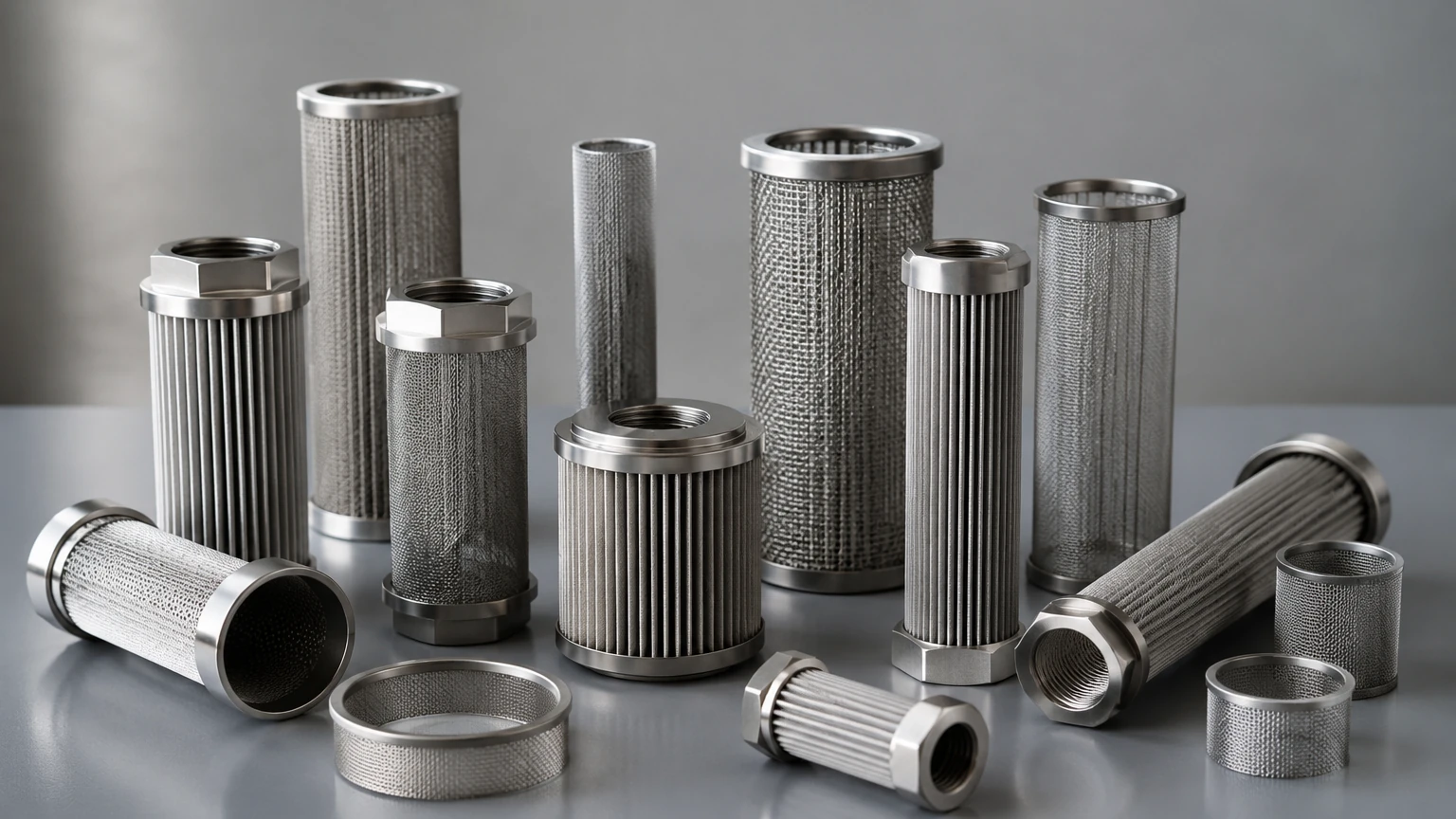
Most industrial filters used in high-temperature or high-pressure applications are constructed from stainless steel wire mesh. This material is preferred due to its thermal stability and resistance to chemical corrosion. At Kaifil, the focus is on providing precision-engineered metal filtration components that meet these rigorous demands.
Material Grades
Stainless steel 304 and 316L are the industry standards. 304 stainless steel offers excellent strength and heat resistance, making it suitable for standard hot melt applications. However, in environments involving corrosive chemicals or pharmaceutical-grade requirements, 316L is preferred due to its higher molybdenum content, which provides superior resistance to pitting and crevice corrosion.
Weave Types
The performance of a filter is largely determined by the weave of the wire mesh. Common types include:
- Plain Weave: The most straightforward construction where wires cross over and under each other. It provides high flow rates but is generally limited to coarser filtration levels.
- Dutch Weave: This utilizes a heavier wire diameter in one direction and a finer wire in the other, resulting in a dense, strong mesh capable of very fine micron ratings and high pressure resistance.
- Twilled Weave: Allows for thicker wires and is used for heavy-duty applications where mechanical strength is paramount.
Evaluating Micron Ratings and Filtration Efficiency
When selecting Nordson filters or compatible replacements, the micron rating is the most critical specification. However, it is important to distinguish between nominal and absolute filtration ratings. A nominal rating refers to the ability of the filter to retain a majority of particles of a certain size, whereas an absolute rating implies that 99.9% of particles above that size will be captured.
In adhesive dispensing, filters are typically categorized by mesh count (the number of openings per linear inch). A higher mesh count corresponds to a finer filtration level. For example:
- 50 Mesh: Used for high-viscosity materials or primary filtration stages to remove large contaminants.
- 100 Mesh: A common standard for general-purpose adhesive dispensing.
- 200 Mesh: Required for fine nozzles and low-viscosity fluids where precision is critical.
Engineers must balance the desire for fine filtration with the reality of pressure drop. As the filtration becomes finer, the resistance to flow increases. If the micron rating is too low for the application, the system may experience a significant pressure drop, forcing the pump to work harder and potentially leading to cavitation or reduced flow at the applicator.
Customization Options for Industrial Filter Cartridges
Standard off-the-shelf filters do not always meet the unique requirements of specialized industrial processes. Customization is often necessary when dealing with non-standard fluid viscosities, extreme temperatures, or unique housing geometries. As a professional manufacturer, Kaifil provides tailored solutions that allow engineers to specify the exact parameters needed for their application.
Customization options include:
- End Cap Configurations: Filters can be designed with various fittings, such as NPT threads, O-ring seals, or flange mounts, to ensure a leak-proof fit within the filter manifold.
- Reinforced Cores: For high-pressure applications, internal perforated cores or external shrouds can be added to prevent the mesh from collapsing under hydraulic stress.
- Multi-Layer Sintering: Sintered wire mesh combines multiple layers of mesh into a single, robust structure. This process bonds the wires at their contact points, ensuring that the pore size remains constant even under extreme vibration or pressure pulses.
For those looking to explore specialized designs or standard replacements, visiting the Main Page offers a comprehensive overview of available filtration technologies and engineering support.
Operational Challenges: Pressure Drop and Clogging
A common issue in industrial filtration is the "dirty" pressure drop—the increase in resistance as the filter accumulates debris. In Nordson systems, many filter manifolds are equipped with pressure gauges or sensors to monitor this differential. A sudden increase in pressure drop usually indicates that the filter has reached its holding capacity and requires cleaning or replacement.
If a filter is left in service beyond its effective life, several risks emerge:
1. Bypass Flow: In some designs, a clogged filter may trigger a bypass valve, allowing unfiltered fluid to reach the nozzles to prevent pump damage. This, however, risks immediate clogging of the applicators.
2. Media Migration: Under extreme pressure, inferior filter media may break apart, sending metal fragments or fibers downstream into the fluid path.
3. Pump Strain: The increased resistance forces the motor to draw more current, leading to overheating and potential electrical failure.
Regular maintenance intervals should be established based on the volume of material processed and the known purity of the raw materials. In many cases, switching to a high-capacity pleated filter can extend these intervals by increasing the total surface area available for filtration.
Material Selection for High-Temperature and Corrosive Environments
Temperature is a defining factor in filter selection for adhesive systems. Hot melt adhesives are typically processed at temperatures between 150°C and 200°C (300°F to 400°F). At these temperatures, standard polymer-based filters would degrade or melt. Stainless steel is the material of choice because it maintains its structural integrity and filtration accuracy across a wide thermal range.
In chemical processing or food and beverage applications where Nordson equipment might be used for coating or sealing, the filter must also be chemically inert. The use of 316L stainless steel ensures that the filter does not react with acidic or alkaline cleaning agents, which is vital for maintaining food safety and preventing batch contamination. Furthermore, metal filters can be ultrasonically cleaned, allowing for reuse in certain applications, which reduces the total cost of ownership compared to disposable plastic cartridges.
Procurement Strategies for Industrial Filtration Components
When purchasing Nordson filters or compatible wire mesh components, procurement teams should look beyond the initial unit price. The total cost of filtration includes the cost of the filter, the labor required for replacement, the cost of potential downtime, and the risk associated with component failure.
Working directly with a manufacturer like Kaifil provides several advantages:
- Technical Expertise: Direct access to engineers who understand the relationship between mesh geometry and flow dynamics.
- Quality Assurance: Reliable manufacturers implement rigorous testing for bubble point, flow permeability, and structural integrity.
- OEM Compatibility: Ensuring that replacement parts meet or exceed the original equipment manufacturer's specifications ensures that warranties remain intact and systems operate as intended.
For purchasing teams, confirming the specific alloy, mesh count, and physical dimensions before ordering is essential. Small variations in the length or diameter of a filter cartridge can result in bypass leakage, rendering the filtration process ineffective.
Strategic Considerations for Long-Term Performance
To optimize the performance of Nordson filters within a production line, a holistic approach to fluid management is required. This includes not only the selection of the correct filter but also the implementation of proper handling and storage of raw materials to minimize the introduction of external contaminants.
Engineers should also consider the benefits of staged filtration. By using a coarse primary filter at the tank outlet and a fine secondary filter at the nozzle, the service life of the fine filter is significantly extended. This "depth filtration" strategy is often more cost-effective than relying on a single fine filter to handle the entire contaminant load.
In summary, the selection of filtration components is a critical engineering decision that impacts the reliability and profitability of industrial dispensing operations. By focusing on high-quality stainless steel construction, accurate micron ratings, and customized designs, manufacturers can ensure their systems remain productive and efficient. For more information on custom stainless steel filtration solutions and technical specifications, please refer to the Main Page for detailed product insights and application guidance.
