


Air Respirable
In industrial environments where workers are exposed to hazardous vapors, oxygen-deficient atmospheres, or high concentrations of particulates, the provision of air respirable quality is a critical safety requirement. Compressed air systems, while ubiquitous in manufacturing and processing, do not inherently produce air that is safe for human consumption. Transforming standard industrial compressed air into breathable air involves a sophisticated multi-stage filtration and purification process designed to meet stringent international standards.
For engineers and safety managers, understanding the technical nuances of these systems is essential. This includes the selection of filtration media, the management of pressure drops, and the assurance of material integrity. Stainless steel filtration components play a pivotal role in these systems, particularly in demanding environments where durability and chemical resistance are non-negotiable. As a specialized manufacturer, Kaifil provides the precision components necessary to maintain the integrity of these life-critical systems.
Understanding Standards for Air Respirable Quality
The definition of "air respirable" is governed by specific regional and international standards that dictate the maximum allowable concentrations of contaminants. In North America, the Compressed Gas Association (CGA) Grade D specifications are the benchmark for breathing air. Similarly, in Europe, EN 12021 defines the requirements for compressed air for breathing apparatus.
Key parameters regulated by these standards include:
* Oxygen Content: Typically required to be between 19.5% and 23.5%.
* Carbon Monoxide (CO): Limits are usually set at 10 ppm or lower, as CO prevents blood from carrying oxygen.
* Carbon Dioxide (CO2): Limits are generally 1,000 ppm to prevent respiratory distress.
* Oil and Hydrocarbons: Must be filtered to levels where no odor or mist is detectable (often <5 mg/m³).
* Water Content: Compressed air must be dry enough to prevent freezing in the regulator and to inhibit the growth of bacteria.
* Particulates: Dust and scale from the compressor or piping must be removed to prevent lung irritation and mechanical failure of breathing equipment.
Achieving these levels requires a systematic approach to filtration, starting from the intake of the compressor through to the final point of use. For more information on the components used in these high-precision systems, you can visit the Main Page of our technical resource center.
Critical Contaminants in Industrial Breathing Air
Standard industrial compressors introduce several contaminants that must be aggressively managed to ensure the air is respirable. These contaminants originate from the ambient intake air, the compressor lubricant, and the distribution piping itself.
Oil Aerosols and Vapors
Lubricated compressors inevitably discharge oil into the compressed air stream. This oil exists as liquid droplets, aerosols, and vapors. While coalescing filters are effective at removing droplets and aerosols, oil vapor requires adsorption beds, often containing activated alumina or charcoal. Stainless steel mesh pre-filters are vital here to protect these sensitive adsorption beds from heavy liquid loading and particulate fouling.
Moisture and Humidity
Water vapor in breathing air can lead to corrosion within the breathing apparatus and, more critically, can freeze during the rapid expansion of air at the regulator. This can cause a sudden loss of air supply. Desiccant dryers are used to lower the dew point, and precision metal filters are used downstream to ensure that desiccant dust does not enter the user's air supply.
Solid Particulates
Rust, pipe scale, and atmospheric dust can cause significant damage to the respiratory system. In high-pressure breathing systems, these particles can also cause "particle impact" ignition in oxygen-rich environments or simply clog fine orifices in masks and regulators. Sintered stainless steel filters are preferred in these applications due to their high structural integrity and precise micron ratings.
Engineering Stainless Steel Filtration for Respirable Systems
When designing filtration for air respirable applications, engineers must balance filtration efficiency with the necessity of maintaining adequate flow and pressure. Stainless steel is often the material of choice for the housings and the primary filter elements for several technical reasons.
Structural Integrity under High Pressure
Breathing air systems often operate at high pressures, especially in SCBA (Self-Contained Breathing Apparatus) charging stations where pressures can exceed 300 bar. Unlike polymer-based filters, stainless steel wire mesh and sintered components do not deform or bypass under high differential pressures. This ensures that the filtration efficiency remains constant even during peak flow demands.
Chemical and Thermal Resistance
In chemical processing or pharmaceutical environments, the ambient air may contain corrosive gases. Stainless steel (specifically 316L grade) provides superior resistance to corrosion compared to aluminum or plastic components. Furthermore, if the air purification system is located near high-heat processes, stainless steel maintains its mechanical properties where other materials might fail.
No Media Migration
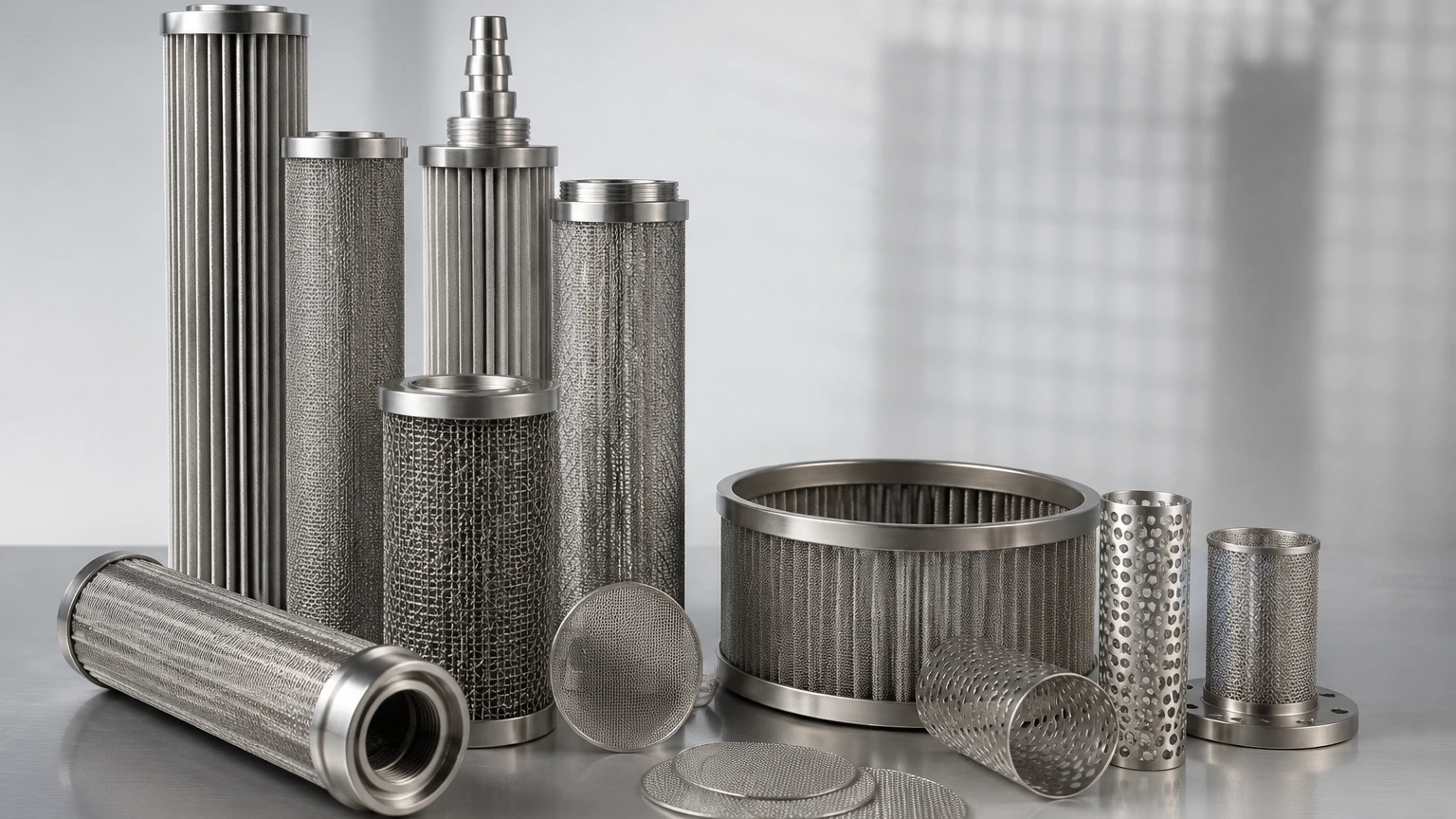
One of the most critical requirements for respirable air is that the filter itself must not become a source of contamination. Fiber-based filters (such as fiberglass or cellulose) can occasionally shed fibers into the air stream—a phenomenon known as media migration. Precision-woven wire mesh and sintered metal filters are inherently stable and do not shed particles, ensuring the purity of the downstream air.
Material Selection: 304 vs. 316L Stainless Steel
Selecting the correct grade of stainless steel is a fundamental engineering decision in the construction of breathing air filtration components. While both 304 and 316L offer excellent durability, their applications differ based on the environment.
* Grade 304: This is the standard "18/8" stainless steel. It is suitable for most general industrial breathing air applications where the environment is not excessively corrosive. It provides excellent strength and cost-effectiveness for particulate filtration and support structures for adsorption media.
* Grade 316L: The "L" stands for low carbon, which improves weldability and resistance to intergranular corrosion. Grade 316 contains molybdenum, which significantly increases resistance to chlorides and acidic environments. In offshore oil rigs, marine environments, or chemical plants where the air intake may contain salt spray or corrosive fumes, 316L is the mandatory choice for ensuring the long-term safety of the respirable air system.
Kaifil specializes in manufacturing components from these high-grade materials to meet specific engineering tolerances, ensuring that the final assembly meets the required safety certifications.
Performance Evaluation and Micron Ratings
In the context of air respirable systems, the micron rating of a filter determines its ability to remove specific sizes of contaminants. However, engineers must distinguish between "nominal" and "absolute" ratings.
* Nominal Rating: An approximate value indicating the filter's ability to retain the majority of particles of a certain size. In breathing air, nominal ratings are often used for pre-filtration to extend the life of more expensive secondary filters.
* Absolute Rating: The diameter of the largest hard spherical particle that will pass through the filter under specified test conditions. For final stage particulate filtration in breathing air systems, absolute ratings are required to guarantee that no harmful particles reach the user.
For respirable air, a typical filtration sequence might involve a 5-micron pre-filter to remove bulk liquids and scale, followed by a 0.01-micron coalescer for oil aerosols, and finally a 1-micron or sub-micron sintered metal filter to capture any remaining particulates or desiccant dust. Monitoring the differential pressure (ΔP) across these stages is the primary method for evaluating performance. A sudden drop in ΔP might indicate a ruptured element (bypass), while a rapid increase indicates heavy loading, both of which require immediate maintenance to ensure air safety.
Maintenance and Replacement Cycles
The reliability of an air respirable system is only as good as its maintenance schedule. Unlike standard industrial filtration, where a filter might be run until it significantly impacts production, breathing air filters must be replaced proactively.
1. Saturated Media: Coalescing filters and adsorption beds have a finite capacity. Once saturated, "breakthrough" occurs, and contaminants like oil vapor or CO will pass through to the user.
2. Biological Growth: In systems where moisture is present, filters can become breeding grounds for bacteria if not serviced regularly. Stainless steel elements are advantageous here as they can be cleaned and sterilized (e.g., via ultrasonic cleaning or autoclaving) in certain applications, though in many breathing air systems, elements are treated as consumables to ensure absolute safety.
3. Seal Integrity: During every filter change, O-rings and seals must be inspected. Even the highest quality stainless steel filter element is useless if air can bypass it through a degraded seal.
Custom OEM Solutions for Specialized Breathing Apparatus
Many industrial applications require bespoke filtration solutions that do not fit standard off-the-shelf specifications. This is common in specialized diving equipment, aerospace life support, and integrated emergency breathing systems in hazardous chemical zones.
Customization options often include:
* Custom Geometry: Designing filter cartridges that fit into compact or uniquely shaped housings within portable breathing units.
* Layered Media: Combining different weaves of wire mesh to achieve specific flow characteristics and filtration depths.
* Integrated Fittings: Manufacturing filter elements with welded end caps and specific threading (NPT, BSP, or custom) to eliminate potential leak points in high-vibration environments.
By working closely with an experienced manufacturer, engineering teams can develop filtration components that are optimized for the specific flow rates and pressure requirements of their air respirable systems. For a comprehensive look at customization capabilities and material options, engineers are encouraged to review the product options and application support available on the Main Page.
Conclusion: Prioritizing Safety through Precision Filtration
Ensuring that compressed air is truly respirable is a complex engineering challenge that leaves no room for error. The transition from industrial-grade air to life-sustaining air depends entirely on the sequence and quality of the filtration components used. By selecting high-performance stainless steel media, adhering to strict international standards, and implementing rigorous maintenance protocols, facilities can protect their most valuable assets—their personnel.
Whether you are designing a new breathing air station or upgrading an existing system, focusing on the technical details of filtration efficiency, material compatibility, and structural durability is the only way to guarantee a continuous supply of safe, breathable air in the world's most demanding industrial environments.
