


Woven Wire Mesh Manufacturer China: A Technical Guide for Industrial Procurement
In the landscape of industrial filtration and separation, selecting the right material is critical to process efficiency and equipment longevity. Woven wire mesh serves as a foundational component across diverse sectors, including chemical processing, pharmaceuticals, food and beverage, and hydraulic systems. When searching for a reliable woven wire mesh manufacturer china, engineering and procurement teams must look beyond simple price points to evaluate technical capabilities, material integrity, and manufacturing precision.
As a specialized manufacturer, Kaifil provides high-performance stainless steel filtration solutions designed for demanding environments. This guide explores the technical parameters of woven wire mesh, the nuances of sourcing from China, and the criteria essential for selecting a partner that can meet rigorous industrial standards.
Understanding the Engineering Fundamentals of Woven Wire Mesh
Woven wire mesh is produced by weaving metallic wires on industrial looms, creating a structured fabric with precise openings. The performance of the mesh is dictated by the material grade, the weave pattern, and the mechanical properties of the wire itself. For industrial applications, stainless steel is the preferred material due to its balance of mechanical strength and corrosion resistance.
Key Technical Specifications
When specifying mesh for a project, engineers must define several critical parameters:
1. Mesh Count: This refers to the number of openings per linear inch. A higher mesh count indicates a finer mesh with smaller apertures.
2. Wire Diameter: The thickness of the wire used in the weave. This affects the mesh's strength, weight, and open area.
3. Aperture (Opening Size): The clear distance between two adjacent parallel wires. This determines the filtration rating or the size of particles that can pass through.
4. Open Area Percentage: The ratio of the area of the openings to the total area of the mesh. A higher open area generally results in lower pressure drops and higher flow rates.
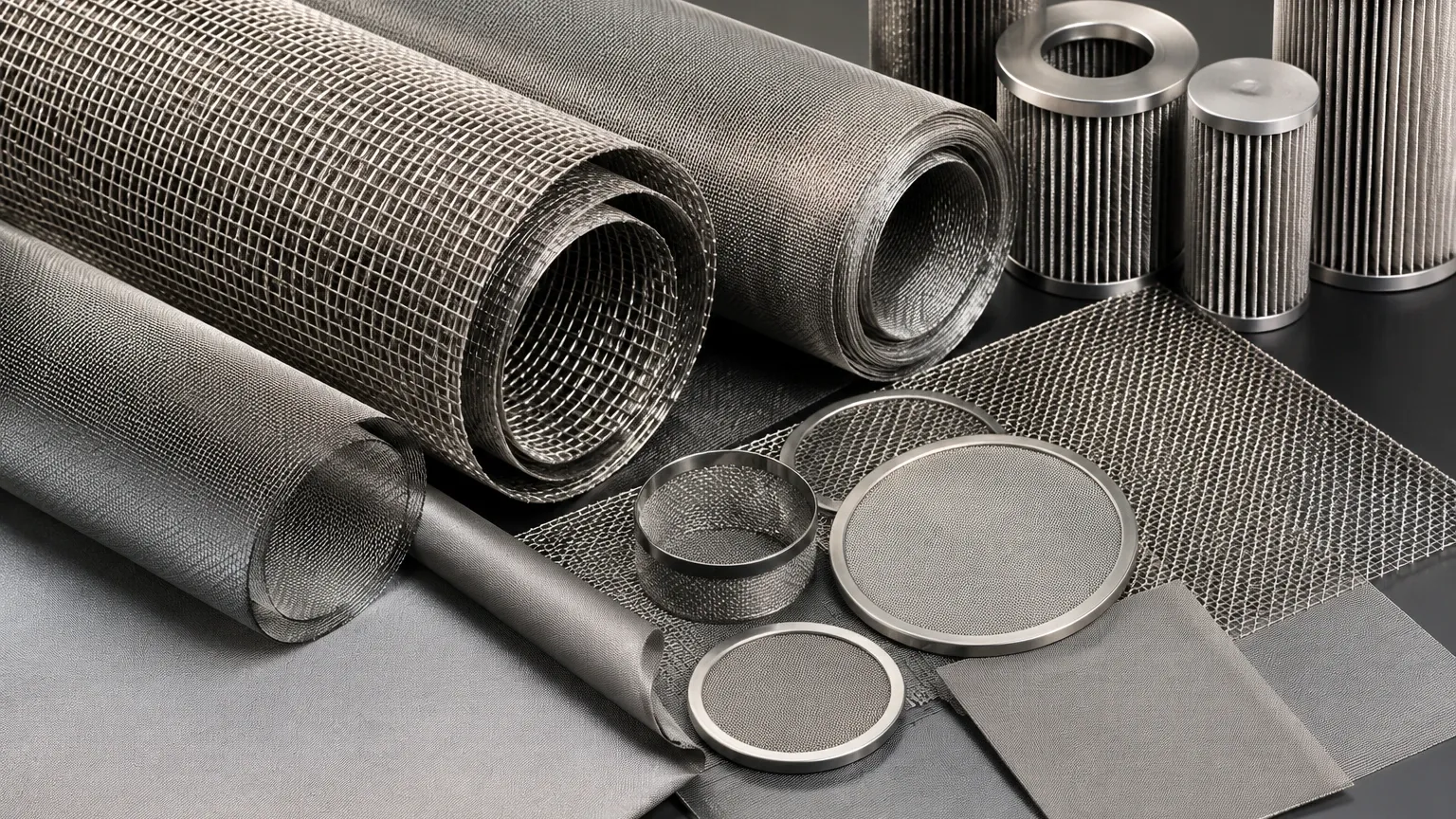
For those seeking specific configurations, Kaifil offers Plain, twill and dutch woven wire mesh in SS304/316L — rolls, cut mesh and framed panels. Send mesh count or micron target for a technical quote.
Evaluating a Woven Wire Mesh Manufacturer in China
China is a global hub for wire mesh production, offering a vast range of capabilities from standard commercial grades to high-precision industrial filters. However, the disparity in quality between suppliers can be significant. Evaluating a woven wire mesh manufacturer china requires a deep dive into their quality management systems and technical infrastructure.
Material Traceability and Grade Verification
The most common risk in sourcing metal mesh is material substitution—for instance, receiving SS201 or SS304 when SS316L was specified. A professional manufacturer should provide Mill Test Reports (MTRs) and perform Positive Material Identification (PMI) testing to ensure the alloy composition matches the application requirements, particularly in corrosive chemical or pharmaceutical environments.
Weaving Precision and Consistency
Industrial filtration requires absolute uniformity in aperture size. Inconsistent weaving leads to "bypass," where particles larger than the target micron rating pass through larger-than-average openings. A high-quality manufacturer utilizes advanced CNC looms and maintains strict tension control during the weaving process to ensure dimensional stability across the entire roll or panel.
Post-Processing Capabilities
Often, raw mesh is only the starting point. Engineers should evaluate whether the manufacturer can perform secondary operations such as:
* Ultrasonic Cleaning: Essential for food-grade and pharmaceutical applications to remove lubricants and particulates from the weaving process.
* Precision Cutting: Utilizing laser or waterjet cutting to ensure clean edges and dimensional accuracy for integration into filter housings.
* Sintering: Bonding multiple layers of mesh to increase mechanical strength while maintaining filtration precision.
* Framing and Fabrication: Providing finished components like framed panels or pleated cartridges.
Common Weave Types and Their Industrial Applications
The choice of weave pattern significantly impacts the mechanical behavior and filtration efficiency of the product. A competent woven wire mesh manufacturer china should be able to advise on the best weave for a specific flow rate or pressure requirement.
Plain Weave
This is the most common and straightforward weave pattern, where each warp wire crosses alternately over and under each weft wire. It offers a high open area and is ideal for general screening and low-pressure filtration tasks.
Twill Weave
In a twill weave, each weft wire passes over and under two warp wires. This allows for the use of heavier wires for a given mesh count, resulting in a stronger mesh that can withstand higher mechanical loads. It is frequently used in heavy-duty industrial filtration.
Dutch Weave (Plain and Twill)
Dutch weaves use different wire diameters for the warp and weft. The result is a dense, tight mesh with no visible openings when viewed straight on. Instead, it creates a tortuous path for the fluid, providing excellent surface filtration and high pressure resistance. This is the standard for high-precision hydraulic and fuel filtration.
Quality Assurance and Risk Mitigation in Sourcing
Sourcing from a woven wire mesh manufacturer china involves managing risks related to quality consistency and lead times. To mitigate these risks, procurement teams should establish a robust verification process.
Inspection Standards
Standardized testing protocols such as ASTM E2016 (Standard Specification for Industrial Woven Wire Cloth) provide a framework for inspecting mesh. Key inspection points include:
* Aperture Tolerance: Ensuring the openings fall within the allowable deviation range.
* Surface Defects: Checking for broken wires, oil stains, or irregular weaving patterns.
* Mechanical Testing: Verifying tensile strength and elongation if the mesh is subject to high-pressure environments.
Communication and Technical Support
A manufacturer that acts as a technical partner is far more valuable than a simple vendor. At Kaifil, we prioritize engineering collaboration, helping clients determine the optimal mesh count and wire diameter based on their specific fluid dynamics and particle load. This technical support reduces the risk of specifying an over-engineered (and unnecessarily expensive) or under-engineered (and prone to failure) solution.
The Total Cost of Ownership (TCO) Perspective
While the initial purchase price is a major factor when choosing a woven wire mesh manufacturer china, the Total Cost of Ownership (TCO) provides a more accurate picture of value. TCO includes the unit price plus the costs associated with:
* Maintenance and Cleaning: High-quality stainless steel mesh that is properly cleaned and passivated will last longer and require less frequent replacement.
* Process Downtime: A filter failure due to poor mesh quality can lead to expensive production halts. Investing in precision-woven mesh reduces this risk.
* Logistics and Inventory: Reliable manufacturers provide transparent lead times and consistent packaging to prevent damage during transit.
By focusing on durability and filtration accuracy, Kaifil helps industrial users achieve a lower TCO through products that maintain their integrity in demanding chemical, hydraulic, and thermal environments.
Customization: Beyond Standard Rolls
Industrial applications rarely fit a "one size fits all" model. A leading woven wire mesh manufacturer china must offer extensive customization options to support OEM requirements. This includes custom widths, specific alloy selections (such as Monel, Inconel, or Hastelloy for extreme conditions), and bespoke fabrication.
Whether the requirement is for a single high-precision filter element or high-volume production of cut-to-size mesh discs, the manufacturer’s ability to scale and adapt their production line is a key indicator of their reliability. Kaifil’s manufacturing facility is equipped to handle custom orders that require tight tolerances and specialized material handling, ensuring that the final filtration component integrates seamlessly into the client’s system.
Conclusion: Selecting Your Filtration Partner
Choosing a woven wire mesh manufacturer china is a strategic decision that impacts the efficiency and reliability of industrial processes. By prioritizing technical expertise, material verification, and precision manufacturing, engineering teams can secure filtration solutions that perform consistently under pressure.
Kaifil stands at the intersection of manufacturing excellence and engineering insight. We provide more than just wire mesh; we deliver tailored filtration components designed to solve specific industrial challenges. From initial material selection to the final quality inspection, our focus remains on providing dependable, high-performance products for the global market.
For detailed specifications or to discuss a custom filtration project, engineers and purchasing professionals are encouraged to review our technical capabilities and request a consultation to ensure their filtration requirements are met with the highest standards of precision and quality.
