


Filter Cart Hydraulic
In the realm of industrial fluid power, the cleanliness of hydraulic oil is the single most significant factor determining the longevity and reliability of system components. Contamination, whether in the form of particulate matter, water, or air, accounts for approximately 70% to 80% of all hydraulic system failures. To combat this, engineers and maintenance professionals rely on the filter cart hydraulic unit—a portable, off-line filtration system designed to supplement a machine's primary filtration and ensure that fluid meets stringent ISO cleanliness standards.
A hydraulic filter cart serves as a mobile kidney loop, drawing fluid from a reservoir, passing it through high-efficiency filter elements, and returning it to the system. While many systems have built-in return line or pressure line filters, these are often insufficient for handling the high dirt loads encountered during oil transfers or after catastrophic component failures. This article examines the technical specifications, engineering considerations, and selection criteria for industrial filter carts, with a focus on the critical role of stainless steel filtration components in demanding environments.
The Role of Filter Carts in Hydraulic Fluid Maintenance
The primary objective of using a filter cart hydraulic system is to achieve and maintain a specific ISO 4406 cleanliness code. New hydraulic oil, despite being "fresh" from a drum, is rarely clean enough for modern high-pressure systems. It often contains high levels of particulate contamination introduced during the refining, blending, and packaging processes.
Engineers utilize filter carts for several critical tasks:
1. Pre-filtering New Oil: Before oil is added to a machine reservoir, it should be passed through a filter cart to ensure it does not introduce contaminants into a clean system.
2. Kidney-Loop Filtration: This involves circulating the oil in a reservoir through the cart while the machine is either running or idle. This process continuously removes fine particulates that the system's primary filters might miss.
3. Oil Transfer: Moving fluid from storage containers to machine reservoirs while filtering it in real-time.
4. Post-Repair Cleanup: After a pump or cylinder failure, the entire system is often contaminated with metallic debris. A filter cart is used to flush the lines and reservoir before the system is restarted.
By implementing these practices, facilities can significantly extend the mean time between failures (MTBF) for pumps, valves, and actuators.
Technical Components of an Industrial Hydraulic Filter Cart
A robust industrial filter cart is more than just a pump and a filter. It is an engineered assembly designed to handle various fluid viscosities and environmental conditions. The core components include:
The Pump and Motor Assembly
Typically, gear pumps or vane pumps are used in filter carts due to their ability to handle higher viscosities and provide a consistent flow rate. The motor must be sized to provide enough torque to move cold or high-viscosity oil through the filter media without stalling or tripping circuit breakers. For hazardous environments, such as chemical processing or mining, explosion-proof motors are required.
Filtration Housings and Media
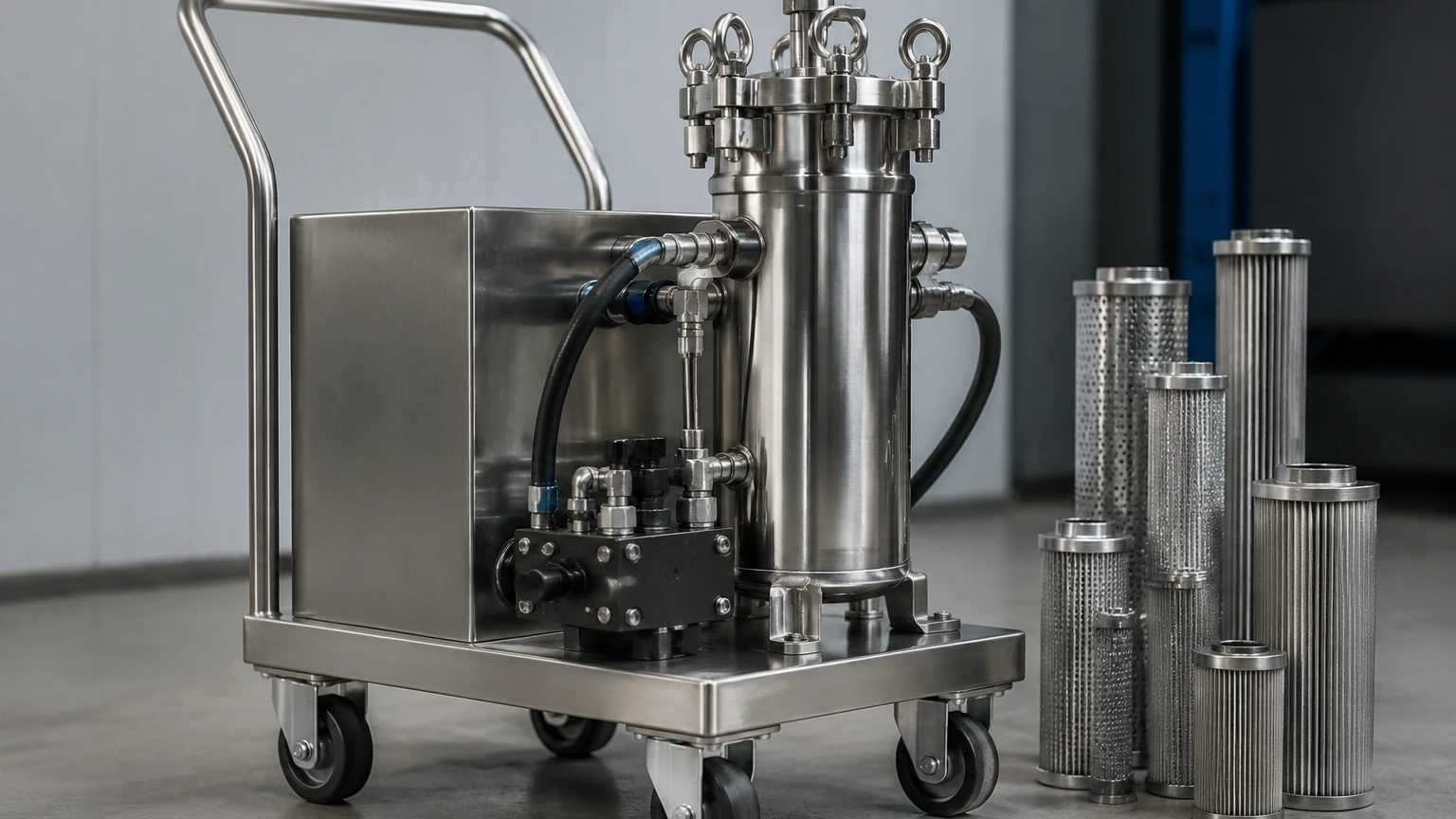
This is the heart of the system. Most carts feature a two-stage filtration process. The first stage usually involves a coarse pre-filter (often a stainless steel wire mesh) to capture large particles, while the second stage utilizes a high-efficiency micro-glass or specialized stainless steel cartridge for fine particulate removal.
As a manufacturer specializing in custom stainless steel filtration solutions, Kaifil provides the precision metal components necessary for these housings. Stainless steel filter cartridges are particularly valued in hydraulic applications where fluid compatibility, high temperatures, or the need for cleanable media are priorities. You can Review product options and application support to understand how different metal mesh configurations impact flow resistance and dirt-holding capacity.
Monitoring Instrumentation
To ensure the cart is operating effectively, it must be equipped with differential pressure gauges or indicators. These tools signal when the filter elements are saturated and require replacement. Advanced units may also include integrated laser particle counters to provide real-time ISO cleanliness data.
Engineering Considerations for Selection
Selecting the right filter cart hydraulic unit requires a deep dive into the technical requirements of the application. Engineers must evaluate several variables to ensure the cart does not become a bottleneck or a source of further contamination.
Fluid Viscosity and Temperature
Hydraulic oils vary significantly in viscosity, measured in Centistokes (cSt) or Saybolt Universal Seconds (SUS). A cart designed for ISO 32 oil may fail when used with ISO 68 or ISO 100 oil, especially in cold start-up conditions. High-viscosity fluids create a higher pressure drop (ΔP) across the filter media. If the ΔP exceeds the bypass valve setting of the filter housing, the oil will bypass the filter entirely, rendering the cart useless. Engineers must select a pump-motor combination and filter media that can handle the maximum expected viscosity at the lowest operating temperature.
Flow Rate vs. Filtration Efficiency
There is often a trade-off between flow rate (GPM) and filtration efficiency. While a higher flow rate allows for faster oil transfers, it can also decrease the "dwell time" of the fluid within the filter media, potentially reducing the capture rate of fine particles. Furthermore, excessive flow through a fine filter can lead to high shear forces, potentially damaging the filter structure or causing electrostatic discharge (ESD) in some synthetic fluids.
Material Compatibility
The seals (Buna-N, Viton, EPDM) and the filter media must be compatible with the hydraulic fluid being used. While standard mineral oils are relatively inert, synthetic fluids like phosphate esters or water-glycols require specialized materials. Stainless steel wire mesh filters are often the preferred choice for aggressive fluids or high-temperature applications where synthetic fibers might degrade.
Advantages of Stainless Steel Filtration Media
In many industrial filter cart hydraulic applications, the choice of filter media is a critical engineering decision. While disposable cellulose or micro-glass elements are common, stainless steel filter cartridges offer distinct advantages in specific B2B contexts:
* Durability and Structural Integrity: Stainless steel mesh can withstand high differential pressures without collapsing or shedding fibers into the fluid stream. This is vital in high-pressure hydraulic circuits where "media migration" can damage sensitive servo-valves.
* Cleanability: Unlike disposable elements, stainless steel filters can often be cleaned and reused. Through ultrasonic cleaning or backflushing, the accumulated contaminants can be removed, reducing the long-term total cost of ownership (TCO) and environmental waste.
* Chemical and Thermal Resistance: In chemical processing or steel mills, hydraulic fluids may be exposed to extreme heat or corrosive vapors. Stainless steel maintains its mechanical properties and filtration accuracy under conditions that would destroy synthetic media.
* Precision Filtration: Advanced manufacturing techniques allow for the creation of stainless steel wire cloth with absolute micron ratings. This ensures that the filter cart provides consistent, predictable performance over its entire service life.
Operational Best Practices and Common Risks
Deploying a filter cart hydraulic unit effectively requires more than just plugging it in. Maintenance teams should follow established protocols to maximize fluid life and component protection.
Avoiding Cross-Contamination
One of the most common risks in industrial facilities is using the same filter cart for different types of fluids. Mixing even small amounts of incompatible oils (e.g., mineral oil and water-glycol) can lead to additive dropout, foaming, and seal failure. Dedicated carts for specific fluid types, or a rigorous flushing procedure between uses, are essential.
Managing Water Contamination
While particulate removal is the primary focus, water contamination is equally destructive, leading to oil oxidation and corrosion. Many hydraulic filter carts can be equipped with water-absorbing elements. However, for high volumes of water, a vacuum dehydrator may be necessary. Engineers should confirm whether the cart’s secondary stage can accommodate water-removal media if moisture is a known issue in the environment.
Monitoring Pressure Drop
Operating a cart with clogged filters is a frequent mistake. When the differential pressure gauge enters the "red zone," the bypass valve opens to protect the pump, but this means the fluid is no longer being filtered. Regular inspection and a stock of replacement stainless steel or synthetic elements are required to maintain the unit's efficacy.
Total Cost of Ownership and Customization
When evaluating a filter cart hydraulic solution, the initial purchase price is only one component of the total cost. Engineers must also consider the cost of replacement elements, the energy consumption of the motor, and the potential savings from extended component life.
Customization is often necessary for specialized industrial environments. For example, a pharmaceutical plant may require a cart with a 316L stainless steel frame and housings to meet sanitary standards, while a heavy equipment manufacturer might need an off-road ruggedized chassis with large pneumatic tires.
Kaifil’s expertise in manufacturing custom stainless steel filtration components allows for the development of bespoke filter housings and cartridges that meet these specific demands. Whether the requirement is for a specific micron rating, a unique housing geometry, or high-strength wire mesh for high-viscosity fluids, custom engineering ensures the filtration system performs reliably under the intended operating conditions.
Conclusion
The filter cart hydraulic unit is an indispensable tool for modern industrial maintenance. By providing a portable, high-efficiency method for fluid cleaning and transfer, these systems protect the massive investments companies make in hydraulic machinery. Successful implementation depends on a thorough understanding of fluid dynamics, material compatibility, and the selection of high-quality filtration components.
For engineers and purchasing teams, focusing on durable, high-performance materials like stainless steel can lead to better filtration outcomes and lower long-term costs. To explore technical specifications for precision filter components and how they integrate into industrial systems, you may Review product options and application support to find the right solution for your specific hydraulic maintenance needs. Ensuring fluid cleanliness today is the most effective strategy for preventing the costly downtime of tomorrow.
