


Filtros Coalescentes Para Aire Comprimido
In industrial environments, compressed air is often referred to as the "fourth utility." However, unlike electricity or water, the quality of compressed air is highly variable and depends heavily on the filtration systems in place. Among the most critical components in a compressed air circuit are filtros coalescentes para aire comprimido. These specialized filters are engineered to remove sub-micron oil aerosols, water droplets, and solid particulates that standard particulate filters cannot capture. For industries ranging from pharmaceutical manufacturing to precision electronics, understanding the technical nuances of coalescing filtration is essential for protecting downstream equipment and ensuring product integrity.
Fundamentals of Coalescing Filtration in Compressed Air Systems
Standard filtration typically relies on a simple sieving mechanism to trap solid particles. In contrast, coalescing filtration is a sophisticated process designed to handle liquid contaminants suspended in a gas stream. In a compressed air system, oil and water often exist as fine mists or aerosols. These aerosols are typically smaller than 2 microns, making them difficult to remove through mechanical straining alone.
Filtros coalescentes para aire comprimido operate by forcing the air through a dense mat of borosilicate glass fibers or specialized synthetic media. As the air passes through this tortuous path, liquid droplets collide with the fibers. Through a process of accumulation, these tiny droplets merge—or coalesce—into larger, heavier drops. Gravity then pulls these larger drops to the bottom of the filter housing, where they are collected in a quiet zone and eventually discharged through an automatic or manual drain.
For engineers designing these systems, the choice of filter media and the structural integrity of the filter element are paramount. High-performance coalescing filters must balance high capture efficiency with low differential pressure (pressure drop) to maintain system energy efficiency.
The Three Mechanisms of Particle Capture
To achieve the high levels of purity required in B2B industrial applications, coalescing filters utilize three distinct physical mechanisms. Each mechanism targets a specific range of particle and droplet sizes:
1. Direct Impaction: This occurs with larger particles (typically those greater than 1 micron). Due to their mass and velocity, these particles cannot follow the streamlined flow of the air as it bends around the filter fibers. Instead, they travel in a straight line and impact the fiber directly, where they are trapped.
2. Interception: This mechanism targets mid-sized particles (0.1 to 1 micron). These particles are small enough to follow the air streamlines but are large enough that their physical diameter brings them into contact with the fiber as they pass by. Once they touch the fiber, they are held by Van der Waals forces.
3. Diffusion (Brownian Motion): This is critical for the smallest sub-micron particles (less than 0.1 micron). These particles move in a random, erratic pattern due to collisions with gas molecules. This random motion increases the probability that the particle will eventually collide with a filter fiber and become trapped.
By combining these three mechanisms, high-quality filtros coalescentes para aire comprimido can achieve efficiencies of 99.99% or higher for particles as small as 0.01 microns. For more information on the engineering of these precision components, you can visit the Main Page to review product options and application support.
Technical Specifications and ISO 8573-1 Air Quality Classes
When specifying filters for industrial procurement, engineers must refer to the international standard ISO 8573-1. This standard classifies compressed air quality based on the concentration of solid particles, water, and oil. Coalescing filters are the primary tools used to meet the stringent requirements of Classes 1 and 2 for oil and particulate matter.
* Class 1: Requires oil concentration to be $\le$ 0.01 mg/m³.
* Class 2: Requires oil concentration to be $\le$ 0.1 mg/m³.
Achieving these classes often requires a multi-stage filtration approach. A typical configuration includes a general-purpose coalescing filter followed by a high-efficiency coalescing filter. In some ultra-sensitive applications, such as breathing air or food-grade processing, an activated carbon adsorber is added downstream to remove oil vapors that remain in a gaseous state after the coalescing process.
Material Selection: The Advantages of Stainless Steel Components
In demanding industrial environments, the materials used to construct the filter housing and the internal support structures are just as important as the filter media itself. While aluminum is common for standard applications, stainless steel is the preferred choice for high-pressure, high-temperature, or corrosive environments.
Stainless steel (304 or 316L) provides several technical advantages:
* Corrosion Resistance: Compressed air often contains acidic condensates. Stainless steel resists the pitting and oxidation that can lead to structural failure or downstream contamination.
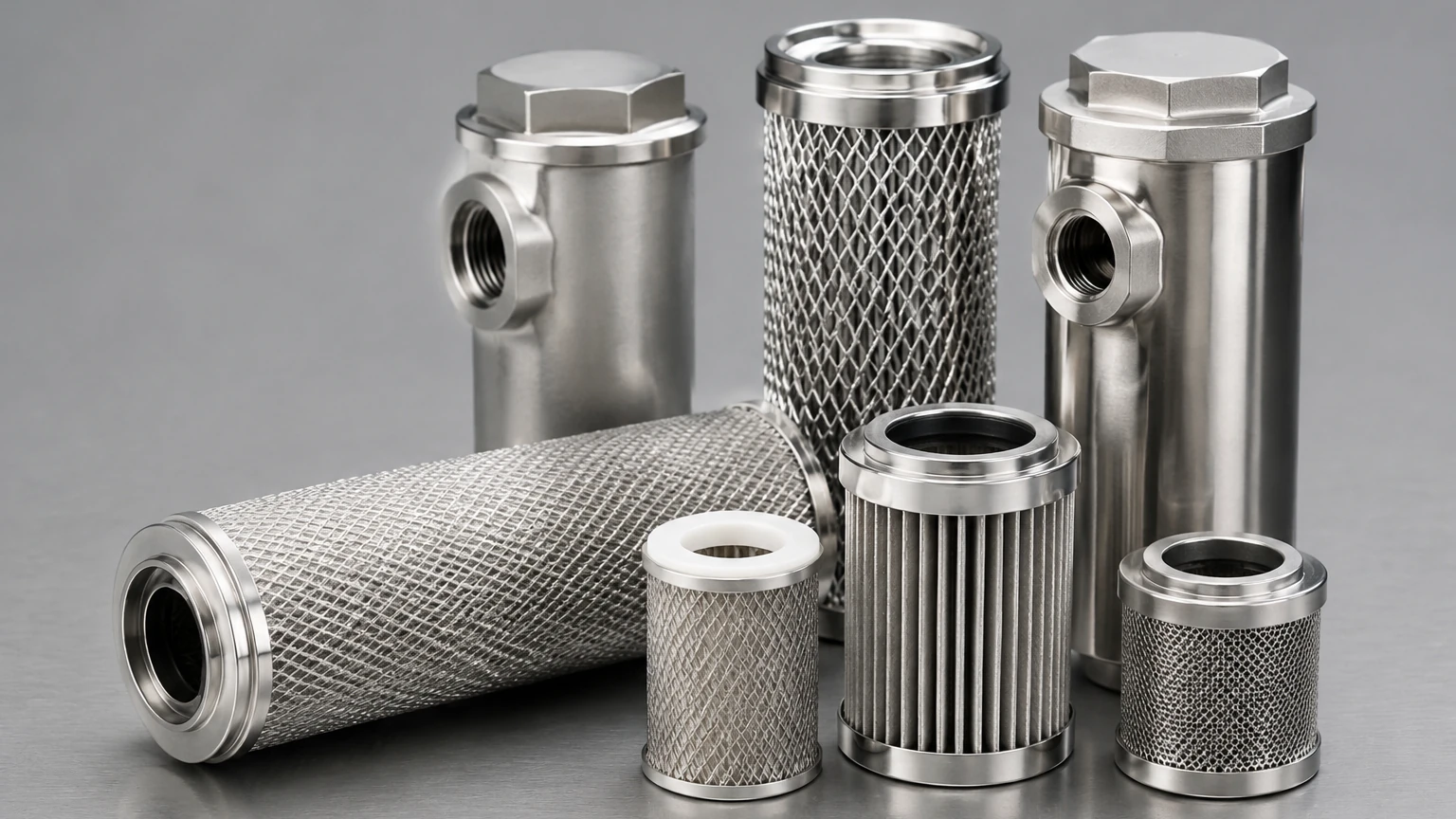
* Structural Integrity: Under high-pressure cycles, the internal support cores of the filter must maintain their shape to prevent media migration. Precision-engineered stainless steel mesh and perforated cores provide the necessary rigidity.
* Chemical Compatibility: In chemical processing and pharmaceutical industries, the filters may be exposed to aggressive cleaning agents or process chemicals. Stainless steel ensures that the filtration system does not react with or leach impurities into the air stream.
As a manufacturer specializing in custom stainless steel filtration solutions, Kaifil emphasizes the use of high-grade alloys to ensure that filtros coalescentes para aire comprimido can withstand the rigors of continuous industrial operation without compromising filtration accuracy.
Critical Selection Criteria for Engineers and Purchasing Teams
Selecting the right coalescing filter involves more than just matching a pipe size. To optimize performance and minimize the total cost of ownership (TCO), the following factors must be evaluated:
Flow Rate and Velocity
Coalescing filters are highly sensitive to air velocity. If the flow rate exceeds the filter's rated capacity, the velocity of the air through the media becomes too high. This can lead to "re-entrainment," where the air strips collected liquid off the fibers and carries it downstream, defeating the purpose of the filter. Always size the filter based on the maximum possible flow at the minimum operating pressure.
Operating Pressure
Pressure affects the density of the air and the behavior of the contaminants. High-pressure applications (above 16 bar) require specialized housings and reinforced filter elements. Conversely, at very low pressures, the air expands, increasing the velocity and potentially requiring a larger filter housing to maintain efficiency.
Temperature Limits
Standard coalescing filters typically operate effectively up to 66°C (150°F). At higher temperatures, oil aerosols may begin to vaporize, passing through the coalescing media in a gaseous state. If high-temperature operation is necessary, pre-cooling the air or using specialized high-temperature media is required.
Initial and Saturated Pressure Drop
A new filter will have a low "dry" pressure drop. However, as the filter begins to coalesce liquids, the media becomes "wetted," and the pressure drop increases. This is known as the "saturated pressure drop." Engineers must account for this increased resistance in their energy calculations, as every 2 psi (0.14 bar) of pressure drop can increase compressor energy consumption by approximately 1%.
Maintenance Cycles and Performance Monitoring
One of the most common mistakes in industrial filtration management is neglecting the replacement cycle of coalescing elements. Unlike particulate filters, which increase in pressure drop as they clog with solids, a coalescing filter primarily handling liquid aerosols may reach a steady-state pressure drop and stay there. However, the media will eventually degrade due to chemical attack from oil additives or the accumulation of fine solid particles.
Most manufacturers recommend replacing coalescing elements every 6 to 12 months, or when the pressure drop reaches a predetermined limit (typically 0.35 to 0.5 bar). Modern systems often utilize differential pressure gauges with "red/green" indicators to provide a visual cue for maintenance teams. Neglecting these cycles increases the risk of oil carryover, which can damage pneumatic valves, contaminate products, and lead to expensive system downtime.
Custom OEM Solutions for Specialized Applications
Standard off-the-shelf filters do not always meet the unique requirements of specialized industrial equipment. In many B2B scenarios, such as integrated hydraulic power units, offshore oil rigs, or medical gas systems, custom-designed filtros coalescentes para aire comprimido are necessary.
Customization options often include:
* Non-standard Dimensions: Fitting high-efficiency filtration into compact machine footprints.
* Extreme Pressure Ratings: Engineering housings and elements for pressures exceeding 350 bar.
* Alternative End-Cap Designs: Using specific threading or flange types to match proprietary equipment interfaces.
* Enhanced Material Traceability: Providing full material certifications (MTRs) for regulated industries like pharmaceuticals or aerospace.
By working with a manufacturer like Kaifil, engineers can develop filtration components that are tailored to the specific flow dynamics and environmental challenges of their application, ensuring long-term reliability and precise performance.
Conclusion
Effective compressed air treatment is a prerequisite for modern industrial efficiency. Filtros coalescentes para aire comprimido play the vital role of removing liquid and sub-micron contaminants that would otherwise compromise system performance. By focusing on high-quality materials like stainless steel, adhering to ISO 8573-1 standards, and selecting filters based on accurate flow and pressure data, organizations can protect their investments and maintain the highest levels of operational purity. For technical consultation on custom filtration components or to explore a wide range of industrial filter cartridges, visit https://www.kaifil.com/ for professional guidance.
