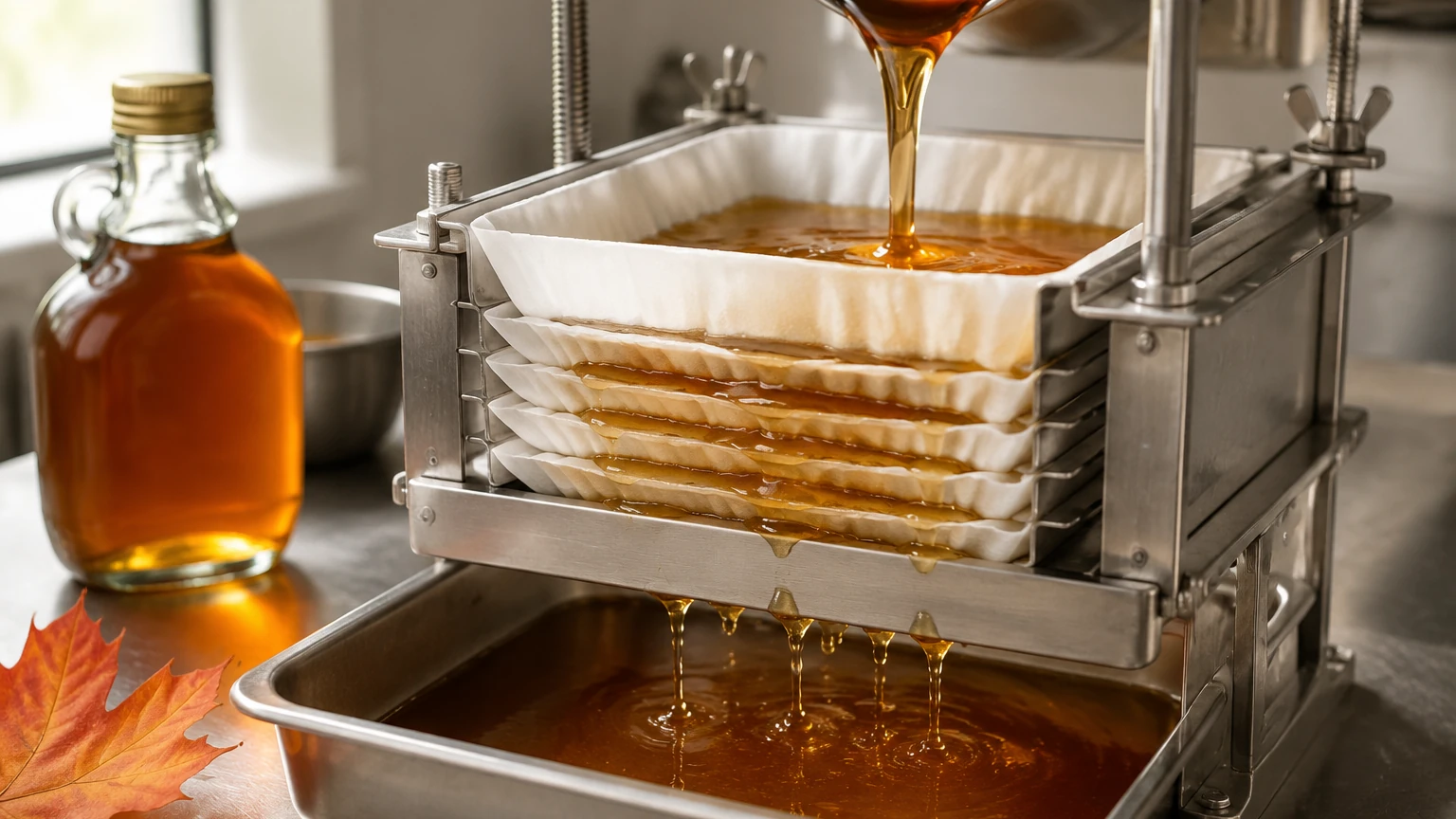
Maple Syrup Press Filter
In the commercial production of maple syrup, the transition from a raw, boiled concentrate to a shelf-stable, crystal-clear consumer product relies heavily on the efficiency of the filtration stage. A maple syrup press filter is the industry standard for achieving the clarity and purity required for Grade A classification. Unlike basic gravity-fed systems used in hobbyist operations, industrial press filters utilize mechanical pressure to drive hot syrup through a series of filter media, effectively removing suspended solids known as "sugar sand" or nitre. For engineers and facility managers, selecting the right filtration components is a matter of balancing throughput, filtration precision, and long-term operational durability.
The Role of Filtration in Commercial Syrup Production
As maple sap is evaporated, the concentration of minerals—primarily calcium malate—increases. When the sap reaches the density of syrup (typically 66.0 to 66.9 degrees Brix), these minerals precipitate out of the solution, forming a cloudy sediment called nitre. If not removed, nitre imparts a gritty texture to the syrup, clouds its appearance, and can even affect the flavor profile over time.
A maple syrup press filter addresses this by employing a pump to force the syrup through a stack of filter plates. These plates support filter media, which may include paper, felt, or specialized stainless steel mesh. The use of a press allows for much faster processing speeds than gravity or vacuum systems, which is critical in high-volume commercial environments where syrup must be filtered while it is still hot (typically between 180°F and 190°F) to maintain low viscosity.
Engineering Considerations for Press Filter Design
When evaluating a maple syrup press filter, technical professionals must look beyond the external housing and focus on the internal engineering that dictates performance. Several factors influence the effectiveness of the filtration process:
1. Pressure and Flow Dynamics
Industrial maple syrup presses usually operate at pressures ranging from 40 to 60 PSI, though some high-capacity systems may go higher. The pump must provide consistent pressure to overcome the resistance of the filter cake as it builds up on the media. Engineers must ensure that the filter plates and the internal support structures can withstand these pressures without warping. Precision-engineered stainless steel components are preferred here due to their high modulus of elasticity and resistance to mechanical fatigue.
2. Thermal Stability
Temperature is a critical variable in maple syrup filtration. If the syrup cools too much, its viscosity increases exponentially, making it difficult to pump and significantly reducing the flow rate through the filter media. Conversely, the filtration equipment must be able to handle constant exposure to near-boiling liquids. Stainless steel is the material of choice for these applications because it maintains its structural integrity and corrosion resistance at high temperatures, unlike some plastics or lower-grade alloys.
3. Material Selection: The Move to Stainless Steel
Historically, some press filters utilized cast aluminum plates. However, modern food-grade standards and the need for longevity have shifted the industry toward stainless steel, specifically 304 or 316L grades. Stainless steel is non-reactive, meaning it will not leach metallic tastes into the syrup or react with the natural acids present in the sap. Furthermore, stainless steel components are compatible with aggressive Clean-in-Place (CIP) protocols, which are essential for maintaining hygiene in food processing.
Technical Specifications: Micron Ratings and Mesh Geometry
The heart of any maple syrup press filter is the filtration media and its support structure. Achieving the desired clarity requires a specific micron rating. Nitre particles can vary in size, but a effective commercial system usually targets a filtration level between 1 and 5 microns for the final pass.
* Surface Filtration vs. Depth Filtration: In many press setups, a combination of filter aids (like diatomaceous earth) and mechanical filters are used. The mechanical filter—often a stainless steel wire mesh or a precision-perforated plate—acts as the final barrier.
* Wire Mesh Selection: For OEM applications, the geometry of the wire mesh is vital. Square weave mesh provides predictable flow paths, while Dutch weave patterns offer higher strength and finer filtration capabilities. Engineers must calculate the "open area" percentage to ensure that the filter does not become a bottleneck in the production line.
For those seeking high-performance components for these systems, reviewing specialized manufacturing capabilities is essential. You can Review product options and application support on our Main Page to understand how precision metal filters are integrated into industrial food processing equipment.
Customization and OEM Integration
No two maple syrup operations are identical. Large-scale producers may require automated plate-shifters and high-capacity manifolds, while smaller artisanal producers need compact, manual units. This diversity necessitates a high degree of customization in the manufacturing of filtration components.
Customization options often include:
* Bespoke Plate Dimensions: Tailoring the size and number of plates to meet specific Gallons Per Hour (GPH) requirements.
* Specialized Fitting Connections: Ensuring the press integrates seamlessly with existing NPT, Tri-Clamp, or flange-based piping systems.
* Reinforced Filter Elements: For operations that process extremely high-density syrups or alternative sweeteners, reinforced stainless steel cartridges or mesh screens can prevent media rupture under high-pressure spikes.
By working with a manufacturer that specializes in custom stainless steel filtration, such as Kaifil, engineers can specify the exact tolerances and material grades required for their specific maple syrup press filter application.
Operational Challenges and Maintenance
Maintaining the efficiency of a press filter requires a rigorous maintenance schedule and an understanding of common failure points.
Filter Cake Management
As the press operates, the sugar sand accumulates on the filter media, forming a "cake." While this cake actually helps with filtration by creating a finer mechanical barrier, it eventually increases the pressure drop across the filter to an unsustainable level. Operators must monitor the pressure gauges; a significant spike indicates that the press needs to be blown out (clearing the remaining syrup with air or steam) and the filter media replaced or cleaned.
Gasket and Seal Integrity
In a plate-and-frame press, the seals between the plates are critical. Leaks not only result in product loss but also introduce the risk of contamination. High-temperature food-grade silicone or EPDM gaskets are typically used. Engineers should verify the chemical compatibility of these seals with both the maple syrup and the cleaning agents used during the off-season.
Cleaning and Passivation
At the end of the maple season, the maple syrup press filter must be thoroughly cleaned to prevent the growth of mold or bacteria in residual syrup. Stainless steel components should be cleaned with non-chlorinated detergents. Periodically, the stainless steel may require re-passivation—a chemical process that restores the protective chromium oxide layer on the surface of the metal, ensuring it remains rust-proof for the next season.
Total Cost of Ownership (TCO) in Filtration
When purchasing a maple syrup press filter, the initial capital expenditure is only one part of the equation. Purchasing teams must consider the Total Cost of Ownership, which includes:
* Consumables Cost: The price and frequency of replacing filter papers or cloths.
* Labor Efficiency: How quickly can the press be disassembled, cleaned, and reassembled?
* Product Yield: A well-engineered press minimizes the amount of syrup trapped in the filter cake or lost to leaks.
* Durability: A stainless steel press from a reputable manufacturer may have a higher upfront cost but can last for decades, whereas cheaper alternatives may require frequent part replacements due to corrosion or warping.
Investing in high-quality, precision-manufactured filtration components ensures that the production line remains operational during the short, high-intensity maple harvesting window. Equipment failure during a "big run" can result in thousands of dollars in lost revenue, making the reliability of the filter press a top priority.
Conclusion
The maple syrup press filter is a cornerstone of professional syrup production, transforming a raw agricultural product into a refined commodity. By focusing on the technical aspects of filtration—material science, pressure dynamics, and micron precision—producers can ensure they are delivering the highest quality syrup to the market. Whether you are designing a new filtration system or upgrading an existing one, the choice of internal filtration components is paramount. For detailed technical specifications and custom filtration solutions, visit the Main Page to explore how advanced stainless steel engineering can optimize your industrial food and beverage applications.