


Hplc Column Frits
In the field of analytical chemistry and liquid chromatography, the efficiency of a separation process is often attributed to the chemistry of the stationary phase or the precision of the pump system. However, from an engineering and manufacturing perspective, the mechanical components that support the column bed are equally vital. Among these, hplc column frits serve as critical gatekeepers. These porous components are responsible for retaining the packing material within the column while ensuring a uniform distribution of the mobile phase.
For engineers and laboratory managers, selecting the correct frit is not merely a matter of fitting a part; it involves understanding the interplay between porosity, material science, and fluid dynamics. As a specialist in custom stainless steel filtration, Kaifil provides high-precision components designed to meet the rigorous demands of industrial and laboratory-scale chromatography. For more information on our capabilities, you can visit our Main Page.
The Critical Role of Frits in High-Performance Liquid Chromatography
HPLC column frits are positioned at both the inlet and outlet of a chromatography column. Their primary function is two-fold: mechanical containment and flow homogenization.
Mechanical Containment
Chromatography columns are packed with micro-particulate stationary phases, often ranging from 1.7 µm to 10 µm in diameter. These particles are subjected to high pressures, sometimes exceeding 10,000 psi in UHPLC applications. The frits must be robust enough to withstand these pressures without deforming, while their pore size must be small enough to prevent the stationary phase particles from escaping into the detector or the fluidic lines. If a frit fails or has an incorrect pore size, the resulting "leak" of packing material can lead to column voids, catastrophic system clogs, and expensive downtime.
Flow Distribution and Homogenization
At the inlet, the frit must distribute the incoming mobile phase evenly across the entire cross-section of the column bed. If the flow is concentrated in the center or skewed to one side, it leads to non-uniform migration of analytes, resulting in asymmetric peaks and reduced resolution. A high-quality frit ensures that the solvent enters the packing material as a flat "plug," which is essential for maintaining high theoretical plate counts.
Material Selection and Chemical Compatibility
The choice of material for hplc column frits is dictated by the chemical nature of the mobile phase and the required mechanical strength. Most industrial and analytical applications utilize porous metal frits due to their durability and precision.
316L Stainless Steel
316L stainless steel is the industry standard for most HPLC applications. It offers excellent mechanical strength and resistance to a wide range of organic solvents. In B2B manufacturing, 316L is preferred because it can be sintered to very specific porosities with high repeatability. However, when working with proteins, peptides, or certain inorganic ions, stainless steel may require passivation to prevent the leaching of metal ions (such as iron or nickel), which can interact with the sample and cause peak tailing or sample degradation.
Titanium and Specialty Alloys
For applications involving high-salt buffers or corrosive acids that might cause pitting in stainless steel, titanium frits are often specified. Titanium is highly biocompatible and offers superior corrosion resistance. Other specialty alloys, such as Hastelloy, may be used in extreme chemical environments where standard stainless steel would fail.
PEEK (Polyetheretherketone)
In bio-inert applications where any metal contact must be avoided, PEEK frits are used. While PEEK offers excellent chemical resistance, it lacks the mechanical rigidity of metal. Therefore, PEEK frits are typically used in lower-pressure applications or are reinforced with specialized housings.
Engineering Specifications: Porosity and Micron Ratings
When specifying hplc column frits, the most critical parameter is the micron rating. This rating defines the size of the particles the frit can effectively retain.
The Relationship Between Particle Size and Pore Size
A general engineering rule in chromatography is that the frit pore size should be significantly smaller than the average particle size of the packing material. For a column packed with 5 µm particles, a 2 µm frit is standard. For 3 µm particles, a 0.5 µm frit is typically required. Using a frit with pores that are too large will lead to media migration, while pores that are too small will cause unnecessary back-pressure and are more prone to clogging from mobile phase contaminants.
Porosity and Pressure Drop
Porosity refers to the percentage of open space within the frit structure. A higher porosity allows for better flow but may compromise the structural integrity of the frit. Engineers must balance the need for low pressure drop (Darcy’s Law) with the requirement for mechanical stability. In high-pressure systems, the frit must be thick enough to resist bowing under pressure but thin enough to minimize "dead volume" or "swept volume," which can contribute to extra-column band broadening.
Impact on Chromatographic Performance: Peak Broadening and Pressure
The frit is a component of the "extra-column volume." Any space within the frit or the area where the frit connects to the column tubing that is not perfectly swept by the mobile phase can cause peak broadening.
Minimizing Dead Volume
In modern HPLC, especially in microbore or capillary chromatography, minimizing dead volume is essential. If a frit has a high internal volume or is poorly fitted, analytes can linger in the porous structure, causing the peaks to broaden as they exit the column. This reduces the sensitivity of the analysis and the ability to resolve closely eluting compounds.
Pressure Monitoring
One of the most common indicators of frit failure or contamination is a steady increase in system back-pressure. Because the frit acts as the first point of contact for the mobile phase, it often traps particulates from the solvent or the pump seals. Over time, these particulates fill the pores of the frit. Engineers should implement pressure-monitoring protocols; a 15-20% increase in pressure over the baseline often suggests that the inlet frit requires cleaning or replacement.
Manufacturing Standards and Customization for OEM Applications
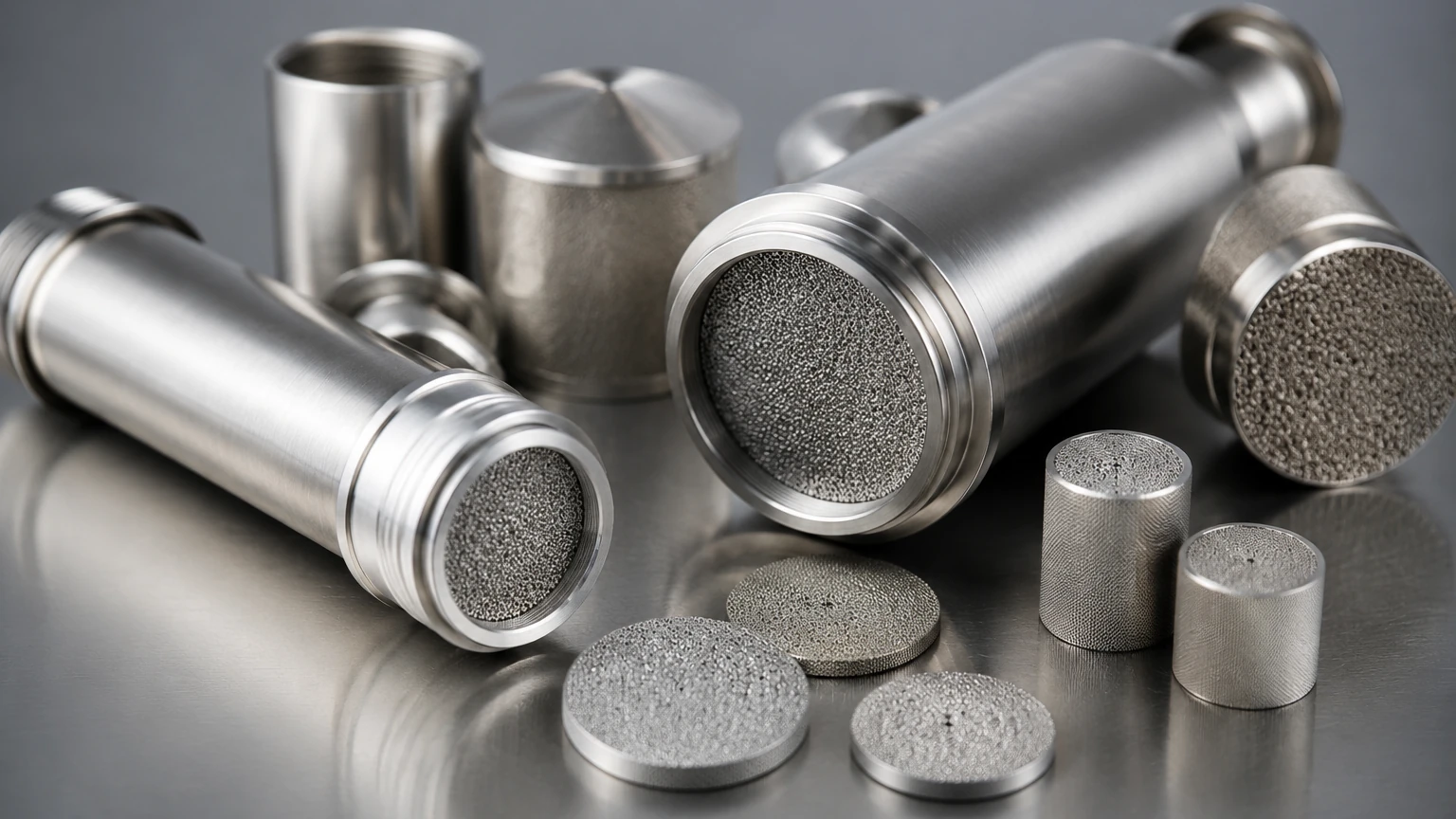
For equipment manufacturers (OEMs), the ability to source customized hplc column frits is vital for developing proprietary column designs. Kaifil specializes in the precision manufacturing of these components, ensuring that each frit meets exact dimensional and performance tolerances.
The Sintering Process
Metal frits are manufactured through a process called powder metallurgy. Spherical metal powders are placed in a mold and heated in a vacuum furnace to a temperature just below their melting point. This causes the particles to bond at their contact points, creating a rigid, porous structure. The control of temperature, pressure, and powder size distribution allows manufacturers to produce frits with highly uniform pore structures.
Custom Dimensions and Geometries
Standard HPLC columns often use frits with diameters of 2.1 mm, 4.6 mm, or 10 mm. However, industrial-scale preparative chromatography may require frits with diameters of several inches. Customization options include:
- Frit Thickness: Adjusting thickness to balance pressure resistance and swept volume.
- Integrated Rings: Some frits are pressed into PEEK or stainless steel rings to ensure a leak-free seal within the column hardware.
- Surface Finish: Electropolishing or specialized passivation to improve chemical inertness.
Maintenance, Troubleshooting, and Replacement Strategies
Understanding the lifecycle of hplc column frits is essential for maintaining laboratory productivity and reducing the total cost of ownership.
Cleaning vs. Replacement
In many cases, an inlet frit clogged with particulates can be partially restored by back-flushing the column (if the column packing allows) or by removing the frit and cleaning it in an ultrasonic bath with a suitable solvent (e.g., 6M Nitric Acid for stainless steel). However, in high-stakes analytical environments, replacement is often more cost-effective than cleaning, as it eliminates the risk of cross-contamination and ensures a return to baseline performance.
Signs That a Frit Needs Attention
1. High Back-Pressure: The most common sign of a clogged frit.
2. Split Peaks: If the inlet frit is partially clogged, it can disrupt the flow profile, causing a single analyte to appear as two peaks.
3. Ghost Peaks: Contaminants trapped in the frit may slowly leach out during subsequent runs, creating unexpected peaks in the chromatogram.
4. Loss of Resolution: Broadening of all peaks in the chromatogram often points to an issue with the frit or the column head.
Total Cost Considerations
While frits are relatively inexpensive compared to the cost of a complete HPLC column or the value of the samples being analyzed, their impact on data quality is immense. Purchasing teams should prioritize quality and consistency over the lowest unit price. A poorly manufactured frit that sheds particles or leaches ions can ruin a column worth thousands of dollars and invalidate weeks of research.
Conclusion
Successful chromatography depends on the precision of every component in the fluid path. Hplc column frits may be small, but they are fundamental to the mechanical stability and separation efficiency of the system. By selecting the appropriate material, micron rating, and manufacturing quality, engineers can ensure reliable performance and extended column life.
As a dedicated manufacturer of stainless steel filtration solutions, Kaifil understands the technical nuances required for high-performance applications. Whether you are designing a new analytical column or looking for reliable OEM components for industrial filtration, our team provides the expertise and customization necessary to achieve optimal results. For detailed product specifications and to explore our full range of filtration components, please visit our Main Page.
