


Woven Wire Mesh Machine Manufacturers: A Technical Guide to Production Standards and Filtration Quality
In the industrial filtration sector, the performance of a stainless steel filter is fundamentally dictated by the precision of the weaving process. For engineers and procurement specialists, understanding the capabilities of woven wire mesh machine manufacturers is essential for evaluating the quality, consistency, and reliability of the resulting media. The machinery used to produce industrial mesh determines critical factors such as pore size uniformity, tensile strength, and the ability to handle high-performance alloys like SS304 and SS316L.
This guide explores the technical landscape of mesh production technology, the criteria for evaluating machinery standards, and how these factors influence the final application in chemical processing, pharmaceuticals, and hydraulic systems.
The Role of Machinery in Industrial Filtration
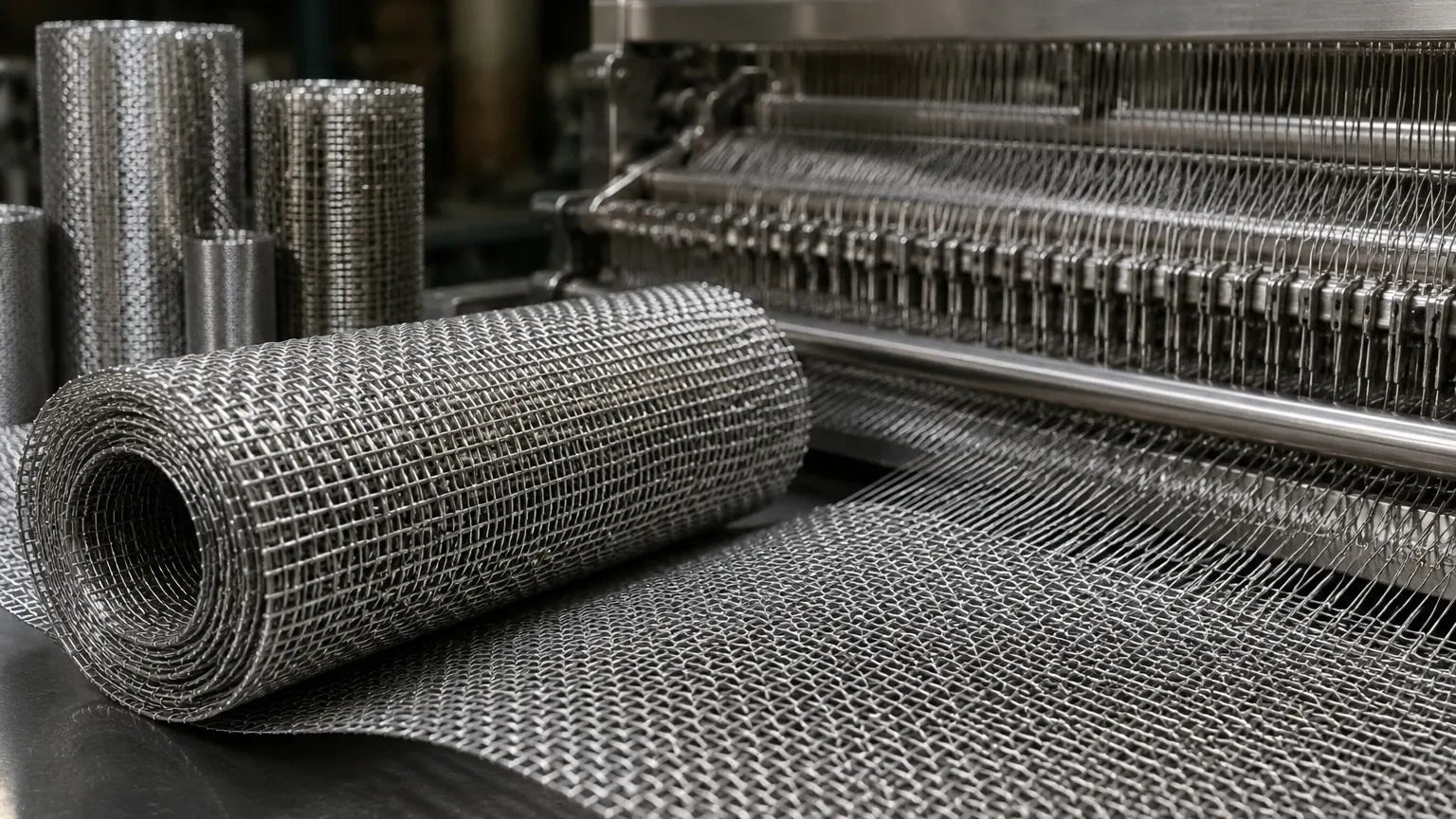
Industrial Woven Wire Mesh is produced on specialized looms that must maintain extreme tension and geometric accuracy. The evolution of weaving technology has moved from traditional shuttle looms to advanced rapier and projectile looms, which offer higher speeds and greater precision.
When sourcing filtration components, it is important to recognize that the quality of the mesh is a direct reflection of the loom's stability. Woven wire mesh machine manufacturers focus on several core engineering challenges:
* Tension Management: Maintaining consistent tension across the warp (lengthwise) and weft (crosswise) wires is critical to prevent mesh distortion.
* Wire Diameter Handling: Machines must be calibrated to handle ultra-fine wires, sometimes thinner than a human hair, without causing mechanical fatigue or breakage.
* Weave Pattern Versatility: The ability to switch between plain, twill, and complex Dutch weaves requires sophisticated control systems.
Types of Looms Used by Woven Wire Mesh Machine Manufacturers
Different industrial applications require different weaving technologies. The choice of machinery used by a manufacturer determines the range of mesh counts and wire diameters they can offer.
1. Rapier Looms
Rapier looms are widely regarded as the standard for high-quality industrial mesh. They use a flexible or rigid "rapier" to pull the weft wire across the loom. These machines are favored for their versatility, allowing for the production of both light and heavy-duty mesh. They are particularly effective for weaving stainless steel alloys where precision is paramount.
2. Projectile Looms
Projectile looms use a small metallic carrier to propel the weft wire. These machines are known for their high width capacity, making them ideal for producing large rolls of mesh used in architectural applications or large-scale industrial sieves. However, they require meticulous maintenance to ensure the projectile does not damage delicate wires.
3. Shuttle Looms
While largely replaced by faster technologies in many sectors, shuttle looms are still utilized for specific heavy-duty or custom weaves. They are often slower but can provide high levels of structural integrity for thick-diameter wire mesh used in mining or heavy vibratory screening.
Technical Parameters Influencing Filtration Precision
When evaluating the output of various woven wire mesh machine manufacturers, technical professionals must look at the specific performance metrics the machinery can achieve. These metrics directly impact the filtration efficiency of the final product.
Mesh Count and Micron Rating
The mesh count (number of openings per linear inch) is a primary specification. High-precision machines can produce mesh with counts exceeding 500, resulting in micron ratings suitable for fine pharmaceutical and laboratory filtration. If the machinery lacks precise indexing, the openings will be irregular, leading to "bypass" where particles larger than the target micron size pass through the filter.
Aperture Uniformity
Uniformity is perhaps the most critical factor in liquid and gas filtration. If a machine has inconsistent tensioning, the apertures (openings) will vary in size across the width of the roll. This creates weak points in the filtration system and reduces the overall lifespan of the filter cartridge.
Surface Smoothness and Wire Integrity
Advanced machinery ensures that the wire surface is not abraded during the weaving process. Any nicks or scratches on the stainless steel wire can become focal points for stress corrosion or chemical attack, especially in aggressive environments like chemical processing plants.
Engineering Considerations for Material Selection
The machinery must be compatible with the mechanical properties of the wire being woven. Most industrial filtration requires stainless steel due to its corrosion resistance and thermal stability.
* SS304/304L: The standard for general industrial use, providing good balance between cost and corrosion resistance.
* SS316/316L: Contains molybdenum, making it essential for marine environments or applications involving chlorides and acids.
Reliable woven wire mesh machine manufacturers design their equipment to handle the high tensile strength of these alloys. The loom must be rigid enough to withstand the forces required to bend and interlock stainless steel wires without deforming the machine frame itself.
Evaluating Manufacturers: What Engineers Should Confirm
Before selecting a supplier or assessing a manufacturer's capability, engineers should request specific technical data regarding their production floor. This helps in mitigating risks associated with material failure or performance gaps.
1. Automation and CNC Control: Does the manufacturer use CNC-controlled looms? Automated systems provide better repeatability and lower error rates compared to manual or semi-automated equipment.
2. In-line Inspection Systems: High-end production lines often include laser or optical inspection systems that scan the mesh in real-time for defects, such as broken wires or irregular spacing.
3. Customization Capabilities: Can the machinery be adjusted for non-standard widths or unique weave patterns? For specialized OEM projects, the ability to customize the weaving parameters is often more important than high-volume throughput.
4. Cleaning and Degreasing: Post-weaving processes are just as important as the weave itself. Confirm that the manufacturer has the equipment to remove lubricants and residues used during the weaving process, which is vital for food-grade and pharmaceutical applications.
The Relationship Between Machinery and Total Cost of Ownership
While the initial purchase price of mesh is a concern, the total cost of ownership (TCO) is heavily influenced by the machinery used in production. Mesh produced on inferior machines is prone to premature failure, clogging, and inconsistent flow rates.
Investing in mesh produced by top-tier woven wire mesh machine manufacturers ensures:
* Longer Service Life: Uniform tension and high-quality wire handling reduce mechanical fatigue.
* Predictable Maintenance: Consistent pore sizes allow for more accurate scheduling of filter cleaning and replacement cycles.
* Lower Operational Risk: Reducing the chance of media migration (where pieces of the filter break off and enter the process stream) protects downstream equipment like pumps and valves.
Customization and OEM Integration
For many B2B buyers, the standard off-the-shelf mesh is insufficient. Customization is where the technical prowess of the machinery truly shines. Whether it is a specific Dutch weave for high-pressure hydraulic filtration or a unique mesh laminate for aerospace applications, the flexibility of the manufacturer's equipment is key.
At Kaifil, we leverage deep manufacturing expertise to provide tailored filtration solutions. By understanding the mechanical limits and possibilities of weaving technology, we assist engineers in selecting the right Plain, twill and dutch woven wire mesh in SS304/316L — rolls, cut mesh and framed panels. Send mesh count or micron target for a technical quote. to meet their exact operational requirements.
Conclusion: Selecting a Partner Based on Technical Excellence
The landscape of woven wire mesh machine manufacturers is diverse, ranging from high-volume commodity producers to specialized engineering firms. For industrial applications where precision and durability are non-negotiable, the focus must remain on the technical capabilities of the production equipment.
By prioritizing machinery that offers superior tension control, material compatibility, and automated quality checks, purchasing teams can ensure they receive filtration media that performs reliably under pressure. Understanding these manufacturing nuances allows for better communication with suppliers and ultimately leads to more efficient and cost-effective industrial processes.
