


How to Backwash Cartridge Filter
In industrial filtration, the ability to clean and reuse filter media is a critical factor in managing operational costs and minimizing downtime. While many depth-style filters are designed for single-use disposal, high-performance stainless steel cartridge filters are engineered for longevity through a process known as backwashing. Understanding how to backwash cartridge filter systems effectively requires a technical grasp of fluid dynamics, pressure differentials, and material limits.
For engineers and plant managers, the decision to implement a backwashable system often hinges on the nature of the contaminant, the value of the process fluid, and the structural integrity of the filter media. This guide provides a factual, technical overview of the backwashing process, focusing on the engineering considerations necessary to maintain peak filtration performance.
The Principles of Backwashing in Industrial Filtration
Backwashing, or reverse flow cleaning, is the process of reversing the flow of a fluid through a filter medium to dislodge accumulated solids from the upstream side. In a standard filtration cycle, fluid moves from the outside of the cartridge toward the center (outside-in). As particles are trapped on the surface or within the mesh, a "filter cake" begins to form. While this cake can initially improve filtration efficiency by acting as a secondary barrier, it eventually increases the resistance to flow.
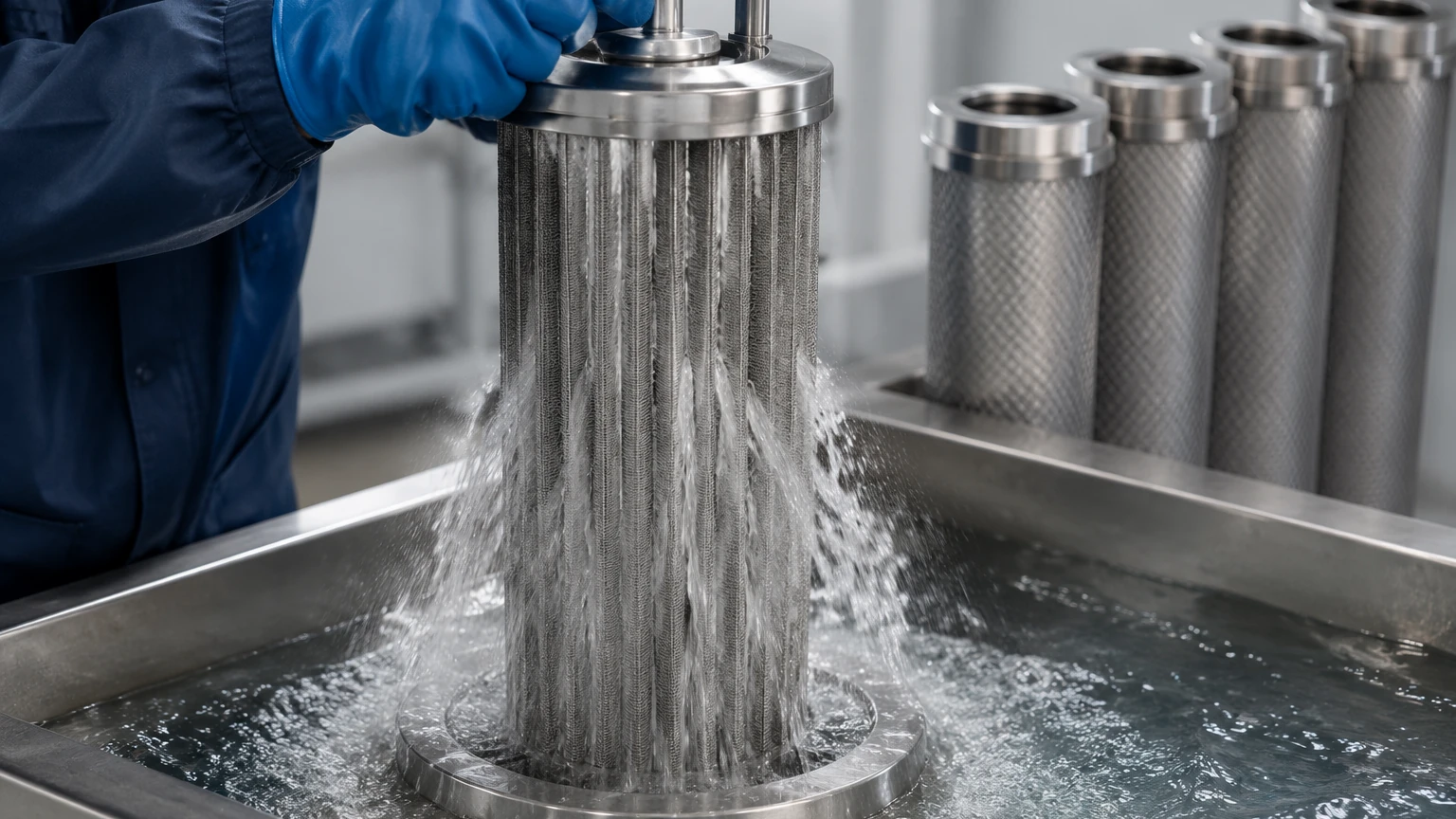
When the pressure drop ($ΔP$) across the filter reaches a predetermined terminal limit, the filter must be cleaned. How to backwash cartridge filter components involves forcing clean fluid—either the filtrate itself or an external cleaning agent—from the inside of the cartridge toward the outside (inside-out). This reverse pressure breaks the bond between the contaminants and the filter media, flushing the solids out through a drain or recovery port.
Distinguishing Backwashable Media from Disposable Cartridges
Not all cartridge filters are candidates for backwashing. It is essential to distinguish between the physical properties of various media to avoid damaging the system.
Disposable Depth Media
Filters made from polypropylene, melt-blown fibers, or pleated paper are generally considered disposable. Because these materials rely on "depth filtration," where particles are trapped deep within a complex web of fibers, reverse flow is rarely effective. Attempting to backwash these materials often results in permanent deformation or the further embedding of particles, which can lead to media migration and downstream contamination.
Cleanable Metallic Media
Stainless steel filters, such as those manufactured by Kaifil, are specifically designed for backwashing and ultrasonic cleaning. These filters utilize stainless steel wire mesh, sintered metal felt, or wedge wire. Because these materials are rigid and resistant to high pressures, they can withstand the mechanical stress of reverse flow. Sintered mesh, in particular, provides a fixed pore structure that does not shift during backwashing, ensuring that the original micron rating is maintained after multiple cleaning cycles.
Step-by-Step Procedure: How to Backwash Cartridge Filter Systems
To ensure the structural integrity of the filter and the cleanliness of the process, a standardized technical procedure must be followed. While automated systems handle these steps via PLC (Programmable Logic Controller), manual systems require careful coordination.
1. System Isolation
The filter housing must be isolated from the main process flow. This involves closing the inlet and outlet valves to ensure that no contaminated fluid bypasses the system during the cleaning cycle and that no backwash fluid enters the downstream process.
2. Pressure Equalization and Drainage
Before initiating the reverse flow, the internal pressure of the housing should be stabilized. In many applications, the housing is partially drained to allow space for the backwash fluid to move at high velocity. If the contaminants are hazardous, this step must include proper containment protocols.
3. Initiation of Reverse Flow
Clean fluid is introduced into the core of the filter cartridge. The flow rate during this stage is typically higher than the service flow rate. The objective is to create enough kinetic energy to lift the filter cake off the surface of the wire mesh. In some specialized configurations, compressed air or nitrogen is used in a "gas assist" backwash to create a more turbulent cleaning action.
4. Monitoring Discharge
The backwash effluent is directed to a waste tank or a recovery system. Engineers monitor the clarity of the discharge or the duration of the cycle to ensure all accumulated solids are removed. A typical backwash cycle for a stainless steel cartridge lasts between 30 to 120 seconds, depending on the stickiness of the contaminants.
5. Return to Service
Once the backwash is complete, the reverse flow is stopped, and the drain is closed. The inlet valve is slowly opened to refill the housing, followed by the outlet valve. It is standard practice to monitor the initial "clean" pressure drop to verify that the filter has returned to its baseline resistance.
Critical Engineering Variables for Successful Cleaning
Successfully executing the process of how to backwash cartridge filter elements requires precise control over several variables. If these parameters are ignored, the cleaning will be incomplete, leading to "short cycling" where the filter clogs again almost immediately.
* Backwash Flow Velocity: The velocity of the reverse flow must be sufficient to overcome the adhesive forces between the particles and the mesh. Typically, a backwash flow rate 2 to 3 times the service flow rate is recommended for metallic mesh.
* Pressure Differential (ΔP) Limits: Backwashing should be initiated based on a specific pressure drop rather than a fixed time interval. For most industrial stainless steel cartridges, backwashing is triggered when the ΔP reaches 0.7 to 1.0 bar (10-15 psi) above the clean pressure drop.
* Fluid Compatibility: The fluid used for backwashing must be chemically compatible with both the filter media and the process fluid. If using an external water source to clean a filter used in oil processing, for example, the risk of emulsion must be addressed.
* Temperature Considerations: In high-temperature applications, such as polymer filtration or steam processing, the backwash fluid should be at a temperature that prevents thermal shock to the metal components.
Evaluating Backwash Efficiency and Media Longevity
While stainless steel filters are durable, they are not infinite. Over time, certain particles may become permanently lodged in the pore structure—a phenomenon known as "pore blinding."
To evaluate the efficiency of the backwash process, engineers should track the "recovery ratio." This is the ratio of the clean pressure drop after backwashing to the original clean pressure drop of a brand-new filter. If the recovery ratio begins to decline significantly, it indicates that surface backwashing is no longer sufficient. At this stage, the cartridges may require off-site ultrasonic cleaning or chemical soaking to restore their original flux.
Furthermore, the mechanical stress of repeated backwashing can lead to fatigue in the wire mesh. It is vital to inspect the pleats and support structures of the cartridge for signs of deformation or wire breakage. High-quality manufacturing, involving precise welding and robust support cores, is essential for filters intended for high-frequency backwash cycles.
Selecting Custom Filtration Solutions for Automated Backwash Systems
For many B2B industrial operations, manual backwashing is inefficient. Automated backwash systems utilize sensors and pneumatic valves to perform the cleaning cycle without operator intervention. When designing these systems, the choice of the filter element is the most critical factor.
When consulting with a manufacturer like Kaifil, engineers should provide detailed information regarding particle size distribution, fluid viscosity, and the expected solids loading. This data allows for the customization of the filter cartridge, including:
* Micron Rating Selection: Ensuring the mesh is fine enough to capture contaminants but open enough to release them during backwash.
* Structural Reinforcement: Adding internal perforated cores or external cages to prevent the pleats from collapsing under reverse pressure.
* Alloy Selection: Choosing 304, 316L, or specialty alloys like Monel or Hastelloy to resist corrosion from cleaning chemicals or aggressive process fluids.
Common Risks and Troubleshooting
Even with a well-designed system, challenges can arise during the backwashing process. Addressing these early can prevent costly equipment failure.
1. Incomplete Cleaning: If the backwash flow is too low, only the path of least resistance will be cleaned. This leaves sections of the filter clogged, leading to higher localized velocities and potential media damage.
2. Water Hammer: Rapidly opening or closing valves during the backwash cycle can cause hydraulic shock. This can burst the filter mesh or damage the housing seals. Slow-actuating valves or dampeners are often required.
3. Cross-Contamination: If the check valves or isolation valves fail, backwash fluid can leak into the clean process line. Regular maintenance of the valve seats is a necessary part of the filtration system's upkeep.
4. Cake Compression: In some applications, if the filter is left in service too long before backwashing, the filter cake becomes so compressed that reverse flow cannot dislodge it. Setting conservative ΔP triggers is the best defense against this issue.
Conclusion
Mastering how to backwash cartridge filter systems is a fundamental skill for maintaining efficient industrial processes. By transitioning from disposable media to cleanable stainless steel solutions, facilities can significantly reduce waste and long-term procurement costs. However, the success of a backwashable system depends on the synergy between the filter's structural design and the operational parameters of the cleaning cycle.
For technical professionals seeking to optimize their filtration performance, selecting the right media and understanding the nuances of reverse-flow dynamics are the first steps toward a sustainable and cost-effective operation. For more information on custom stainless steel filtration components and engineering support, visit the Main Page to explore available solutions and application-specific designs.
