


Johnson Well Screen
In the realm of industrial filtration and resource extraction, the Johnson well screen—often referred to globally as a wedge wire screen or continuous-slot screen—represents a pinnacle of engineering efficiency. Originally developed for the water well industry, its unique design has become a standard for demanding applications in chemical processing, food and beverage production, and large-scale water treatment. For engineers and procurement specialists, understanding the technical nuances of these screens is essential for optimizing flow rates, ensuring structural integrity, and minimizing long-term maintenance costs.
As a specialized manufacturer of stainless steel filtration solutions, Kaifil recognizes that the selection of a filtration component is rarely about a single metric. Instead, it is a balance of metallurgy, mechanical design, and fluid dynamics. This guide explores the technical foundations of the johnson well screen and provides the data necessary for informed industrial selection.
Understanding the Engineering Behind Johnson Well Screens
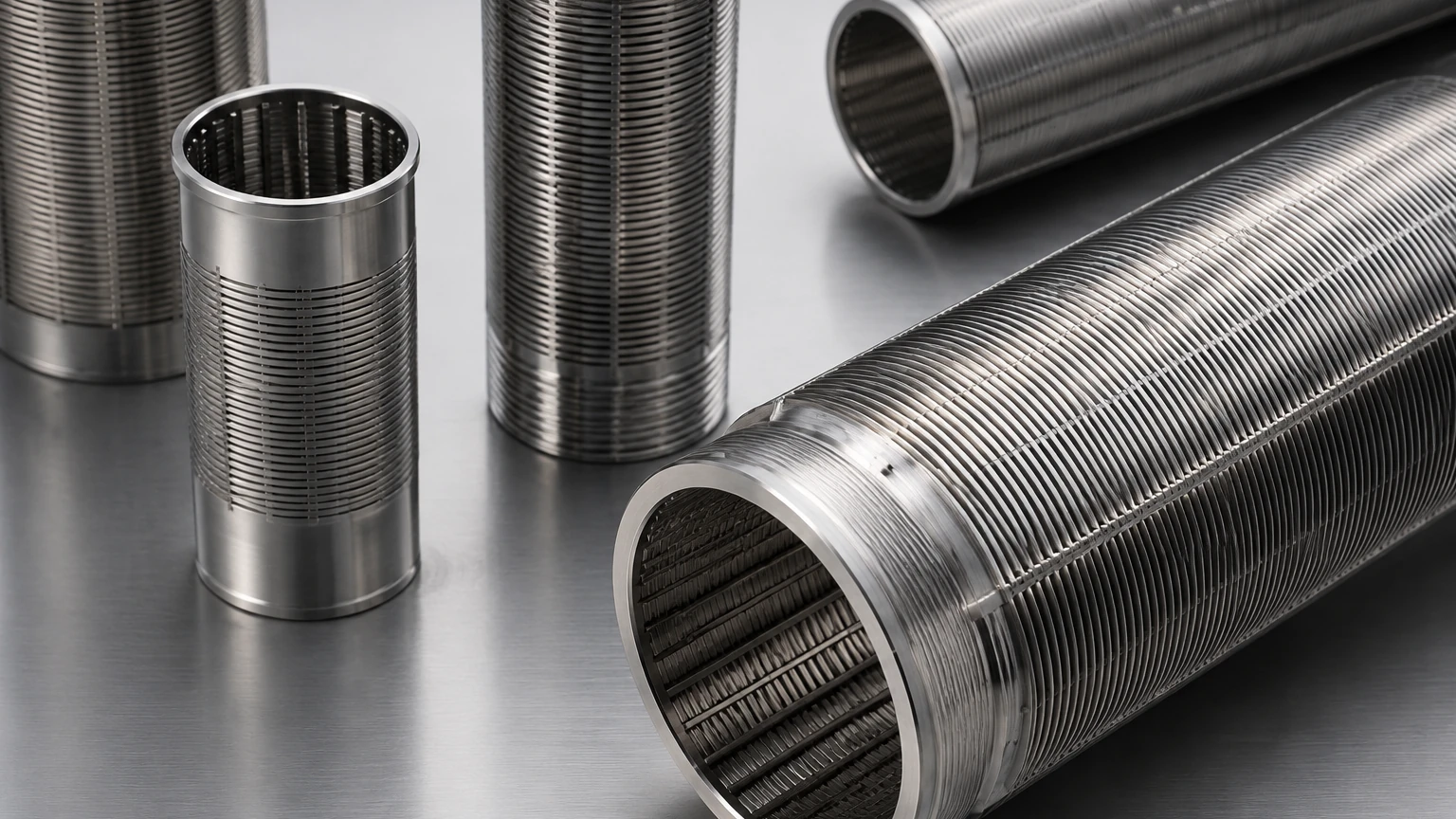
The fundamental advantage of the johnson well screen lies in its "wedge wire" construction. Unlike traditional perforated pipe or woven wire mesh, these screens are manufactured by wrapping a V-shaped profile wire around a circular array of internal longitudinal support rods. Each intersection of the wire and rod is fusion-welded, creating a robust, one-piece cylindrical structure.
The V-Shaped Profile Advantage
This design creates a continuous slot that widens inwardly. In a standard filtration scenario, particles that are slightly smaller than the slot opening pass through easily without becoming wedged. In contrast, in square-mesh or perforated filters, particles often become trapped within the thickness of the filter media, leading to "blinding" or clogging. The V-shape ensures that only two-point contact occurs between the particle and the screen, significantly reducing the risk of permanent blockage.
Continuous Slot Design
Because the wrap wire is applied continuously, the resulting slot is also continuous. This provides a significantly higher percentage of open area compared to drilled pipe or mesh-lined screens. For industrial operators, a higher open area translates directly to lower entrance velocities, reduced pressure drop, and improved pump efficiency. To explore specific configurations and technical drawings, engineers can visit the Main Page for a comprehensive overview of available filtration geometries.
Material Selection and Corrosion Resistance
Industrial environments often subject filtration components to aggressive chemical cleaning agents, high temperatures, and corrosive fluids. The longevity of a johnson well screen is primarily dictated by its material composition. While carbon steel options exist for low-stakes environments, stainless steel remains the industry standard for high-performance applications.
1. Grade 304 Stainless Steel: The most common choice for general industrial use and water treatment. It offers excellent strength and basic corrosion resistance at a cost-effective price point.
2. Grade 316L Stainless Steel: Essential for chemical processing and pharmaceutical applications. The addition of molybdenum and a lower carbon content provides superior resistance to pitting and crevice corrosion, particularly in chloride-rich environments.
3. Duplex and Super Duplex Steels: Utilized in offshore oil and gas or high-salinity desalination plants where extreme mechanical strength and exceptional corrosion resistance are required.
When specifying materials, engineers must consider the "Total Cost of Ownership." While a 316L screen may have a higher initial capital expenditure than 304, its resistance to chemical degradation often results in a significantly longer service life and fewer unscheduled shutdowns.
Calculating Filtration Efficiency: Slot Size and Open Area
The precision of the slot size is the most critical variable in determining filtration efficiency. In industrial well applications, the slot size is typically determined by the grain size analysis of the surrounding formation or the specific particulate matter intended for removal.
Precision Manufacturing
Modern manufacturing techniques allow for slot tolerances as tight as ±0.05mm. This level of precision is vital in industries like food and beverage, where consistent particle separation is required for product quality. The relationship between slot width and the width of the surface wire determines the total open area.
* Formula for Open Area: (Slot Size / (Slot Size + Wire Width)) x 100.
For example, a screen with a 0.5mm slot and a 1.5mm wire width provides a 25% open area. Increasing the open area reduces the velocity of the fluid passing through the screen, which minimizes the migration of fine sands or debris into the system and reduces the rate of mechanical erosion on the screen surface.
Structural Integrity and Collapse Resistance
Unlike surface-level filters, a johnson well screen often operates under significant hydrostatic pressure or mechanical loads from the surrounding formation. Failure to account for these forces can lead to screen collapse, a catastrophic failure that often requires the complete abandonment of the well or filtration vessel.
Collapse Strength Factors
The collapse strength of a screen is determined by three main factors:
* Support Rod Frequency: Increasing the number of internal support rods enhances the radial strength.
* Wire Gauge: Heavier profile wires provide more material to resist external pressure.
* Alloy Properties: The yield strength of the chosen metal impacts how much deformation the screen can withstand before failure.
Engineers must calculate the maximum expected differential pressure during both normal operation and cleaning cycles (such as backwashing) to ensure the screen is specified with an appropriate safety factor. Custom manufacturing allows for these variables to be adjusted to meet specific depth or pressure requirements.
Applications Across the Industrial Spectrum
While the name implies a focus on water wells, the johnson well screen architecture is utilized across diverse sectors due to its versatility and durability.
Water Treatment and Desalination
In large-scale water intake systems, these screens prevent aquatic life and debris from entering the treatment plant. Their low-velocity intake design is particularly important for environmental compliance and protecting downstream membrane systems.
Food and Beverage Processing
In breweries, wedge wire screens are used in lauter tuns for wort separation. The flat or cylindrical screens provide a precise gap that allows liquid to pass while retaining the grain bed, which itself acts as a secondary filter medium.
Chemical and Petrochemical Refining
Reactors often utilize screen laterals or center pipes made of wedge wire to retain catalyst beads while allowing processed fluids to flow through. The high-temperature resistance of stainless steel makes it ideal for these volatile environments.
Pulp and Paper
Screens are used for fiber recovery and wastewater dewatering. The non-clogging nature of the V-wire is essential when dealing with fibrous materials that would easily tangle in traditional mesh.
Maintenance, Cleaning, and Replacement Cycles
One of the primary reasons engineers specify a johnson well screen is its ease of cleaning. Because the slot narrows only at the surface, most accumulated debris sits on the exterior of the screen rather than within the pores.
Cleaning Methods
* Backwashing: Reversing the flow of fluid through the screen to dislodge surface cake. The structural strength of the fusion-welded rods allows for high-pressure backpulsing without deforming the slots.
* Chemical Cleaning: Stainless steel screens can be treated with acids or bases to dissolve mineral scaling or biological growth without damaging the base metal.
* Mechanical Pigging: In some pipeline applications, mechanical brushes or pigs can be used to clear the screen surface.
Determining Replacement
The replacement cycle depends on the erosive nature of the fluid and the frequency of cleaning. Indicators that a screen requires replacement include a permanent increase in baseline pressure drop (indicating deep-seated fouling) or the presence of formation solids in the filtrate (indicating a breach in the screen or slot widening due to erosion).
Customization and OEM Procurement Strategies
For many industrial projects, a standard off-the-shelf screen is insufficient. Customization is often required to integrate the screen into existing infrastructure or to meet specific hydraulic profiles. When sourcing filtration components, procurement teams should confirm several key details with the manufacturer:
* End Fittings: Does the application require NPT threads, weld rings, flanges, or custom machined fittings?
* Reinforcement: Is additional internal or external reinforcement needed for high-vibration environments?
* Surface Treatment: Would electropolishing or passivating enhance the corrosion resistance for a specific chemical application?
Working with a manufacturer like Kaifil allows for the development of tailored filtration components that go beyond the standard johnson well screen. By focusing on precision engineering and high-grade materials, industrial operators can achieve a balance of performance and longevity. For more information on custom stainless steel filtration components and engineering support, visit the Main Page to review product options and application support.
Conclusion
The johnson well screen remains a cornerstone of industrial filtration due to its mechanical simplicity and hydraulic efficiency. Whether used for groundwater extraction or as a critical component in a chemical reactor, its ability to provide high open area with minimal clogging is unmatched by most alternative technologies. By carefully considering material grades, slot precision, and structural requirements, engineers can ensure their filtration systems operate at peak efficiency with minimal downtime. As industrial requirements continue to evolve toward higher purity and greater sustainability, the role of high-precision wedge wire filtration will only continue to expand.
