


Polyester Foam
In the landscape of industrial filtration and material science, polyester foam—specifically reticulated polyester-based polyurethane foam—serves as a critical component for air and liquid management. For engineers and procurement specialists, understanding the technical nuances of this material is essential for optimizing system performance, ensuring chemical compatibility, and managing the total cost of ownership. While often categorized alongside other flexible foams, polyester-based variants offer distinct physical and chemical properties that make them suitable for specific demanding environments, particularly where oil resistance and physical strength are paramount.
This guide examines the engineering characteristics of polyester foam, its role in filtration hierarchies, and the criteria for selecting between polymer-based media and high-performance alternatives like stainless steel wire mesh.
The Role of Polyester Foam in Modern Filtration Systems
Polyester foam is a specialized type of flexible polyurethane foam. In industrial contexts, it is most frequently utilized in its "reticulated" form. Reticulation is a post-processing stage—often involving a controlled explosion or thermal process—that strips away the cell membranes (windows), leaving only the skeletal structure or "struts." This creates an open-cell material with high porosity and a consistent three-dimensional structure.
From a filtration perspective, this open-cell geometry allows for depth filtration. Unlike surface filters that capture particles on a single plane, the complex network of struts within polyester foam creates a tortuous path for fluids and gases. This path increases the probability of particle impingement and interception, allowing the foam to hold a significant volume of contaminants before reaching a critical pressure drop. In many B2B applications, polyester foam serves as a primary filter for HVAC systems, small engines, and compressor intakes, or as a pre-filter designed to protect more expensive, high-precision downstream components.
Technical Specifications: Reticulated Polyester Foam Properties
When evaluating polyester foam for industrial integration, engineers must look beyond basic dimensions and focus on pore density, physical durability, and thermal thresholds.
Pore Density (PPI)
Filtering performance is primarily defined by Pores Per Inch (PPI). Industrial polyester foams typically range from 10 PPI (very coarse) to 100 PPI (very fine).
- 10 to 30 PPI: Used for high-flow applications where large particulate matter (such as sand or large dust) must be removed with minimal resistance.
- 45 to 75 PPI: Standard for general-purpose air filtration and mist elimination.
- 80 to 100 PPI: Utilized for fine filtration, though these grades exhibit higher initial pressure drops and require more frequent maintenance.
Mechanical Strength and Durability
Polyester-based foams are recognized for their superior tensile strength, elongation, and tear resistance compared to polyether-based foams. This mechanical robustness allows the foam to be die-cut into complex shapes, sewn, or even felted (compressed under heat) to create higher-density filtration media. In vibration-heavy environments, such as heavy machinery or automotive intakes, the structural integrity of the polyester struts ensures the filter does not shed fibers or collapse under high face velocities.
Comparing Polyester Foam and Polyether Foam for Industrial Use
A common challenge for purchasing teams is distinguishing between polyester and polyether foams. While they may appear identical, their chemical backbones dictate their suitability for different industrial fluids.
Chemical and Oil Resistance
Polyester foam is the preferred choice for applications involving hydrocarbons. It exhibits excellent resistance to petroleum products, oils, fuels, and common solvents. This makes it the standard for lubricating oil filtration, fuel tank baffles, and degreasing equipment. Conversely, polyether foams tend to swell and degrade when exposed to these substances.
Hydrolytic Stability
The primary limitation of polyester foam is its susceptibility to hydrolysis. In environments with high humidity and elevated temperatures, the ester bonds in the polymer chain can break down, leading to a phenomenon known as "crumbling." For water treatment or high-humidity outdoor applications, engineers often pivot to polyether foams or, more reliably, to corrosion-resistant metal media. Understanding this trade-off is vital: if the application involves constant water contact at temperatures exceeding 50°C, a polymer-based polyester solution may face a shortened replacement cycle.
Evaluating Filtration Efficiency and Pressure Drop
In any fluid power or air handling system, the relationship between filtration efficiency and pressure drop (Delta P) is the most critical engineering consideration. Polyester foam offers a relatively low pressure drop due to its high void volume—often exceeding 95%.
However, as the foam captures debris, the effective flow area decreases. Engineers must calculate the "dust holding capacity" to determine service intervals. In B2B environments where downtime is costly, selecting a foam with a PPI that is too fine can lead to rapid clogging and system strain.
Furthermore, the thickness of the foam plays a dual role. Increasing the depth of the foam improves the capture rate of fine particles through the depth filtration effect but exponentially increases the resistance to flow. Precision-engineered systems often utilize a gradient density approach, where a coarse polyester foam pre-filter is followed by a finer mesh or cartridge to balance efficiency with energy consumption.
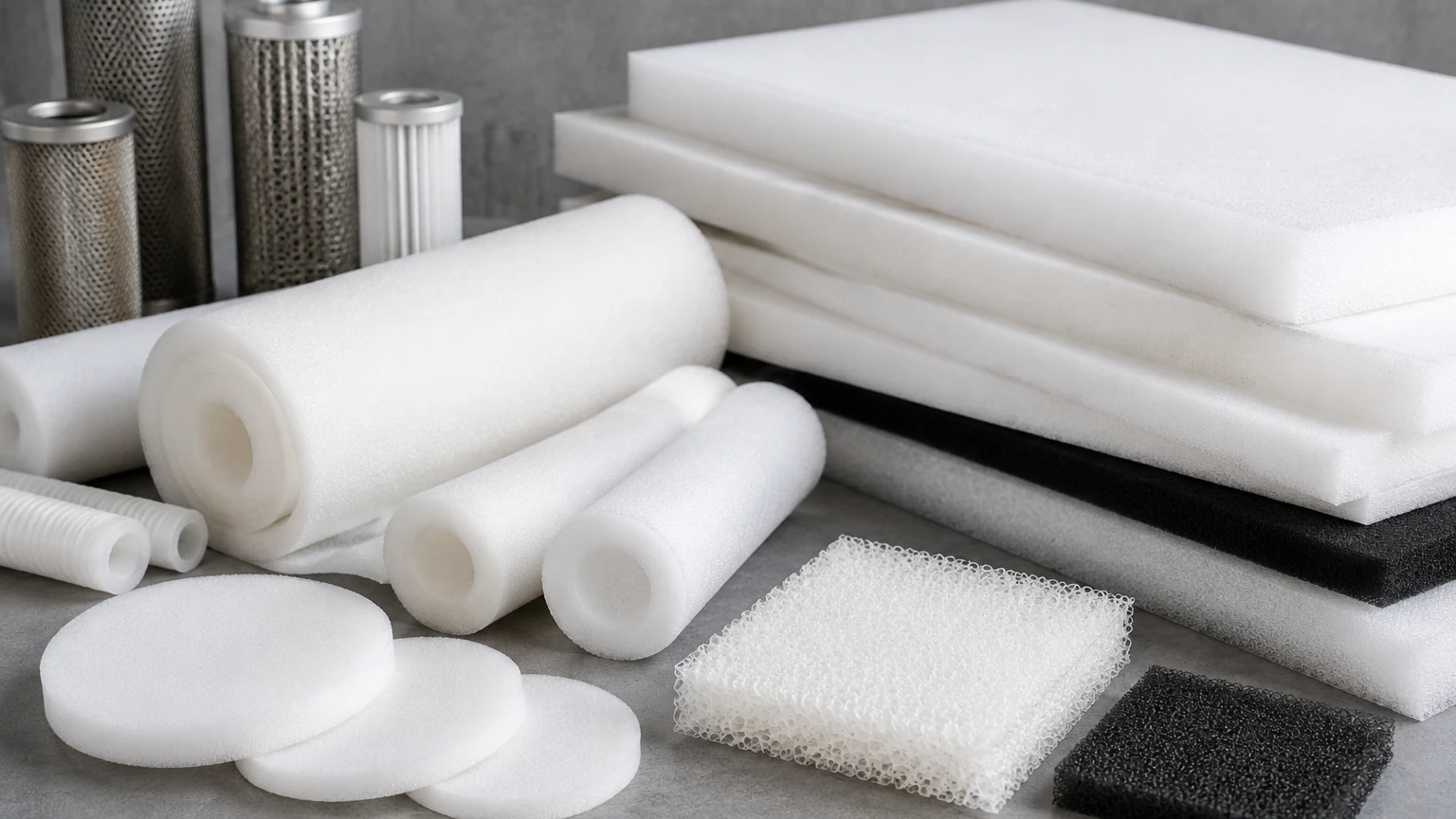
When to Choose Stainless Steel Over Polyester Foam
While polyester foam is a cost-effective and versatile material, it has clear functional boundaries. Technical professionals must recognize the transition point where polymer foams are no longer viable and more robust solutions, such as those found on the Main Page of industrial filtration specialists, become necessary.
Temperature Extremes
Polyester foam typically has a maximum continuous operating temperature of approximately 100°C to 120°C. Beyond this, the material softens and loses structural integrity. For steam filtration, high-temperature exhaust, or chemical processing at elevated heats, stainless steel wire mesh or sintered metal cartridges are required. Metal filters can withstand temperatures exceeding 400°C while maintaining precise micron ratings.
High-Pressure Applications
In hydraulic systems or high-pressure gas lines, the flexible nature of polyester foam can be a liability. Under high differential pressure, foam can compress, which changes the pore size and bypasses contaminants. Stainless steel filtration components provide the rigid structure necessary to withstand high pressure without deformation, ensuring consistent filtration accuracy throughout the service life.
Sterilization and Cleanability
In the pharmaceutical and food and beverage industries, the ability to clean and sterilize equipment is non-negotiable. Polyester foam is generally considered a disposable medium because its porous structure can harbor microbial growth and is difficult to sanitize completely. Stainless steel filters, however, are compatible with Clean-in-Place (CIP) and Sterilize-in-Place (SIP) protocols, offering a reusable and more hygienic long-term solution.
Maintenance and Replacement Cycles in Industrial Environments
For procurement departments, the "unit cost" of a polyester foam filter is only one part of the equation. The total cost of ownership includes the labor required for replacement and the environmental cost of disposal.
1. Disposable vs. Washable: Some low-PPI polyester foams can be washed with mild detergents or solvents and reused. However, each cleaning cycle slightly degrades the cell structure, eventually reducing filtration efficiency.
2. Monitoring Systems: Implementing differential pressure gauges across the filter housing is the most effective way to manage replacement cycles. Relying on visual inspection often leads to premature replacement or, worse, system bypass due to overloading.
3. Customization: For OEM applications, polyester foam can be custom-molded or laminated to other substrates. When a standard foam filter fails to meet durability requirements, engineers often look toward hybrid designs that incorporate a metal support structure to extend the service life of the foam media.
Engineering the Right Solution
Selecting the appropriate filtration media requires a balance of material science and application-specific data. Polyester foam remains a staple for air intake, oil mist removal, and general industrial cushioning and filtration due to its excellent oil resistance and high void volume. However, as system requirements move toward higher pressures, more aggressive chemicals, or stricter hygiene standards, the limitations of polyurethane become apparent.
For organizations looking to optimize their filtration processes, it is essential to consult with manufacturers who understand the full spectrum of media options. Whether your application requires the lightweight versatility of a polymer or the uncompromising durability of a custom metal component, the goal is to achieve the highest possible filtration precision with the lowest operational impact. You can explore more advanced industrial filtration configurations and technical support by visiting the Main Page for a comprehensive overview of high-performance solutions.
