


Cyclonic Filters
In the landscape of industrial liquid and gas separation, cyclonic filters—often referred to as centrifugal separators or hydrocyclones—represent a critical technology for managing high solids loading. Unlike traditional barrier filtration, which relies on a physical medium to intercept particles, cyclonic filters utilize centrifugal force to separate contaminants based on density. For engineers and procurement teams managing complex fluid systems in chemical processing, water treatment, or oil and gas, understanding the integration of cyclonic separation with precision stainless steel filtration is essential for optimizing system longevity and reducing operational costs.
At Kaifil, we recognize that industrial filtration is rarely a single-stage process. High-performance stainless steel wire mesh and filter cartridges often perform best when protected by robust pre-filtration technologies. This guide examines the technical principles of cyclonic filters, their engineering advantages, and how they complement precision metal filtration components in demanding industrial environments.
The Engineering Principles of Cyclonic Separation
Cyclonic filters operate on the principle of centrifugal sedimentation. The process begins when a fluid (liquid or gas) enters the cylindrical chamber of the filter at a high tangential velocity. This entry method creates a powerful vortex, forcing the fluid into a rapid spiral motion.
As the fluid spins, the particles within the stream are subjected to centrifugal forces that are significantly higher than the force of gravity. Because the solid contaminants are typically denser than the carrier fluid, they are slung toward the outer walls of the cyclone. Once they hit the wall, they lose kinetic energy and spiral downward into a collection chamber or "underflow" at the bottom of the unit. Meanwhile, the cleaned fluid forms an inner vortex that moves upward through the center of the chamber, exiting through the "overflow" or discharge port.
Key variables that determine the efficiency of cyclonic filters include:
* Inlet Velocity: Higher velocities generally increase centrifugal force, improving the separation of smaller particles, though this must be balanced against increased pressure drop.
* Particle Density: The greater the difference in density between the solid and the fluid, the more effective the cyclonic separation.
* Fluid Viscosity: Higher viscosity fluids resist the movement of particles toward the walls, which can reduce separation efficiency for fine solids.
* Geometry of the Cyclone: The diameter of the cylinder and the taper of the cone section directly influence the "cut point"—the particle size at which the filter achieves 50% separation efficiency.
Material Selection: Why Stainless Steel is Standard
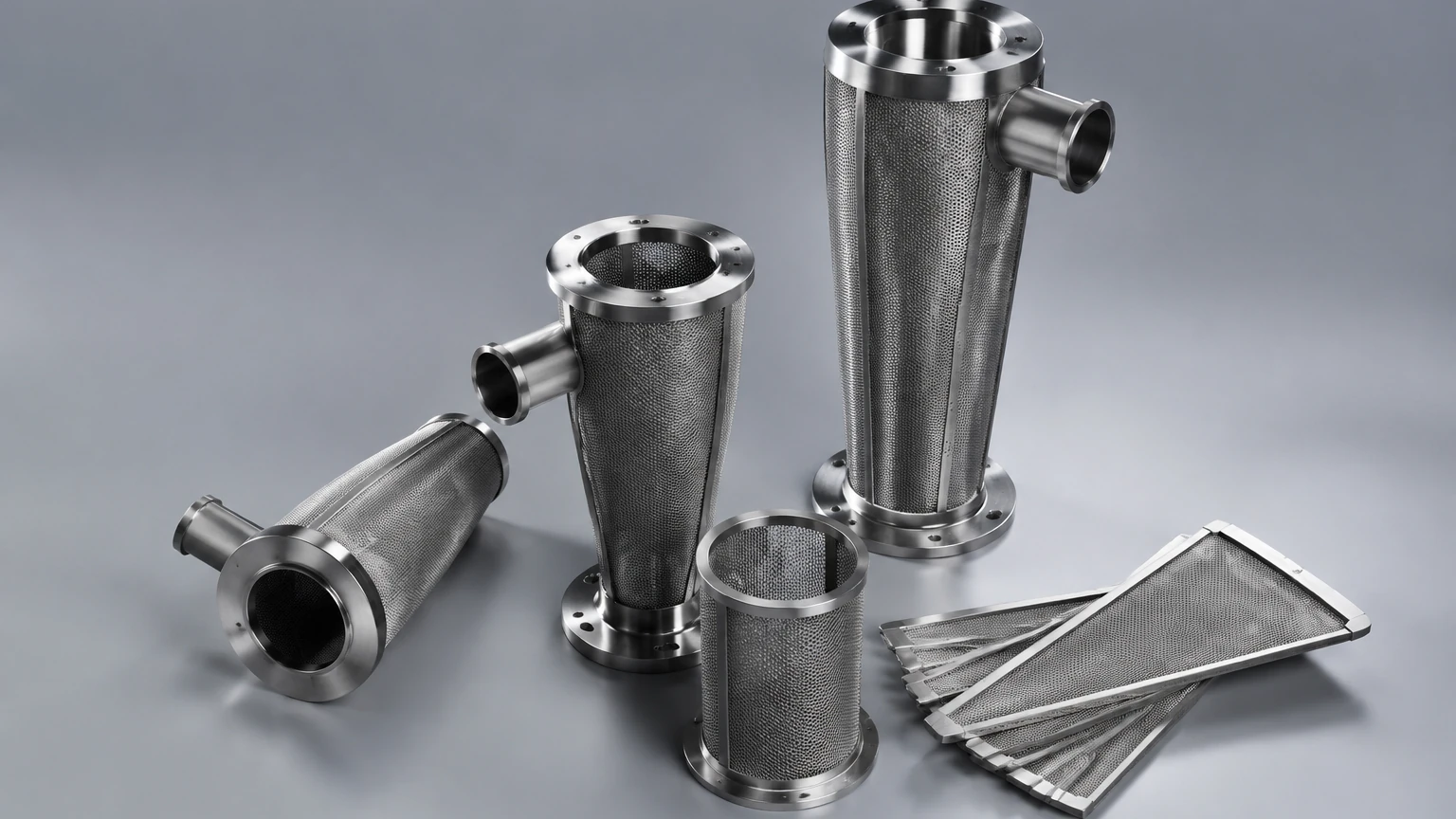
While the internal dynamics of cyclonic filters are focused on fluid physics, the physical construction of the unit is a matter of material science. In many industrial applications, cyclonic filters are subjected to abrasive particles, high pressures, and corrosive fluids. This makes the choice of housing material a primary engineering consideration.
Stainless steel, particularly grades 304 and 316L, is the preferred material for high-end industrial cyclonic separators. The reasons for this include:
1. Abrasion Resistance
Cyclonic filters work by intentionally directing high-velocity particles against the inner walls of the chamber. Over time, this can lead to significant erosion. Stainless steel provides the structural integrity and surface hardness required to withstand this constant bombardment, especially when compared to plastic or carbon steel alternatives.
2. Corrosion Resistance
In chemical processing and water treatment, the fluids being filtered are often chemically aggressive. 316L stainless steel, with its molybdenum content, offers superior resistance to chlorides and acidic environments, preventing premature failure of the filter housing and internal components.
3. Thermal Stability
Industrial processes often operate at elevated temperatures. Stainless steel maintains its mechanical properties across a wide temperature range, ensuring that the cyclonic filter remains leak-proof and structurally sound during thermal cycling.
Comparing Cyclonic Filters and Barrier Filtration
It is important for engineers to distinguish between cyclonic filters and barrier filters (such as the wire mesh and sintered metal filters produced by Kaifil). Each has a distinct role in a filtration circuit.
| Feature | Cyclonic Filters | Barrier Filters (Stainless Steel Mesh) |
| :— | :— | :— |
| Mechanism | Centrifugal force / Density-based | Physical interception / Size-based |
| Maintenance | Low (no media to replace) | Periodic cleaning or replacement |
| Particle Size | Best for large, heavy solids | Capable of sub-micron to micron-level precision |
| Pressure Drop | Constant (does not increase with loading) | Increases as the filter cake builds up |
| Waste Handling | Continuous or batch purge of solids | Requires backwashing or manual cleaning |
In many high-efficiency systems, cyclonic filters are used as the first stage of a multi-stage filtration strategy. By removing the bulk of heavy solids (such as sand, scale, or metal shavings), the cyclonic stage prevents the downstream precision stainless steel filter cartridges from becoming prematurely blinded. This "protect and refine" approach is the hallmark of a well-engineered industrial system.
Integration with Precision Stainless Steel Components
For engineers designing a complete filtration solution, the relationship between the cyclonic pre-filter and the final stage stainless steel wire mesh filter is critical. A common challenge in industrial filtration is the "total cost of ownership" (TCO). If a system relies solely on high-precision cartridges to handle raw, high-solids influent, the cost of frequent cleaning or replacement becomes prohibitive.
By installing cyclonic filters upstream, the loading on the precision Main Page components is significantly reduced. This allows for:
* Extended Service Intervals: Stainless steel mesh filters can operate for much longer periods between cleaning cycles when the heavy particulate load is removed by the cyclone.
* Consistent Flow Rates: Because cyclonic filters do not "clog" in the traditional sense, they maintain a consistent flow and pressure drop, providing a stable feed to the secondary filtration stage.
* Protection of Sensitive Equipment: In hydraulic systems or high-pressure pumps, even a few large particles can cause catastrophic failure. The cyclonic filter acts as a reliable safeguard against these larger contaminants.
Technical Selection Criteria for Engineers
When specifying cyclonic filters for an industrial application, several technical parameters must be confirmed to ensure the unit meets performance expectations.
Flow Rate and Pressure Drop
Cyclonic filters are sized based on flow rate. Unlike barrier filters, which can often handle variable flows by simply increasing the surface area, a cyclonic filter has an optimal "sweet spot." If the flow is too low, the centrifugal force will be insufficient to separate the solids. If the flow is too high, the pressure drop (delta P) will become excessive, and turbulence may re-entrain particles into the clean fluid stream.
Cut Point and Efficiency
Engineers must determine the required cut point. If the goal is to remove 90% of particles above 50 microns, the cyclone must be designed with the appropriate diameter and cone angle. It is important to note that cyclonic filters are rarely 100% efficient for all particle sizes; they are most effective for particles with a high specific gravity relative to the fluid.
Solids Discharge Method
How the separated solids are removed is a key operational decision. Options include:
* Manual Purge: A valve at the bottom of the collection chamber is opened periodically by an operator.
* Automated Timed Purge: An electronic controller opens a motorized valve at set intervals.
* Continuous Underflow: A small portion of the fluid is continuously bled off from the bottom, carrying the solids with it. This is common in high-volume industrial processes.
Common Risks and Mitigation in Cyclonic Systems
While cyclonic filters are remarkably durable due to their lack of moving parts, they are not immune to operational issues. One common risk is "air ingress." If air is allowed to enter the vortex, it can disrupt the flow dynamics and cause the separated solids to be pulled back into the clean overflow. Ensuring a airtight system and proper venting is essential.
Another risk is the presence of neutrally buoyant solids. If a contaminant has a density very close to that of the carrier fluid, centrifugal force will have little effect on it. In these instances, the cyclonic filter will serve only as a coarse separator, and the heavy lifting must be done by downstream stainless steel wire mesh filters that rely on size exclusion rather than density.
Conclusion: Achieving Optimized Filtration Performance
Cyclonic filters are a powerful tool in the industrial engineer's arsenal, providing a low-maintenance, high-durability solution for removing heavy solids from fluid streams. However, their true value is realized when they are integrated into a comprehensive filtration strategy that includes precision metal components.
By leveraging the strengths of centrifugal separation for bulk removal and the precision of stainless steel wire mesh for final polishing, industrial facilities can achieve superior fluid purity with minimal downtime. At Kaifil, we specialize in the custom design and manufacture of the stainless steel filtration components that make these systems successful. From material selection to filtration accuracy, we work with global partners to deliver reliable solutions for the most demanding industrial environments.
For more information on how to integrate high-performance stainless steel filters into your system or to discuss customized filtration designs, engineers and purchasing teams are encouraged to review product options and application support on our Main Page.
