


Hydraulic Oil Filter Cart
In modern industrial hydraulics, fluid cleanliness is the single most critical factor determining the longevity and reliability of system components. Contamination, often invisible to the naked eye, accounts for approximately 70% to 80% of all hydraulic system failures. While onboard filtration systems provide a primary line of defense, they are often insufficient for handling high-volume contamination events, such as system flushes or the introduction of new oil. This is where a hydraulic oil filter cart—a portable, offline filtration system—becomes an indispensable tool for maintenance engineers and facility managers.
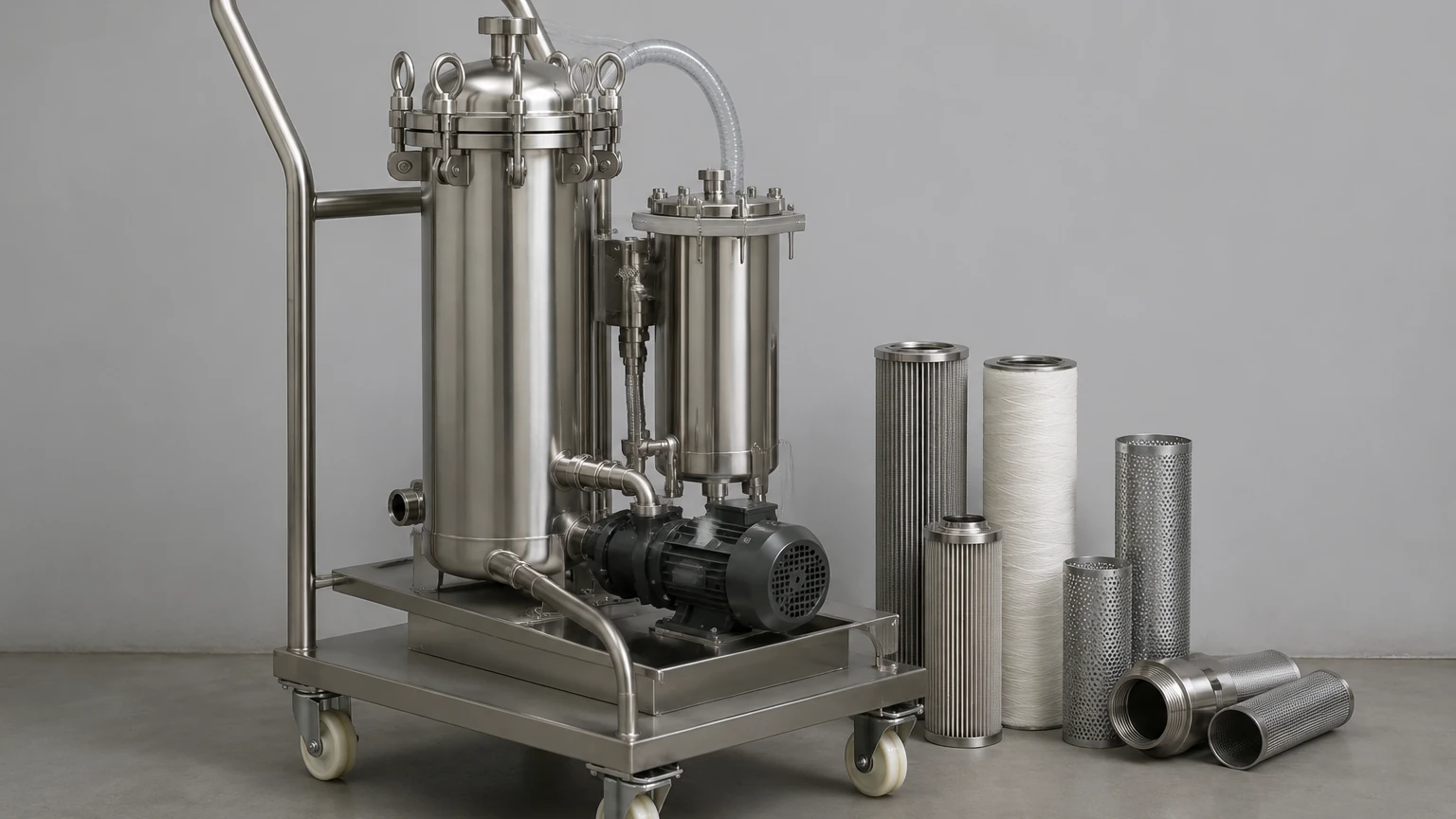
A hydraulic oil filter cart serves as a mobile kidney-loop system, designed to remove particulate matter and, in some configurations, water from hydraulic fluids, lubricating oils, and gear oils. By utilizing high-efficiency filter elements, often housed in robust stainless steel assemblies, these carts allow for the continuous cleaning of fluid without requiring the main system to be shut down. As a specialist in custom stainless steel filtration solutions, Kaifil provides the precision-engineered components that ensure these carts perform reliably under demanding industrial conditions.
The Role of Portable Filtration in Fluid Management
The primary function of a hydraulic oil filter cart is to achieve and maintain specific ISO 4406 cleanliness codes. These codes represent the number of particles per milliliter of fluid at three different sizes: 4 microns, 6 microns, and 14 microns. Achieving a target cleanliness level is not a one-time event but a continuous process of fluid conditioning.
Pre-Filtering New Oil
One of the most common misconceptions in industrial maintenance is that new oil is clean oil. In reality, new oil delivered in drums or bulk containers often has a cleanliness level that exceeds the tolerances of sensitive hydraulic components like servo valves or high-pressure piston pumps. A hydraulic oil filter cart is used to transfer oil from the drum to the reservoir, passing it through high-efficiency media to ensure that no external contaminants are introduced into the system.
Kidney-Loop Filtration
During operation, hydraulic systems generate internal wear particles. While the system's return-line or pressure-line filters capture much of this, a portable filter cart can be attached to the reservoir to provide supplemental filtration. This "kidney-looping" process allows the fluid to pass through the filter multiple times, significantly reducing the overall particle count and extending the life of the primary system filters.
System Recovery After Failure
When a component such as a pump or cylinder fails catastrophically, it releases a massive amount of metallic debris into the circuit. Before the system can be put back into service, the entire fluid volume must be decontaminated. A filter cart provides the high-capacity filtration necessary to purge these particles, preventing a secondary failure of the newly installed components.
Technical Components of a High-Performance Filter Cart
To understand the effectiveness of a hydraulic oil filter cart, one must examine the engineering of its core components. The synergy between the pump, motor, and filtration media determines the cart's suitability for specific applications.
Pump and Motor Assembly
The heart of the cart is the pump, typically a gear pump or a vane pump, driven by an electric motor. The selection of the pump must account for the viscosity of the fluid being processed. High-viscosity gear oils require slower pump speeds and higher torque to prevent cavitation and ensure consistent flow. Conversely, low-viscosity hydraulic fluids allow for higher flow rates, enabling faster turnover of the reservoir volume.
Filter Housings and Elements
The filtration efficiency is dictated by the filter element. In industrial environments where durability is paramount, stainless steel filter cartridges are often preferred. These elements, manufactured with precision wire mesh or sintered metal fibers, offer several advantages over disposable cellulose or synthetic media:
* Chemical Compatibility: Stainless steel is resistant to a wide range of hydraulic fluids, including fire-resistant fluids and synthetic esters.
* Thermal Stability: Metal filters can withstand higher temperatures without losing structural integrity.
* Cleanability: Unlike disposable elements, certain stainless steel mesh filters can be cleaned and reused, reducing the long-term cost of consumables.
Differential Pressure Monitoring
Effective filtration requires monitoring the pressure drop across the filter element. As the media captures contaminants, the resistance to flow increases. A hydraulic oil filter cart should be equipped with a differential pressure gauge or a "dirt alarm." This indicator informs the operator when the element is saturated and requires cleaning or replacement, ensuring that the cart does not operate in bypass mode, which would allow unfiltered oil to circulate.
Engineering Considerations for Media Selection
Selecting the correct filtration media for a hydraulic oil filter cart involves a balance between filtration fineness and flow capacity. Engineers must consider the "Beta Ratio" (β), which is a measure of a filter’s capture efficiency at a specific micron size.
Micron Ratings and Beta Ratios
A filter rated at 10 microns "absolute" (βx ≥ 75 or 200) is significantly more effective than one rated at 10 microns "nominal." For sensitive hydraulic systems, media with high beta ratios at the 3-micron or 6-micron level are typically required. Kaifil’s expertise in manufacturing precision wire mesh filters allows for the creation of customized elements that meet these stringent requirements while maintaining the structural strength needed to resist pressure surges.
Depth vs. Surface Filtration
Most portable carts use depth filtration media for general particulate removal because of their high dirt-holding capacity. However, for specific applications involving coarse contaminants or high-temperature fluids, surface filtration using stainless steel wire mesh is often employed. Surface filtration allows for precise control over the largest particle size permitted to pass through the system, which is critical for protecting specific downstream components.
Operational Challenges and Risk Mitigation
While a hydraulic oil filter cart is a powerful tool, improper use can lead to system issues. Understanding these risks is essential for maintenance teams.
Fluid Cross-Contamination
A significant risk occurs when a single cart is used for different types of fluids. Residual oil in the pump, hoses, and filter housing can contaminate the next system. For example, mixing a small amount of zinc-based hydraulic oil into a system using zinc-free (ashless) oil can lead to additive drop-out and sludge formation. To mitigate this, dedicated carts should be used for different fluid groups, or a rigorous flushing procedure must be implemented between uses.
Air Entrainment and Cavitation
If the suction wand of the filter cart is positioned too close to the surface of the oil in the reservoir, it can draw in air. This leads to foaming and aeration, which can cause oxidation of the oil and cavitation in the main system pumps. Operators must ensure that suction and return lines are submerged and positioned to promote optimal circulation within the reservoir without disturbing settled contaminants at the bottom.
Viscosity Limits
Operating a filter cart with oil that is too cold or too viscous can lead to high pressure drops that trigger the bypass valve prematurely. In cold environments, it may be necessary to use a cart equipped with an integrated heater to lower the fluid's viscosity to a range that allows for effective filtration.
Customization and OEM Solutions
Every industrial facility has unique requirements based on their machinery, environment, and fluid types. Standard off-the-shelf filter carts may not always provide the optimal solution. This is where custom manufacturing and OEM expertise become vital.
At Kaifil, we specialize in developing custom stainless steel filtration components that serve as the backbone of high-performance hydraulic oil filter carts. Whether the application requires specialized porting, unique housing geometries, or specific alloy selections like 316L stainless steel for corrosive environments, customized engineering ensures that the filtration system aligns perfectly with the operational demands. For companies looking to integrate high-end filtration into their maintenance routines, exploring the Main Page provides insight into the technical capabilities available for custom filter design.
Customization options often include:
* High-Capacity Housings: For systems with high dirt loads, larger housings allow for greater surface area and longer intervals between element changes.
* Water Removal Media: Specialized elements designed to coalesce or absorb free and emulsified water from the oil.
* Explosion-Proof Motors: Required for use in chemical processing plants or refineries where volatile vapors may be present.
* Integrated Particle Counters: Real-time fluid analysis to provide immediate feedback on the effectiveness of the filtration process.
Total Cost of Ownership and Maintenance
When evaluating a hydraulic oil filter cart, the initial purchase price is only one part of the equation. The total cost of ownership (TCO) includes the cost of replacement elements, energy consumption, and the labor required for operation.
Investing in high-quality, durable components—such as stainless steel filter cartridges—can significantly reduce TCO. While the initial cost of a metal element is higher than a disposable paper element, the ability to clean and reuse the metal mesh, combined with its superior resistance to chemical degradation, often results in lower costs over the life of the equipment. Furthermore, the increased reliability of the hydraulic system, manifested in fewer unplanned downtimes and extended component life, provides a high return on investment (ROI) for the filtration hardware.
Maintenance of the cart itself is straightforward but essential. This includes regular inspection of hoses for wear, checking the pump seals for leaks, and ensuring the motor is free of dust and debris. Most importantly, the filter elements must be managed according to the differential pressure readings to ensure the cart is actually cleaning the oil and not simply circulating it through a bypass valve.
Conclusion
The hydraulic oil filter cart is a cornerstone of proactive maintenance. By removing the contaminants that lead to wear, heat, and fluid degradation, these portable units protect the significant investment represented by industrial hydraulic machinery. Success in fluid conditioning depends on the quality of the filtration media and the engineering of the system components.
For engineers and purchasing teams, selecting a filtration partner with deep technical expertise in material science and fluid dynamics is essential. By focusing on precision-manufactured stainless steel solutions, facilities can ensure their hydraulic systems remain clean, efficient, and reliable for years to come. To learn more about specialized filtration components and industrial solutions, visit the Kaifil Main Page for comprehensive product information and application support.
